Galeomorphi
Galeomorphi is a superorder of sharks. They are sometimes called galea or galean sharks. There are about 300 living species in 23 families. Galean sharks are divided into four orders: the Heterodontiformes, Orectolobiformes, Lamniformes, and Carcharhiniformes. The extinct, enigmatic Synechodontiformes are presently placed by some authors in the galeomorphs, but their taxonomic position still remains uncertain.

Pterantula (Terry Goss) at en.wikipedia · CC BY 2.5 · via Wikipedia/Commons. May be a photograph of a specimen, or an artist’s reconstruction — an interpretation of a skeleton, since colour and soft tissue are almost never preserved.
On record
Recorded, not inferred- Sits inside
- ElasmobranchiiPBDB
- Diet
- carnivorePBDB, for Chondrichthyes
- Life habit
- nektonicPBDB, for Chondrichthyes
- Motility
- actively mobilePBDB, for Chondrichthyes
Time the record covers
At least 346 million years on record.
The record covers at least 346.7 Mya to 11.7 ka. No occurrence read is dated outside 358.86 Mya to 0 Mya.
2,152 occurrences of Galeomorphi on record, most of them in the Late Cretaceous. The Paleobiology Database records this as a living group. Bar height is expected occurrences, not a count: each fossil is spread across the span it is dated to, so a tall narrow bar means tight dating and a low wide one means loose.
When
2,152 occurrences- Carboniferousunder 1%
- Permianunder 1%
- Early Triassic2%
- Middle Triassic2%
- Late Triassic6%
- Early Jurassic6%
- Middle Jurassic3%
- Late Jurassic3%
- Early Cretaceous11%
- Late Cretaceous35%
- Paleocene7%
- Eocene19%
- Oligocene1%
- Miocene4%
- Plioceneunder 1%
- Pleistoceneunder 1%
- Holoceneunder 1%
These are dates about fossils, not the animal: the record can only begin after it arose and end before it died out, so either end may reach further. Shares are expected occurrences: a fossil dated to a span is counted partly in each period it straddles. More on what this infers.
Found in
330 formations
- Hunstanton Formation65
- Mesaverde Formation40
- Matam Formation37
- Westbury Formation · Penarth Group30
- Marnes de Donzacq Formation28
- Speeton Clay Formation27
Loading coastlines…
The named rock units Galeomorphi has been recovered from, largest first. Drawn where the rock is now, not where it formed. 306 further formations hold fewer occurrences each and are not listed. 753 occurrences have no formation on record, which is common for older literature.
Galeomorphi and its relatives
Late CretaceousWhere Galeomorphi and its relatives were recorded in the Late Cretaceous.
Found in the same rock
3,227 taxa- Teleostei39 sites
- Myledaphus bipartitus38 sites
- Myliobatis33 sites
- Ischyrhiza mira31 sites
- Carcharias29 sites
- Crocodylia27 sites
- Squalicorax kaupi27 sites
- Trionychidae26 sites
- Rhinobatos25 sites
- Hybodus24 sites
- Archaeolamna kopingensis23 sites
- Meristodonoides montanensis22 sites
- Cretalamna appendiculata21 sites
- Protoplatyrhina renae21 sites
- Theropoda21 sites
- Aves20 sites
- Lepisosteus20 sites
- Odontaspis aculeatus20 sites
- Restesia americana20 sites
- Scapanorhynchus texanus20 sites
- Baenidae19 sites
- Carcharhinus19 sites
- Cretorectolobus olsoni19 sites
- Dasyatis19 sites
The Paleobiology Database records at least 990 sites for Galeomorphi, and this reads 240 of them. The number is how many of those sites it was catalogued from too. The 24 sharing the most are listed.
This is not a list of everything alive at the time. It is only what has come out of the same ground as this animal and been written down.
Entered from
452 references- Les Orectolobiformes, Carcharhiniformes et Myliobatiformes (Elasmobranchii, Neoselachii) des bassins à phosphate du Maroc (Maastrichtien-Lutétien basal). Systématique, biostratigraphie, évolution et dynamique des faunes107
- Sharks (Elasmobranchii: Euselachii) from the Late Cretaceous of France and the UK91
- Late Cretaceous and Danian neoselachians from southern Sweden85
- Albian and Cenomanian selachian assemblages from north-east England78
- Toarcian shark and ray faunas (Chondrichthyans) from Luxembourg and Belgium in the aftermath of the T-OAE64
- Les sélaciens des terrains néocrétacés and paléocènes de Belgique and des contrées limitrophes. Eléments d'une biostratigraphie intercontinentale64
- Nouvelle faunes de sélaciens (Elasmobranchii, Neoselachii) de l'Eocène moyen des Landes (Sud-Ouest, France). Implication dans la connaissance des communautés de sélaciens d'eau profondes48
- The selachian fauna (sharks and rays) of the phosphate series of Ndendouri-Ouali Diala (Matam, Western Senegal): Dating and paleoenvironmental interests37
- Taxonomy and biostratigraphy of middle and late Triassic Elasmobranch Ichthyoliths from Northeastern British Columbia37
- Shark and ray faunas in the Middle and Late Eocene of the Fayum Area, Egypt36
- A new selachian fauna from the late Campanian of Wyoming (Teapot Sandstone Member, Mesaverde Formation, Big Horn Basin)36
- Placoid scales (Chondrichthyes: Elasmobranchii) from the Late Jurassic (Kimmeridgian) of northern Germany31
Each of the 2,152 occurrences read was entered from one of these publications, ordered by how many each accounts for. This is not a search for papers mentioning the name. 440 further references are not listed. Entries link to doi.org where the Paleobiology Database holds an identifier, and to its own record where it does not. Relayed as the Paleobiology Database holds them, not checked against what they resolve to.
Media and terms
Media content1
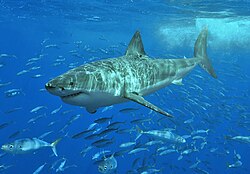
Picture of Galeomorphi
- Source
- Wikipedia/Commons
- Credit
- Pterantula (Terry Goss) at en.wikipedia
- Licence
- CC BY 2.5
- Commercial use
- the licence allows it
No 3D scan of Galeomorphi was found in MorphoSource and Sketchfab.
Smithsonian Open Access was not reached for this taxon, so this list is what the others held rather than everything there is.
The description on this site
- Source
- Wikipedia, “Galeomorphi”
- Licence
- CC BY-SA 4.0
This is what the site found, which is not the same as what exists.
Keep going
What may have been alongside itElasmobranchii through timeFormations of the Late CretaceousThe world it lived on
Occurrence data from the Paleobiology Database, CC BY 4.0. (Compagno 1973)