Etmopteridae
The Etmopteridae are a family of sharks in the order Squaliformes, commonly known as lantern sharks. Their name comes from the presence of light-producing photophores on their bodies. The members of this family are small, under 90 cm (35 in) long, and are found in deep waters worldwide. The 45 species are placed in five genera. Three-quarters of the species are in the genus Etmopterus.

Etrusko25 · Public Domain · via Wikipedia/Commons. May be a photograph of a specimen, or an artist’s reconstruction — an interpretation of a skeleton, since colour and soft tissue are almost never preserved.
On record
Recorded, not inferred- Sits inside
- SqualiformesPBDB
- Diet
- carnivorePBDB, for Squaliformes
- Life habit
- nektonicPBDB, for Squaliformes
- Motility
- actively mobilePBDB, for Squaliformes
Time the record covers
At least 199 million years on record.
The record covers at least 201.4 Mya to 1.8 Mya. No occurrence read is dated outside 205.7 Mya to 774 ka.
92 occurrences of Etmopteridae on record, most of them in the Late Cretaceous. The Paleobiology Database records this as a living group, and the chart stops with its fossils rather than at the present. Bar height is expected occurrences, not a count: each fossil is spread across the span it is dated to, so a tall narrow bar means tight dating and a low wide one means loose.
When
92 occurrences- Late Triassic3%
- Early Cretaceous1%
- Late Cretaceous40%
- Paleocene4%
- Eocene21%
- Miocene28%
- Plioceneunder 1%
- Pleistocene2%
These are dates about fossils, not the animal: the record can only begin after it arose and end before it died out, so either end may reach further. Shares are expected occurrences: a fossil dated to a span is counted partly in each period it straddles. More on what this infers.
Found in
25 formations
- Marnes de Miretrain Formation13
- Laksarska Nova Ves Formation8
- Gerhartsreit Formation6
- Byala Formation4
- Neuhofen Formation3
- Northumberland Formation · Nanaimo Group2
Loading coastlines…
The named rock units Etmopteridae has been recovered from, largest first. Drawn where the rock is now, not where it formed. One further formation holds fewer occurrences and is not listed. 34 occurrences have no formation on record, which is common for older literature.
Etmopteridae and its relatives
Late CretaceousWhere Etmopteridae and its relatives were recorded in the Late Cretaceous.
Found in the same rock
408 taxa- Etmopterus24 sites
- Squaliolus schaubi13 sites
- Proetmopterus hemmooriensis12 sites
- Nanocetorhinus tuberculatus11 sites
- Centrophorus granulosus10 sites
- Dasyatis10 sites
- Heterodontus vincenti10 sites
- Squalus10 sites
- Squalus balsvikensis10 sites
- Isurolamna inflata9 sites
- Mustelus9 sites
- Paraetmopterus nolfi9 sites
- Pararhincodon germaini9 sites
- Scyliorhinus9 sites
- Coupatezia8 sites
- Deania8 sites
- Echinorhinus8 sites
- Orthechinorhinus pfeili8 sites
- Squaliformes8 sites
- Isistius triangulus7 sites
- Mitsukurina maslinensis7 sites
- Squalus ballingsloevensis7 sites
- Squatina7 sites
- Centrophorus6 sites
The Paleobiology Database records 75 sites for Etmopteridae, and this reads all of them. The number is how many of those sites it was catalogued from too. The 24 sharing the most are listed.
This is not a list of everything alive at the time. It is only what has come out of the same ground as this animal and been written down.
Entered from
31 references- Nouvelle faunes de sélaciens (Elasmobranchii, Neoselachii) de l'Eocène moyen des Landes (Sud-Ouest, France). Implication dans la connaissance des communautés de sélaciens d'eau profondes14
- Maastrichtian squaloid sharks from southern Sweden12
- Deep-Water Chondrichthyans from the Early Miocene of the Vienna Basin (Central Paratethys, Slovakia)7
- Shifts in composition of northern Tethyan elasmobranch assemblages during the last millennia of the Cretaceous6
- Les Squalidae (Euselachii) miocènes des environs d'Avignon (Vaucluse)6
- A new deep-marine elasmobranch fauna from the Late Cretaceous of Bergen (Bavaria, Germany) dominated by squaliform sharks5
- Revealing elasmobranch diversity across the Cretaceous-Paleogene boundary in the Central Tethys (Byala, Bulgaria)4
- Palaeocentroscymnus (Chondrichthyes: Somniosidae), a new sleeper shark genus from Miocene deposits of Austria (Europe)3
- A new deep-sea elasmobranch fauna from the Central Paratethys (Neuhofener Beds, Mitterdorf, near Passau, Germany, Early Miocene, Middle Burdigalian)3
- On the fossil fishes of the Lithuanian Chalk. I. Selachii3
- L'Infralias dans la Franche-Comté [The Lower Lias of Franche-Comté]3
- Earliest Danian outer neritic elasmobranch assemblages reveal an environmentally controlled faunal turnover at the Cretaceous-Palaeogene boundary in the northern Tethyan Realm (Austria)2
Each of the 92 occurrences read was entered from one of these publications, ordered by how many each accounts for. This is not a search for papers mentioning the name. 19 further references are not listed. Entries link to doi.org where the Paleobiology Database holds an identifier, and to its own record where it does not. Relayed as the Paleobiology Database holds them, not checked against what they resolve to.
Media and terms
Media content1
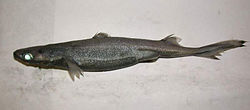
Picture of Etmopteridae
- Source
- Wikipedia/Commons
- Credit
- Etrusko25
- Licence
- Public Domain
- Commercial use
- the licence allows it
No 3D scan of Etmopteridae was found in Sketchfab.
Smithsonian Open Access and MorphoSource were not reached for this taxon, so this list is what the others held rather than everything there is.
The description on this site
- Licence
- CC BY-SA 4.0
This is what the site found, which is not the same as what exists.
Keep going
What may have been alongside itSqualiformes through timeFormations of the Late CretaceousThe world it lived on
Occurrence data from the Paleobiology Database, CC BY 4.0. Fowler 1941