Esox
Esox is a genus of freshwater fish commonly known as pike or pickerel. It is the type genus of the family Esocidae. The type species of the genus is Esox lucius, the northern pike.

Uncredited · via Wikipedia/Commons. May be a photograph of a specimen, or an artist’s reconstruction — an interpretation of a skeleton, since colour and soft tissue are almost never preserved.
On record
Recorded, not inferred- Also called
- pikePBDB
- Sits inside
- EsocidaePBDB
- Motility
- actively mobilePBDB, for Osteichthyes
- Environment
- freshwaterPBDB, for Esocidae
Time the record covers
At least 72 million years on record.
The record covers at least 72.2 Mya to 11.7 ka. No occurrence read is dated outside 83.6 Mya to 0 Mya.
55 occurrences of Esox on record, most of them in the Pleistocene. The Paleobiology Database records this as a living group. Bar height is expected occurrences, not a count: each fossil is spread across the span it is dated to, so a tall narrow bar means tight dating and a low wide one means loose.
When
55 occurrences- Late Cretaceous2%
- Paleocene16%
- Eocene4%
- Oligocene7%
- Miocene13%
- Pliocene9%
- Pleistocene38%
- Holocene11%
These are dates about fossils, not the animal: the record can only begin after it arose and end before it died out, so either end may reach further. Shares are expected occurrences: a fossil dated to a span is counted partly in each period it straddles. More on what this infers.
Found in
16 formations
- Fort Union Formation6
- Cromer Forest Bed Formation4
- Valentine Formation · Ogallala Group1
- Khapry Formation1
- Margaret Formation · Eureka Sound Group1
- Kuyal'nikian Formation1
Loading coastlines…
The named rock units Esox has been recovered from, largest first. Drawn where the rock is now, not where it formed. 31 occurrences have no formation on record, which is common for older literature.
Esox and its relatives
PleistoceneWhere Esox and its relatives were recorded in the Pleistocene.
Found in the same rock
1,209 taxa- Mimomys12 sites
- Rana11 sites
- Leuciscus10 sites
- Cyprinidae9 sites
- Bufo8 sites
- Cervidae8 sites
- Equus8 sites
- Myodes8 sites
- Tinca8 sites
- Acanthomorphata7 sites
- Aves7 sites
- Lepisosteus7 sites
- Osteoglossomorpha7 sites
- Pliomys7 sites
- Scardinius7 sites
- Sorex minutus7 sites
- Stephanorhinus etruscus7 sites
- Trogontherium7 sites
- Acipenser6 sites
- Amia calva6 sites
- Apodemus sylvaticus6 sites
- Microtus arvalis6 sites
- Notogoneus6 sites
- Ondatra zibethicus6 sites
The Paleobiology Database records 53 sites for Esox, and this reads all of them. The number is how many of those sites it was catalogued from too. The 24 sharing the most are listed.
This is not a list of everything alive at the time. It is only what has come out of the same ground as this animal and been written down.
Entered from
40 references- Moderate extinctions and slow recovery of non-marine teleost fishes across the Cretaceous–Paleogene boundary, with a systematic appraisal of early Paleocene teleost fishes from Saskatchewan, Canada and Montana, USA7
- The vertebrate fauna from the interglacial deposits at Sugworth near Oxford5
- The Vertebrata of the Forest Bed Series of Norfolk and Suffolk4
- Biostratigraphy and paleoecology of continental Tertiary vertebrate faunas in the Lower Rhine Embayment (NW-Germany)2
- Pleistocene vertebrate faunas of Hungary2
- A 9,000 Year History of Seal Hunting on Lake Baikal, Siberia: The Zooarchaeology of Sagan-Zaba II1
- Latest Pleistocene paleoecology of Jefferson’s ground sloth (Megalonyx jeffersonii) and elk-moose (Cervalces scotti) in northern Illinois1
- Lower Vertebrates (Teleostei, Amphibia, Sauria) from the Karpatian of the Korneuburg Basin - Paleoecological, environmental and paleoclimatical implications1
- The First Esox (Esocidae: Teleostei) from the Eocene Green River Formation, and a Brief Review of Esocid Fishes1
- Pre-Late Wisconsinan Pleistocene biota from southeastern Michigan, U.S.A.1
- The discovery of heterotidinae (Teleostei: Osteoglossidae) from the Paleocene Paskapoo Formation of Alberta, Canada1
- A new ambystomatid salamander, Dicamptodon antiquus n.sp., from the Paleocene of Alberta, Canada1
Each of the 55 occurrences read was entered from one of these publications, ordered by how many each accounts for. This is not a search for papers mentioning the name. 28 further references are not listed. Entries link to doi.org where the Paleobiology Database holds an identifier, and to its own record where it does not. Relayed as the Paleobiology Database holds them, not checked against what they resolve to.
Media and terms
Media content2
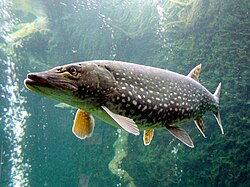
Picture of Esox
- Source
- Wikipedia/Commons
- Credit
- nobody named on the record
- Licence
- not stated by the source
- Commercial use
- cannot be read from the licence given — check the record
CT scan
- Source
- MorphoSource
- Licence
- In Copyright
- Commercial use
- cannot be read from the licence given — check the record
- Specimen
- Esox americanus · TCWC:Ichthyology:15238.03
Smithsonian Open Access was not reached for this taxon, so this list is what the others held rather than everything there is.
The description on this site
- Source
- Wikipedia, “Esox”
- Licence
- CC BY-SA 4.0
This is what the site found, which is not the same as what exists.
Keep going
What may have been alongside itEsocidae through timeFormations of the PleistoceneThe world it lived on
Occurrence data from the Paleobiology Database, CC BY 4.0. Linnaeus 1758