Osteoglossomorpha
Osteoglossomorpha is a superorder of bony fish in the Teleostei.

Cliff · CC BY 2.0 · via Wikipedia/Commons. May be a photograph of a specimen, or an artist’s reconstruction — an interpretation of a skeleton, since colour and soft tissue are almost never preserved.
On record
Recorded, not inferred- Sits inside
- TeleosteiPBDB
- Motility
- actively mobilePBDB, for Osteichthyes
Time the record covers
At least 165 million years on record.
The record covers at least 165.3 Mya to 11.7 ka. No occurrence read is dated outside 168.2 Mya to 0 Mya.
274 occurrences of Osteoglossomorpha on record, most of them in the Late Cretaceous. The Paleobiology Database records this as a living group. Bar height is expected occurrences, not a count: each fossil is spread across the span it is dated to, so a tall narrow bar means tight dating and a low wide one means loose.
When
274 occurrences- Middle Jurassicunder 1%
- Late Jurassicunder 1%
- Early Cretaceous15%
- Late Cretaceous35%
- Paleocene8%
- Eocene17%
- Oligocene2%
- Miocene9%
- Pliocene5%
- Pleistocene5%
- Holocene2%
These are dates about fossils, not the animal: the record can only begin after it arose and end before it died out, so either end may reach further. Shares are expected occurrences: a fossil dated to a span is counted partly in each period it straddles. More on what this infers.
Found in
88 formations
- Hell Creek Formation · Montana Group31
- Koobi Fora Formation14
- Green River Formation10
- Yixian Formation · Jehol Group9
- Milk River Formation9
- Dinosaur Park Formation · Belly River Group8
Loading coastlines…
The named rock units Osteoglossomorpha has been recovered from, largest first. Drawn where the rock is now, not where it formed. 64 further formations hold fewer occurrences each and are not listed. 48 occurrences have no formation on record, which is common for older literature.
Osteoglossomorpha and its relatives
Late CretaceousWhere Osteoglossomorpha and its relatives were recorded in the Late Cretaceous.
Found in the same rock
2,782 taxa- Gymnarchus42 sites
- Hydrocynus39 sites
- Teleostei37 sites
- Synodontis30 sites
- Acanthomorphata29 sites
- Osteoglossidae26 sites
- Anura25 sites
- Hiodontidae21 sites
- Polypterus21 sites
- Labeo sp.20 sites
- Sindacharax sp.20 sites
- Theropoda19 sites
- Lates niloticus18 sites
- Siluriformes18 sites
- Distichodus16 sites
- Dromaeosauridae16 sites
- Otophysa16 sites
- Protopterus16 sites
- Alcelaphini15 sites
- Cichlidae15 sites
- Lepisosteidae15 sites
- Lepisosteus15 sites
- Lycoptera15 sites
- Trionychidae15 sites
The Paleobiology Database records 199 sites for Osteoglossomorpha, and this reads all of them. The number is how many of those sites it was catalogued from too. The 24 sharing the most are listed.
This is not a list of everything alive at the time. It is only what has come out of the same ground as this animal and been written down.
Entered from
137 references- A systematic reappraisal and quantitative study of the nonmarine teleost fishes from the late Maastrichtian of the Western Interior of North America: evidence from vertebrate microfossil localities36
- Early Cretaceous freshwater fish fauna in Kyushu, Japan11
- Non-marine fishes of the late Santonian Milk River Formation of Alberta, Canada – evidence from vertebrate microfossil localities9
- Lothagam: the dawn of humanity in eastern Africa9
- Moderate extinctions and slow recovery of non-marine teleost fishes across the Cretaceous–Paleogene boundary, with a systematic appraisal of early Paleocene teleost fishes from Saskatchewan, Canada and Montana, USA7
- A historical vertebrate collection from the Middle Miocene of the Peruvian Amazon5
- Teleost centra from uppermost Judith River Group (Dinosaur Park Formation, Campanian) of Alberta, Canada5
- Paleontology of the Green River Formation, with a review of the fish fauna5
- Koobi Fora Research Project The Fossil Ungulates: Proboscidea, Perissodactyla, Suidae5
- Paleoecology of Late Cenozoic Fishes from the Turkana Basin, Northern Kenya5
- Taxonomy and biostratigraphy of the elasmobranchs and bony fishes (Chondrichthyes and Osteichthyes) of the lower-to-middle Eocene (Ypresian to Bartonian) Claiborne Group in Alabama, USA, including an analysis of otoliths4
- Two new Palaeocene osteoglossomorphs from Canada, with a reassessment of the relationships of the genus †Joffrichthys, and analysis of diversity from articulated versus microfossil material4
Each of the 274 occurrences read was entered from one of these publications, ordered by how many each accounts for. This is not a search for papers mentioning the name. 125 further references are not listed. Entries link to doi.org where the Paleobiology Database holds an identifier, and to its own record where it does not. Relayed as the Paleobiology Database holds them, not checked against what they resolve to.
Media and terms
Media content1
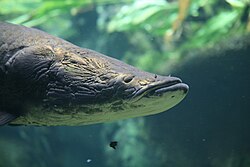
Picture of Osteoglossomorpha
- Source
- Wikipedia/Commons
- Credit
- Cliff
- Licence
- CC BY 2.0
- Commercial use
- the licence allows it
No 3D scan of Osteoglossomorpha was found in Sketchfab.
Smithsonian Open Access and MorphoSource were not reached for this taxon, so this list is what the others held rather than everything there is.
The description on this site
- Licence
- CC BY-SA 4.0
This is what the site found, which is not the same as what exists.
Keep going
What may have been alongside itTeleostei through timeFormations of the Late CretaceousThe world it lived on
Occurrence data from the Paleobiology Database, CC BY 4.0. (Greenwood et al. 1966)