Eridotrypa
Eridotrypa is an extinct genus of bryozoans of the family Aisenvergiidae, consistently forming colonies made of thin branches. Diaphragms are very common in colonies. Distinctively, in the exozone there are serrated dark borders separating the autozooecia.
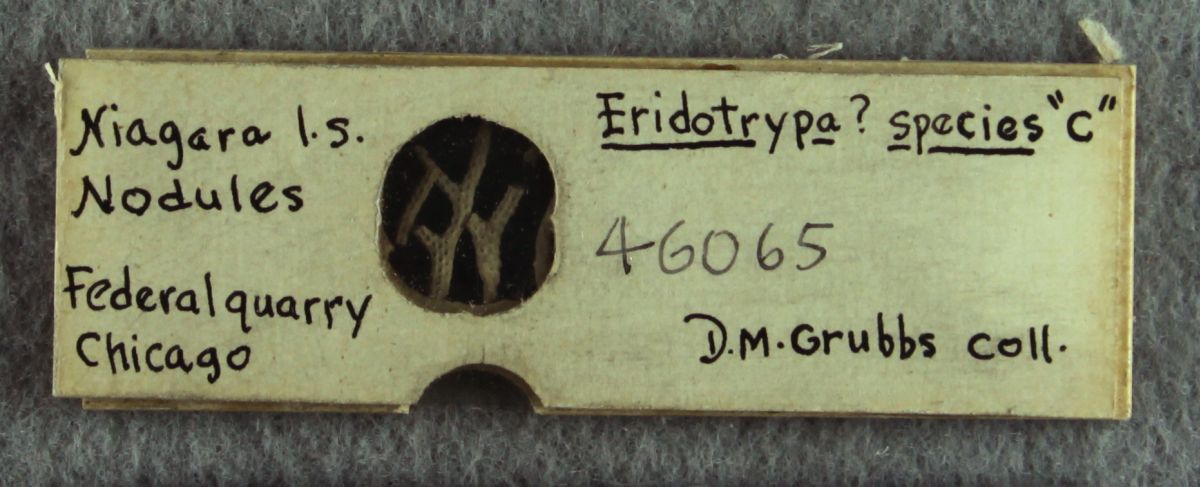
via iDigBio · via iDigBio. May be a photograph of a specimen, or an artist’s reconstruction — an interpretation of a skeleton, since colour and soft tissue are almost never preserved.
On record
Recorded, not inferred- Sits inside
- AisenvergiidaePBDB
- Diet
- suspension feederPBDB, for Stenolaemata
- Life habit
- epifaunalPBDB, for Bryozoa
- Motility
- stationary, attachedPBDB, for Stenolaemata
- Vision
- blindPBDB, for Stenolaemata
- Environment
- marinePBDB, for Lophophorata
Time the record covers
At least 48 million years on record.
The record covers at least 468 Mya to 419.62 Mya. No occurrence read is dated outside 486.85 Mya to 413.02 Mya.
214 occurrences of Eridotrypa on record, most of them in the Ordovician. Bar height is expected occurrences, not a count: each fossil is spread across the span it is dated to, so a tall narrow bar means tight dating and a low wide one means loose.
When
214 occurrences- Ordovician82%
- Silurian17%
- Devonianunder 1%
These are dates about fossils, not the animal: the record can only begin after it arose and end before it died out, so either end may reach further. Shares are expected occurrences: a fossil dated to a span is counted partly in each period it straddles. More on what this infers.
Found in
62 formations
- Denley Limestone Formation · Lower Trenton Group52
- Lexington Limestone Formation11
- Hermitage Formation6
- Verulam Formation · Simcoe Group6
- Catheys Formation5
- Wardell Formation5
Loading coastlines…
The named rock units Eridotrypa has been recovered from, largest first. Drawn where the rock is now, not where it formed. 38 further formations hold fewer occurrences each and are not listed. 36 occurrences have no formation on record, which is common for older literature.
Eridotrypa and its relatives
OrdovicianWhere Eridotrypa and its relatives were recorded in the Ordovician.
Found in the same rock
1,265 taxa- Prasopora67 sites
- Paucicrura rogata57 sites
- Hallopora52 sites
- Platystrophia50 sites
- Stictopora50 sites
- Amplexopora37 sites
- Anazyga recurvirostra37 sites
- Flexicalymene (Flexicalymene) senaria35 sites
- Heterotrypa34 sites
- Homotrypa33 sites
- Merocrinus32 sites
- Isotelus gigas29 sites
- Sowerbyella kayi29 sites
- Rhynchotrema increbescens27 sites
- Batostoma26 sites
- Escharopora26 sites
- Rafinesquina26 sites
- Constellaria25 sites
- Hebertella frankfortensis25 sites
- Mesotrypa25 sites
- Cupulocrinus24 sites
- Graptodictya23 sites
- Orthoceras23 sites
- Pachydictya22 sites
The Paleobiology Database records 186 sites for Eridotrypa, and this reads all of them. The number is how many of those sites it was catalogued from too. The 24 sharing the most are listed.
This is not a list of everything alive at the time. It is only what has come out of the same ground as this animal and been written down.
Entered from
49 references- R. Titus unpublished collections44
- Zonation of the Middle and Upper Ordovician strata in northwestern Georgia24
- Bryozoa from Rocklandian (Middle Ordovician) rocks of the Upper Mississippi Valley region13
- The Clinton of Western and Central New York12
- Lithostratigraphy and depositional environments of the Lexington Limestone (Ordovician) of central Kentucky11
- The early Paleozoic Bryozoa of the Baltic Provinces10
- Pre-Chattanooga stratigraphy in Central Tennessee9
- Fossil Communities of the Middle Trenton Group (Ordovician) of New York State8
- Palaeozoic geology of the Lake Simcoe Area, Ontario6
- Fossil communities of the lower Trenton Group (Middle Ordovician) of central and northwestern New York State5
- Stratigraphy of the Lower Middle Ordovician of Tazewell County, Virginia5
- Upper Ordovician bryozoans of the Pin Formation (Spiti Valley, Northern India)4
Each of the 214 occurrences read was entered from one of these publications, ordered by how many each accounts for. This is not a search for papers mentioning the name. 37 further references are not listed. Entries link to doi.org where the Paleobiology Database holds an identifier, and to its own record where it does not. Relayed as the Paleobiology Database holds them, not checked against what they resolve to.
Media and terms
Media content1
Picture of Eridotrypa
- Source
- iDigBio
- Credit
- via iDigBio
- Licence
- not stated by the source
- Commercial use
- cannot be read from the licence given — check the record
No 3D scan of Eridotrypa was found in MorphoSource and Sketchfab.
Smithsonian Open Access was not reached for this taxon, so this list is what the others held rather than everything there is.
The description on this site
- Source
- Wikipedia, “Eridotrypa”
- Licence
- CC BY-SA 4.0
This is what the site found, which is not the same as what exists.
Keep going
What may have been alongside itAisenvergiidae through timeFormations of the OrdovicianThe world it lived on
Occurrence data from the Paleobiology Database, CC BY 4.0. Ulrich 1893