Eleutherodactylus
Eleutherodactylus is a genus of frogs in the family Eleutherodactylidae. Many of the 200 species of the genus are commonly known as "rain frogs" or "robber frogs", due to their sharp, high-pitched, insect-like calls. They are found from the southern United States south to Central America, and reach their greatest diversity in the Caribbean.

No machine-readable author provided. Pstevendactylus~commonswiki assumed (based on copyright claims). · Public Domain · via Wikipedia/Commons. May be a photograph of a specimen, or an artist’s reconstruction — an interpretation of a skeleton, since colour and soft tissue are almost never preserved.
On record
Recorded, not inferred- Sits inside
- EleutherodactylidaePBDB
- Diet
- carnivorePBDB, for Temnospondyli
- Life habit
- amphibiousPBDB, for Temnospondyli
- Motility
- actively mobilePBDB, for Temnospondyli
- Environment
- brackish,freshwater,terrestrialPBDB, for Tetrapoda
Time the record covers
At least 27 million years on record.
The record covers at least 27.3 Mya to 11.7 ka. No occurrence read is dated outside 33.9 Mya to 0 Mya.
13 occurrences of Eleutherodactylus on record. The Paleobiology Database records this as a living group. Bar height is expected occurrences, not a count: each fossil is spread across the span it is dated to, so a tall narrow bar means tight dating and a low wide one means loose.
When
13 occurrences- Oligocene15%
- Miocene8%
- Pleistocene38%
- Holocene39%
These are dates about fossils, not the animal: the record can only begin after it arose and end before it died out, so either end may reach further. Shares are expected occurrences: a fossil dated to a span is counted partly in each period it straddles. More on what this infers.
Found in
2 formations
Loading coastlines…
The named rock units Eleutherodactylus has been recovered from, largest first. Drawn where the rock is now, not where it formed. 10 occurrences have no formation on record, which is common for older literature.
Found in the same rock
262 taxa- Alsophis cantherigerus3 sites
- Anolis3 sites
- Anolis conspersus3 sites
- Capromys3 sites
- Geocapromys3 sites
- Nesophontes3 sites
- Osteopilus septentrionalis3 sites
- Typhlops3 sites
- Tyto alba3 sites
- Aristelliger2 sites
- Athene cunicularia2 sites
- Bufo woodhousei2 sites
- Buteo lineatus2 sites
- Cardisoma guanhumi2 sites
- Colubridae2 sites
- Crocodylia2 sites
- Crotaphytus collaris2 sites
- Cyclura2 sites
- Cyclura nubila2 sites
- Eptesicus fuscus2 sites
- Falco sparverius2 sites
- Geochelone (Hesperotestudo) wilsoni2 sites
- Hyla2 sites
- Leiocephalus2 sites
The Paleobiology Database records 13 sites for Eleutherodactylus, and this reads all of them. The number is how many of those sites it was catalogued from too. The 24 sharing the most are listed.
This is not a list of everything alive at the time. It is only what has come out of the same ground as this animal and been written down.
Entered from
11 references- Late Quaternary fossil vertebrates from the Cayman Islands3
- Geological context and associated fauna from A South American sebecid from the Miocene of Hispaniola documents the presence of apex predators in early West Indies ecosystems1
- The earliest record of Caribbean frogs: A fossil coquí from Puerto Rico1
- First Report of a Quaternary Crocodylian from a Cave Deposit in Northern Puerto Rico1
- Taphonomy of a late Pleistocene carnivore den, Dade County, Florida1
- Living and late Holocene fossil vertebrates and the vegetation of the Cockpit Country, Jamaica1
- An upper Eocene frog from the Dominican Republic and its implication for Caribbean biogeography1
- Herpetofauna of the Rancholabrean Schulze Cave local fauna of Texas1
- Fossil vertebrates from Antigua, Lesser Antilles: evidence for late Holocene human-caused extinctions in the West Indies1
- Fossil Amphibians and Reptiles from New Providence Island, Bahamas1
- Some Pleistocene amphibians and reptiles from Friesenhahn Cave, Texas1
Each of the 13 occurrences read was entered from one of these publications, ordered by how many each accounts for. This is not a search for papers mentioning the name. Entries link to doi.org where the Paleobiology Database holds an identifier, and to its own record where it does not. Relayed as the Paleobiology Database holds them, not checked against what they resolve to.
Media and terms
Media content3

Picture of Eleutherodactylus
- Source
- Wikipedia/Commons
- Credit
- No machine-readable author provided. Pstevendactylus~commonswiki assumed (based on copyright claims).
- Licence
- Public Domain
- Commercial use
- the licence allows it
CT scan
- Source
- MorphoSource
- Licence
- In Copyright
- Commercial use
- cannot be read from the licence given — check the record
- Specimen
- Eleutherodactylus johnstonei · UF:Herp:27911
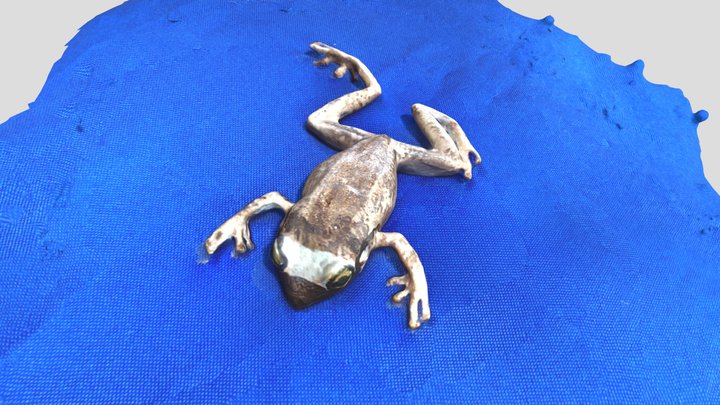
3D model
- Source
- Sketchfab
- Credit
- Alex Griswold
- Licence
- CC Attribution
- Commercial use
- cannot be read from the licence given — check the record
Smithsonian Open Access was not reached for this taxon, so this list is what the others held rather than everything there is.
The description on this site
- Licence
- CC BY-SA 4.0
This is what the site found, which is not the same as what exists.
Keep going
What may have been alongside itEleutherodactylidae through timeThe world it lived on
Occurrence data from the Paleobiology Database, CC BY 4.0. Duméril and Bibron 1841