Diplostraca
Branchiopoda is a class of crustaceans. It comprises fairy shrimp, clam shrimp, Diplostraca, Notostraca, the Devonian Lepidocaris and possibly the Cambrian Rehbachiella. They are mostly small, freshwater animals that feed on plankton and detritus.

Hans Hillewaert Rise0011 Franco Folini Public Library of Science · CC BY-SA 4.0 · via Wikipedia/Commons. May be a photograph of a specimen, or an artist’s reconstruction — an interpretation of a skeleton, since colour and soft tissue are almost never preserved.
On record
Recorded, not inferred- Sits inside
- CalmanostracaPBDB
- Diet
- suspension feeder, detritivorePBDB, for Branchiopoda
- Life habit
- nektobenthicPBDB, for Branchiopoda
- Motility
- slow-movingPBDB, for Branchiopoda
- Vision
- well-developedPBDB, for Branchiopoda
- Environment
- marine,brackish,freshwaterPBDB, for Branchiopoda
Time the record covers
At least 515 million years on record.
The record covers at least 516 Mya to 129 ka. No occurrence read is dated outside 521 Mya to 11.7 ka.
331 occurrences of Diplostraca on record, most of them in the Late Triassic. The Paleobiology Database records this as a living group. Bar height is expected occurrences, not a count: each fossil is spread across the span it is dated to, so a tall narrow bar means tight dating and a low wide one means loose.
When
331 occurrences- Cambrianunder 1%
- Devonian2%
- Carboniferous18%
- Permian17%
- Early Triassic10%
- Middle Triassic12%
- Late Triassic19%
- Early Jurassic2%
- Middle Jurassic1%
- Late Jurassic8%
- Early Cretaceous6%
- Late Cretaceousunder 1%
- Paleoceneunder 1%
- Eoceneunder 1%
- Oligoceneunder 1%
- Mioceneunder 1%
- Pleistoceneunder 1%
These are dates about fossils, not the animal: the record can only begin after it arose and end before it died out, so either end may reach further. Shares are expected occurrences: a fossil dated to a span is counted partly in each period it straddles. More on what this infers.
Found in
110 formations
- Grès à Voltzia Formation22
- Yekchan Formation21
- Wellington Formation · Sumner Group17
- Ottweiler Schichten Formation16
- Morrison Formation13
- Wild Cow Formation · Madera Group12
Loading coastlines…
The named rock units Diplostraca has been recovered from, largest first. Drawn where the rock is now, not where it formed. 86 further formations hold fewer occurrences each and are not listed. 37 occurrences have no formation on record, which is common for older literature.
Diplostraca and its relatives
Late TriassicWhere Diplostraca and its relatives were recorded in the Late Triassic.
Found in the same rock
1,617 taxa- Ostracoda27 sites
- Leaia baentschiana26 sites
- Cyzicus24 sites
- Gastropoda20 sites
- Isaura18 sites
- Lioestheria17 sites
- Actinopterygii15 sites
- Darwinula13 sites
- Euestheria13 sites
- Insecta13 sites
- Dunbarella12 sites
- Estheria12 sites
- Euestheria minuta12 sites
- Lepidotes11 sites
- Pseudestheria11 sites
- Theropoda11 sites
- Acanthodes10 sites
- Lingula10 sites
- Myalina10 sites
- Unionidae9 sites
- Bivalvia8 sites
- Candona elongata8 sites
- Coelacanthidae8 sites
- Lingularia tenuissima8 sites
The Paleobiology Database records 229 sites for Diplostraca, and this reads all of them. The number is how many of those sites it was catalogued from too. The 24 sharing the most are listed.
This is not a list of everything alive at the time. It is only what has come out of the same ground as this animal and been written down.
Entered from
133 references- Die Arthropoden aus dem Carbon und Perm des Saar-Nahe-Pfalz-Gebietes37
- [Sections of the Trias from the upper River Kolym and northern Priochotya]21
- Faunes et paysages du Grès à Voltzia du Nord des Vosges: Essai paléoécologique sur le Buntsandstein supérieur21
- Type and reference sections of the Middle and Upper Permian of the Volga and Kama River Regions: A Field Guidebook of XVIII International Congress on Carboniferous and Permian14
- Paleolimnology: part 2 - Harvey and Sedgwick counties, Kansas: stratigraphy and biota14
- The arthropod fauna of the Upper Carboniferous rocks of the Maritime Provinces11
- Spinicaudata (‘‘Conchostraca,’’ Crustacea) from the Middle Keuper (Upper Triassic) of the southern Germanic Basin, with a review of Carnian–Norian taxa and suggested biozones8
- A Fauna da Formação Brejo Santo, Neojurássico da Bacia do Araripe, Brasil: Interpretações Paleoambientais5
- Preliminary report on Conchostraca from the Upper Jurassic Morrison Formation, western United States5
- Faunal distribution, seasonal deposition, and fish taphonomy at the Upper Pennsylvanian (Missourian) Kinney Brick Company Quarry, central New Mexico5
- Die Fossilien der Modiola-Bank Frankens (Karn, Gipskeuper)5
- Mixed continental-marine biotas following the Permian-Triassic mass extinction in South and North China4
Each of the 331 occurrences read was entered from one of these publications, ordered by how many each accounts for. This is not a search for papers mentioning the name. 121 further references are not listed. Entries link to doi.org where the Paleobiology Database holds an identifier, and to its own record where it does not. Relayed as the Paleobiology Database holds them, not checked against what they resolve to.
Media and terms
Media content1
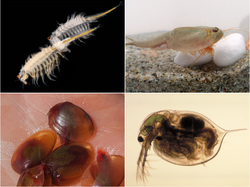
Picture of Diplostraca
- Source
- Wikipedia/Commons
- Credit
- Hans Hillewaert Rise0011 Franco Folini Public Library of Science
- Licence
- CC BY-SA 4.0
- Commercial use
- the licence allows it
No 3D scan of Diplostraca was found in MorphoSource and Sketchfab.
Smithsonian Open Access was not reached for this taxon, so this list is what the others held rather than everything there is.
The description on this site
- Licence
- CC BY-SA 4.0
This is what the site found, which is not the same as what exists.
Keep going
What may have been alongside itCalmanostraca through timeFormations of the Late TriassicThe world it lived on
Occurrence data from the Paleobiology Database, CC BY 4.0. (Gerstecker 1866)