Orthacanthus
Searched as Diplodus. The Paleobiology Database treats Orthacanthus as the accepted name.
Diplodus is a genus of marine ray-finned fish belonging the family Sparidae, which includes the seabreams and porgies. These fishes are found in the Atlantic Ocean, the Mediterranean Sea and the western Indian Ocean.

Roberto Pillon · CC BY 3.0 · via Wikipedia/Commons. May be a photograph of a specimen, or an artist’s reconstruction — an interpretation of a skeleton, since colour and soft tissue are almost never preserved.
On record
Recorded, not inferred- Sits inside
- OrthacanthidaePBDB
- Diet
- carnivorePBDB, for Chondrichthyes
- Life habit
- nektonicPBDB, for Chondrichthyes
- Motility
- actively mobilePBDB, for Chondrichthyes
Time the record covers
At least 399 million years on record.
The record covers at least 399.5 Mya to 11.7 ka. No occurrence read is dated outside 410.62 Mya to 0 Mya.
98 occurrences of Orthacanthus on record, most of them in the Miocene. Bar height is expected occurrences, not a count: each fossil is spread across the span it is dated to, so a tall narrow bar means tight dating and a low wide one means loose.
When
98 occurrences- Devonian2%
- Carboniferous23%
- Permian26%
- Middle Triassic1%
- Late Triassic1%
- Late Jurassic1%
- Oligocene3%
- Miocene36%
- Pliocene3%
- Pleistocene3%
- Holocene1%
These are dates about fossils, not the animal: the record can only begin after it arose and end before it died out, so either end may reach further. Shares are expected occurrences: a fossil dated to a span is counted partly in each period it straddles. More on what this infers.
Found in
35 formations
- Garber Sandstone Formation · Sumner Group9
- Lagos-Portimão Formation6
- Black Prince Limestone Formation4
- Washington Formation3
- Hrušky Formation3
- Wild Cow Formation · Madera Group3
Loading coastlines…
The named rock units Orthacanthus has been recovered from, largest first. Drawn where the rock is now, not where it formed. 11 further formations hold fewer occurrences each and are not listed. 36 occurrences have no formation on record, which is common for older literature.
Orthacanthus and its relatives
MioceneWhere Orthacanthus and its relatives were recorded in the Miocene.
Found in the same rock
296 taxa- Acanthodes6 sites
- Diplodus tenuis5 sites
- Eryops megacephalus5 sites
- Pleuracanthus laevissimus5 sites
- Actinopterygii4 sites
- Sagenodus4 sites
- Strepsodus sauroides4 sites
- Trimerorhachis4 sites
- Archeria3 sites
- Barbclabornia3 sites
- Captorhinus3 sites
- Captorhinus aguti3 sites
- Coelacanthidae3 sites
- Ctenoptychius apicalis3 sites
- Dimetrodon3 sites
- Diplocaulus3 sites
- Helodus simplex3 sites
- Pisces indet.3 sites
- Plantae indet.3 sites
- Rhizodopsis sauroides3 sites
- Trimerorhachis insignis3 sites
- Acanthoidea indet.2 sites
- Acheloma2 sites
- Amphicentrum jurgenai2 sites
The Paleobiology Database records 39 sites for Orthacanthus, and this reads all of them. The number is how many of those sites it was catalogued from too. The 24 sharing the most are listed.
This is not a list of everything alive at the time. It is only what has come out of the same ground as this animal and been written down.
Entered from
58 references- Catalogue of the Fossil Fishes in the British Museum (Natural History) Part 110
- New Specimens of Xenacanth and Hybodont Sharks (Elasmobranchii: Xenacanthida and Hybodontoidea) from the Lower Permian of Southwestern Oklahoma9
- Vertébrés (crocodiliens, poissons) du Miocène marin de l'Argarve occidentale6
- Early Pennsylvanian Xenacanth Chondrichthyans from the Swisshelm Mountains, Arizona, USA4
- Marine to Onshore Vertebrates in the Lower Permian of Kansas and their Paleoenvironmental Implications4
- Fish teeth from the Middle Miocene of Kienberg at Mikulov, Czech Republic, Vienna Basin3
- Chondrichthyan Biostratigraphy of the North American Permian System3
- Middle Miocene (Badenian) fishes from the north-west of the Fore-Carpathian Basin2
- Presència de Tomistoma cf. lusitanica (Vianna i Moraes, 1945) (Reptilia: Crocodylia) al Burdigalià inferior de Mallorca (Illes Balears, Mediterrània occidental). Implicacions paleoambientals2
- Fish otoliths from the pre-evaporitic (Early Messinian) sediments of northern Italy: their stratigraphic and palaeobiogeographic significance2
- Geology and Vertebrate Fauna of a New Site in the Wellington Formation (Lower Permian) of Northern Oklahoma2
- Deciphering "temperature" and "salinity" from biogenic phosphates: the 6180 of coexisting fishes and mammals of the Middle Miocene sea of western France2
Each of the 98 occurrences read was entered from one of these publications, ordered by how many each accounts for. This is not a search for papers mentioning the name. 46 further references are not listed. Entries link to doi.org where the Paleobiology Database holds an identifier, and to its own record where it does not. Relayed as the Paleobiology Database holds them, not checked against what they resolve to.
Media and terms
Media content3
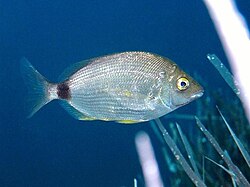
Picture of Orthacanthus
- Source
- Wikipedia/Commons
- Credit
- Roberto Pillon
- Licence
- CC BY 3.0
- Commercial use
- the licence allows it
CT scan
- Source
- MorphoSource
- Licence
- In Copyright
- Commercial use
- cannot be read from the licence given — check the record
- Specimen
- Diplodus annularis · UWFC:ADULT COLLECTION:UW 016854
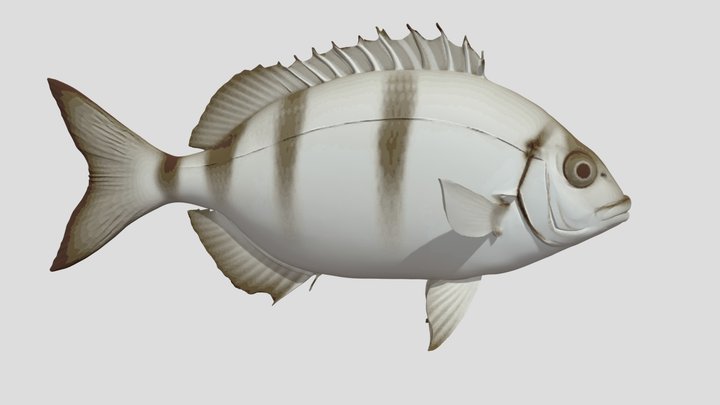
3D model
- Source
- Sketchfab
- Credit
- salvinorinab
- Licence
- CC Attribution
- Commercial use
- cannot be read from the licence given — check the record
The description on this site
- Source
- Wikipedia, “Diplodus”
- Licence
- CC BY-SA 4.0
This is what the site found, which is not the same as what exists.
Keep going
What may have been alongside itOrthacanthidae through timeFormations of the MioceneThe world it lived on
Occurrence data from the Paleobiology Database, CC BY 4.0. Agassiz 1843