Tyrannosauroidea
Searched as Dinodon. The Paleobiology Database treats Tyrannosauroidea as the accepted name.
Lycodon is a genus of snakes, commonly known as wolf snakes, in the subfamily Colubrinae of the family Colubridae.The Neo-Latin name Lycodon is derived from the Greek words λύκος (lykos) meaning wolf and οδόν (odon) meaning tooth, and refers to the fang-like anterior maxillary and mandibular teeth. The species in the genus Lycodon are nonvenomous, but many members strongly resemble the venomous kraits in appearance, an example of Batesian mimicry.

Saleem Hameed <saleemham at rediffmail.com> · CC BY 2.5 · via Wikipedia/Commons. May be a photograph of a specimen, or an artist’s reconstruction — an interpretation of a skeleton, since colour and soft tissue are almost never preserved.
On record
Recorded, not inferred- Sits inside
- TyrannosauroideaPBDB
- Diet
- carnivorePBDB, for Coelurosauria
- Life habit
- ground dwelling, solitaryPBDB, for Theropoda
- Motility
- actively mobilePBDB, for Theropoda
- Environment
- terrestrialPBDB, for Theropoda
Time the record covers
At least 69 million years on record.
The record covers at least 72.2 Mya to 2.58 Mya. No occurrence read is dated outside 83.6 Mya to 774 ka.
10 occurrences of Tyrannosauroidea on record, most of them in the Late Cretaceous. Bar height is expected occurrences, not a count: each fossil is spread across the span it is dated to, so a tall narrow bar means tight dating and a low wide one means loose.
When
10 occurrencesThese are dates about fossils, not the animal: the record can only begin after it arose and end before it died out, so either end may reach further. Shares are expected occurrences: a fossil dated to a span is counted partly in each period it straddles. More on what this infers.
Found in
5 formations
- Kirtland Formation4
- Fruitland Formation2
- Ojo Alamo Formation2
- Judith River Formation · Montana Group1
- Guga Formation1
Loading coastlines…
The named rock units Tyrannosauroidea has been recovered from, largest first. Drawn where the rock is now, not where it formed.
Tyrannosauroidea and its relatives
Late CretaceousWhere Tyrannosauroidea and its relatives were recorded in the Late Cretaceous.
Found in the same rock
1,182 taxa- Tyrannosauridae82 sites
- Hadrosauridae80 sites
- Trionychidae73 sites
- Ceratopsidae66 sites
- Lepisosteus occidentalis59 sites
- Champsosaurus56 sites
- Myledaphus bipartitus56 sites
- Scapherpeton tectum55 sites
- Baenidae53 sites
- Crocodylia48 sites
- Tyrannosaurus rex46 sites
- Opisthotriton kayi44 sites
- Paronychodon44 sites
- Chelydridae43 sites
- Theropoda43 sites
- Brachychampsa montana42 sites
- Borealosuchus sternbergii38 sites
- Anura36 sites
- Teleostei36 sites
- Adocus34 sites
- Aves34 sites
- Multituberculata33 sites
- Compsemys victa30 sites
- Ornithomimidae29 sites
The Paleobiology Database records 616 sites for Tyrannosauroidea, and this reads 240 of them. The number is how many of those sites it was catalogued from too. The 24 sharing the most are listed.
This is not a list of everything alive at the time. It is only what has come out of the same ground as this animal and been written down.
Entered from
5 references- Contributions to the geology and paleontology of San Juan County, New Mexico. 2. Vertebrate faunas of the Ojo Alamo, Kirtland and Fruitland Formations6
- Early Pleistocene Fossil Snakes (Reptilia: Squamata) from Okinawajima Island in the Ryukyu Archipelago, Southwestern Japan1
- An aniliid snake and associated vertebrates from the Campanian of New Mexico1
- Osteology of the carnivorous Dinosauria in the United States National Museum, with special reference to the genera Antrodemus (Allosaurus) and Ceratosaurus1
- Notices of remains of extinct reptiles and fishes, discovered by Dr. F. V. Hayden in the bad lands of the Judith River, Nebraska Territory1
Each of the 10 occurrences read was entered from one of these publications, ordered by how many each accounts for. This is not a search for papers mentioning the name. Entries link to doi.org where the Paleobiology Database holds an identifier, and to its own record where it does not. Relayed as the Paleobiology Database holds them, not checked against what they resolve to.
Media and terms
Media content2

Picture of Tyrannosauroidea
- Source
- Wikipedia/Commons
- Credit
- Saleem Hameed <saleemham at rediffmail.com>
- Licence
- CC BY 2.5
- Commercial use
- the licence allows it
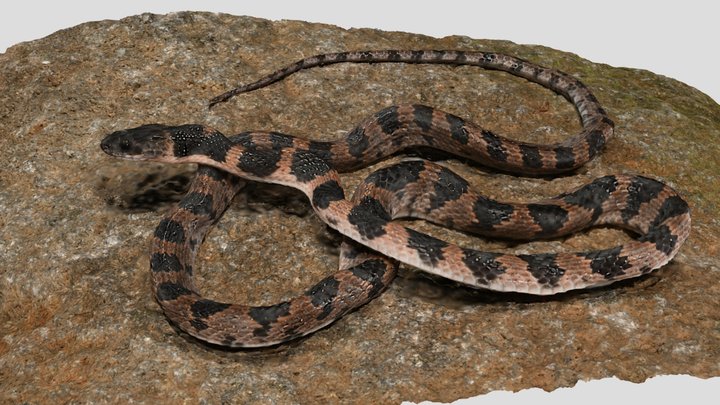
3D model
- Source
- Sketchfab
- Licence
- CC0 Public Domain
- Commercial use
- the licence allows it
Smithsonian Open Access and MorphoSource were not reached for this taxon, so this list is what the others held rather than everything there is.
The description on this site
- Source
- Wikipedia, “Lycodon”
- Licence
- CC BY-SA 4.0
This is what the site found, which is not the same as what exists.
Keep going
What may have been alongside itTyrannosauroidea through timeFormations of the Late CretaceousThe world it lived on
Occurrence data from the Paleobiology Database, CC BY 4.0. Leidy 1856