Dinictis
Dinictis is a genus of the Nimravidae, an extinct family of feliform mammalian carnivores, also known as "false saber-toothed cats". Assigned to the subfamily Nimravinae, Dinictis was endemic to North America from the Late Eocene to Early Oligocene epochs, existing for about 6.2 million years. Including supplementary materials

Daderot · CC0 · via Wikipedia/Commons. May be a photograph of a specimen, or an artist’s reconstruction — an interpretation of a skeleton, since colour and soft tissue are almost never preserved.
On record
Recorded, not inferred- Sits inside
- NimravidaePBDB
- Diet
- carnivorePBDB
- Life habit
- ground dwellingPBDB, for Nimravidae
- Motility
- actively mobilePBDB, for Osteichthyes
- Environment
- terrestrialPBDB, for Eutheria
Time the record covers
At least 4.4 million years on record.
The record covers at least 33.9 Mya to 29.5 Mya. No occurrence read is dated outside 37 Mya to 24.7 Mya.
31 occurrences of Dinictis on record, most of them in the Oligocene. Bar height is expected occurrences, not a count: each fossil is spread across the span it is dated to, so a tall narrow bar means tight dating and a low wide one means loose.
When
31 occurrencesThese are dates about fossils, not the animal: the record can only begin after it arose and end before it died out, so either end may reach further. Shares are expected occurrences: a fossil dated to a span is counted partly in each period it straddles. More on what this infers.
Found in
6 formations
- Brule Formation · White River Group11
- White River Formation6
- Chadron Formation2
- Cypress Hills Formation1
- Renova Formation1
- John Day Formation1
Loading coastlines…
The named rock units Dinictis has been recovered from, largest first. Drawn where the rock is now, not where it formed. 9 occurrences have no formation on record, which is common for older literature.
Dinictis and its relatives
OligoceneWhere Dinictis and its relatives were recorded in the Oligocene.
Found in the same rock
331 taxa- Daphoenus15 sites
- Leptomeryx evansi14 sites
- Ischyromys typus13 sites
- Merycoidodon culbertsonii13 sites
- Hesperocyon gregarius12 sites
- Palaeolagus haydeni11 sites
- Hesperocyon10 sites
- Mesohippus bairdi10 sites
- Brontotheriidae9 sites
- Hypertragulus calcaratus9 sites
- Hyracodon9 sites
- Archaeotherium mortoni8 sites
- Hypisodus8 sites
- Hyracodon nebraskensis8 sites
- Leptictidae8 sites
- Miniochoerus gracilis8 sites
- Poebrotherium8 sites
- Poebrotherium wilsoni8 sites
- Didelphidae7 sites
- Hoplophoneus primaevus7 sites
- Hyaenodon7 sites
- Ischyromys veterior7 sites
- Megalagus turgidus7 sites
- Palaeolagus temnodon7 sites
The Paleobiology Database records 31 sites for Dinictis, and this reads all of them. The number is how many of those sites it was catalogued from too. The 24 sharing the most are listed.
This is not a list of everything alive at the time. It is only what has come out of the same ground as this animal and been written down.
Entered from
16 references- Mammalian Range Zones in the Chadronian White River Formation at Flagstaff Rim, Wyoming5
- Stratigraphy, Structure, and Vertebrate Fossils of the Oligocene Brule Formation, Slim Buttes, Northwestern South Dakota4
- Paleoecology of the Lower Nodular Zone, Brule Formation, in the Big Badlands of South Dakota4
- Synonymies and reidentifications of North American fossil mammals2
- Eocene-Oligocene faunas of the Cypress Hills Formation, Saskatchewan2
- Preliminary biostratigraphy of the White River Group (Oligocene, Chadron and Brule formations) in the vicinity of Chadron, Nebraska2
- A contribution to the Tertiary geology and paleontology of northeastern Colorado2
- The Faunas of the Concretionary Zones of the Oreodon Beds, White River Oligocene2
- Description of an Earliest Orellan Fauna From Badlands National Park, Interior, South Dakota and Implications for the Stratigraphic Position of the Bloom Basin Limestone Bed1
- Revised chronostratigraphy and biostratigraphy of the John Day Formation (Turtle Cove and Kimberly Members), Oregon, with implications for updated calibration of the Arikareean North American land mammal age1
- Vertebrate fossil record, age, and paleoenvironmental setting of the Brule Formation (Oligocene) in North Dakota1
- Personal communication regarding Tertiary faunal lists, Jefferson County, Montana1
Each of the 31 occurrences read was entered from one of these publications, ordered by how many each accounts for. This is not a search for papers mentioning the name. 4 further references are not listed. Entries link to doi.org where the Paleobiology Database holds an identifier, and to its own record where it does not. Relayed as the Paleobiology Database holds them, not checked against what they resolve to.
Media and terms
Media content3
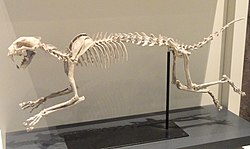
Picture of Dinictis
- Source
- Wikipedia/Commons
- Credit
- Daderot
- Licence
- CC0
- Commercial use
- the licence allows it
Laser scan
- Source
- MorphoSource
- Licence
- not stated by the source
- Commercial use
- cannot be read from the licence given — check the record
- Specimen
- Dinictis sp. · LACM:162986
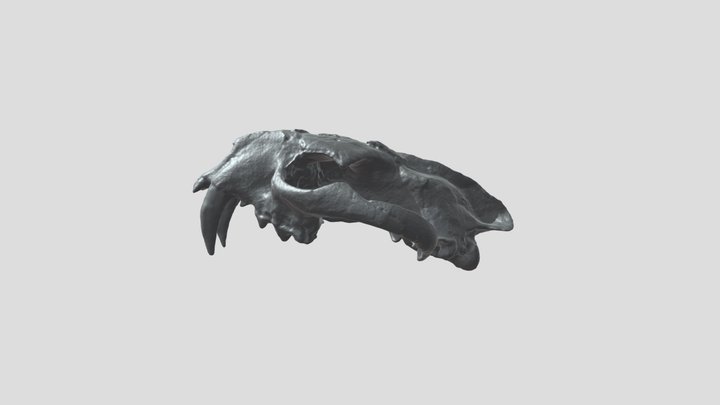
3D model
- Source
- Sketchfab
- Credit
- Badlands Dinosaur Museum
- Licence
- CC Attribution
- Commercial use
- cannot be read from the licence given — check the record
Smithsonian Open Access was not reached for this taxon, so this list is what the others held rather than everything there is.
The description on this site
- Source
- Wikipedia, “Dinictis”
- Licence
- CC BY-SA 4.0
This is what the site found, which is not the same as what exists.
Keep going
What may have been alongside itNimravidae through timeFormations of the OligoceneThe world it lived on
Occurrence data from the Paleobiology Database, CC BY 4.0. Leidy 1854