Hyaenodon
Hyaenodon ("hyena-tooth") is an extinct genus of carnivorous placental mammals from the tribe Hyaenodontini, part of the subfamily Hyaenodontinae, that belonged to the now extinct order Hyaenodonta. The genus was found lived in Eurasia and North America from the Middle Eocene to the Late Miocene, from 38 to 11.4 million years ago, existing for 26.6 million years. Hyaenodon was thought to have evolved in Asia, probably evolving from Propterodon.

Ryan Somma · CC BY 2.0 · via Wikipedia/Commons. May be a photograph of a specimen, or an artist’s reconstruction — an interpretation of a skeleton, since colour and soft tissue are almost never preserved.
On record
Recorded, not inferred- Sits inside
- HyaenodontinaePBDB
- Diet
- carnivorePBDB
- Life habit
- ground dwellingPBDB, for Hyaenodontidae
- Motility
- actively mobilePBDB, for Osteichthyes
- Environment
- terrestrialPBDB, for Eutheria
- Length
- 3 mWikidata
- Mass
- 378 kgWikidata
Time the record covers
At least 25 million years on record.
The record covers at least 41.03 Mya to 15.98 Mya. No occurrence read is dated outside 56 Mya to 11.63 Mya.
184 occurrences of Hyaenodon on record, most of them in the Eocene. Bar height is expected occurrences, not a count: each fossil is spread across the span it is dated to, so a tall narrow bar means tight dating and a low wide one means loose.
When
184 occurrencesThese are dates about fossils, not the animal: the record can only begin after it arose and end before it died out, so either end may reach further. Shares are expected occurrences: a fossil dated to a span is counted partly in each period it straddles. More on what this infers.
Found in
35 formations
- Brule Formation · White River Group30
- Ergilin Dzo Formation17
- Chadron Formation · White River Group12
- Hsanda Gol Formation12
- White River Formation10
- Perrière Formation4
Loading coastlines…
The named rock units Hyaenodon has been recovered from, largest first. Drawn where the rock is now, not where it formed. 11 further formations hold fewer occurrences each and are not listed. 52 occurrences have no formation on record, which is common for older literature.
Hyaenodon and its relatives
EoceneWhere Hyaenodon and its relatives were recorded in the Eocene.
Found in the same rock
1,416 taxa- Brontotheriidae21 sites
- Hesperocyon gregarius20 sites
- Leptomeryx evansi18 sites
- Megalagus turgidus17 sites
- Merycoidodon culbertsonii17 sites
- Palaeolagus haydeni17 sites
- Poebrotherium wilsoni16 sites
- Daphoenus15 sites
- Hypertragulus calcaratus14 sites
- Hyracodon13 sites
- Mesohippus bairdi13 sites
- Paradjidaumo trilophus12 sites
- Archaeotherium mortoni11 sites
- Dinictis11 sites
- Hesperocyon11 sites
- Ischyromys11 sites
- Didelphidae10 sites
- Hyracodon priscidens10 sites
- Ischyromys typus10 sites
- Ischyromys veterior10 sites
- Leptomeryx speciosus10 sites
- Subhyracodon10 sites
- Hypisodus9 sites
- Hyracodon nebraskensis9 sites
The Paleobiology Database records 126 sites for Hyaenodon, and this reads all of them. The number is how many of those sites it was catalogued from too. The 24 sharing the most are listed.
This is not a list of everything alive at the time. It is only what has come out of the same ground as this animal and been written down.
Entered from
81 references- Valbro : un nouveau site à vertébrés de l’Oligocène inférieur (MP22) de France (Quercy). I – Contexte géologique ; Mammalia : Rodentia, Hyaenodontida, Carnivora [Valbro: A new site of vertebrates from the early Oligocene (MP22) of France (Quercy). I – Geological context; Mammalia: Rodentia, Hyaenodontida, Carnivora]12
- Elocene-Oligocene climatic change in North America: The White River Formation near Douglass, East-Central Wyoming10
- On some Oligocene carnivorous mammals from Central Asia10
- Carnivorous mammals of the Late Eocene and Early Oligocene of Trans-Pecos Texas8
- Fossil Mammals of Africa: 19 The Miocene Carnivora of East Africa8
- Oligocene stratigraphy across the Eocene and Miocene boundaries in the Valley of Lakes (Mongolia)7
- Mammalian Range Zones in the Chadronian White River Formation at Flagstaff Rim, Wyoming7
- Nouveaux Hyaenodontidae (Creondonta, Mammalia) du Paléogène de Mongolie5
- Synonymies and reidentifications of North American fossil mammals4
- Les nouvelles faunes de vertebres anterieurs a la "Grande Coupure" decouvertes dans les phosphorites du Quercy4
- A contribution to the Tertiary geology and paleontology of northeastern Colorado4
- The Faunas of the Concretionary Zones of the Oreodon Beds, White River Oligocene4
Each of the 184 occurrences read was entered from one of these publications, ordered by how many each accounts for. This is not a search for papers mentioning the name. 69 further references are not listed. Entries link to doi.org where the Paleobiology Database holds an identifier, and to its own record where it does not. Relayed as the Paleobiology Database holds them, not checked against what they resolve to.
Media and terms
Media content3

Picture of Hyaenodon
- Source
- Wikipedia/Commons
- Credit
- Ryan Somma
- Licence
- CC BY 2.0
- Commercial use
- the licence allows it
CT scan
- Source
- MorphoSource
- Licence
- In Copyright
- Commercial use
- cannot be read from the licence given — check the record
- Specimen
- Hyaenodon mustelinus · UWYO:UW:547
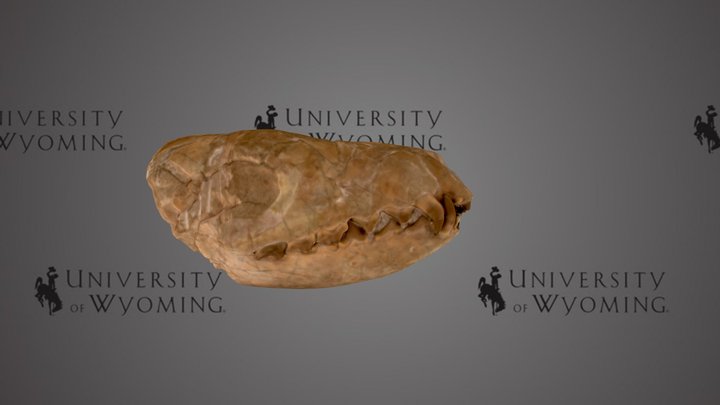
3D model
- Source
- Sketchfab
- Licence
- CC Attribution-NonCommercial
- Commercial use
- the licence does not allow it
The description on this site
- Source
- Wikipedia, “Hyaenodon”
- Licence
- CC BY-SA 4.0
This is what the site found, which is not the same as what exists.
Keep going
Everything alive alongside itHyaenodontinae through timeFormations of the EoceneThe world it lived on
Occurrence data from the Paleobiology Database, CC BY 4.0. Laizer and Parieu 1838