Dichobunidae
Dichobunidae is an extinct family of basal artiodactyl mammals from the early Eocene to late Oligocene of North America, Europe, and Asia. The Dichobunidae include some of the earliest known artiodactyls, such as Diacodexis.

Uncredited · via Wikipedia/Commons. May be a photograph of a specimen, or an artist’s reconstruction — an interpretation of a skeleton, since colour and soft tissue are almost never preserved.
On record
Recorded, not inferred- Sits inside
- DichobunoideaPBDB
- Diet
- frugivore, omnivorePBDB
- Life habit
- ground dwellingPBDB
- Motility
- actively mobilePBDB, for Osteichthyes
- Environment
- terrestrialPBDB
Time the record covers
At least 23 million years on record.
The record covers at least 51.1 Mya to 27.3 Mya. No occurrence read is dated outside 56 Mya to 23.04 Mya.
158 occurrences of Dichobunidae on record, most of them in the Eocene. Bar height is expected occurrences, not a count: each fossil is spread across the span it is dated to, so a tall narrow bar means tight dating and a low wide one means loose.
When
158 occurrencesThese are dates about fossils, not the animal: the record can only begin after it arose and end before it died out, so either end may reach further. Shares are expected occurrences: a fossil dated to a span is counted partly in each period it straddles. More on what this infers.
Found in
32 formations
- Kuldana Formation5
- Sables a Unios et Teredines Formation4
- Wagon Bed ("Tepee Trail") Formation3
- Creechbarrow Limestone Formation3
- Eifel Formation3
- Pondaung Formation3
Loading coastlines…
The named rock units Dichobunidae has been recovered from, largest first. Drawn where the rock is now, not where it formed. 8 further formations hold fewer occurrences each and are not listed. 101 occurrences have no formation on record, which is common for older literature.
Dichobunidae and its relatives
EoceneWhere Dichobunidae and its relatives were recorded in the Eocene.
Found in the same rock
1,330 taxa- Hyrachyus10 sites
- Protodichobune oweni10 sites
- Anguini8 sites
- Dichobune robertiana8 sites
- Eurohippus parvulus8 sites
- Pelorochelon eocaenica8 sites
- Crocodylia7 sites
- Dichobune leporina7 sites
- Eurodexis russelli7 sites
- Heterohyus7 sites
- Palaeotherium7 sites
- Saturninia7 sites
- Amphiperatherium minutum6 sites
- Aumelasia menieli6 sites
- Boidae6 sites
- Cuisitherium lydekkeri6 sites
- Diacodexis varleti6 sites
- Dichodon6 sites
- Diplocynodon6 sites
- Mouillacitherium elegans6 sites
- Necrosaurus6 sites
- Neochelys eocaenica6 sites
- Palaeotherium isselanum6 sites
- Peratherium6 sites
The Paleobiology Database records 80 sites for Dichobunidae, and this reads all of them. The number is how many of those sites it was catalogued from too. The 24 sharing the most are listed.
This is not a list of everything alive at the time. It is only what has come out of the same ground as this animal and been written down.
Entered from
59 references- Les artiodactyles de l'Eocene moyen et superieur d'Europe occidentale; systematique et evolution43
- Les artiodactyles du gisement yprésien terminal de Premontre (Aisne, France)21
- Les mammiferes d'Egerkingen et l'histoire des faunes de l'Eocene d'Europe12
- Synonymies and reidentifications of North American fossil mammals6
- Revision of the Eocene artiodactyls (Mammalia, Placentalia) from Aumelas and Saint-Martin-de-Londres (Montpellier limestones, Hérault, France) questions the early European artiodactyl radiation5
- Catalogue of the Eocene mammal types of the Natural History Museum Basel3
- First fossil primates from Eckfeld Maar, Middle Eocene (Eifel, Germany)3
- Paleontology and Geology of the Badwater Creek Area, Central Wyoming. Part 14. The Artiodactyls3
- Neochorlakkia myaingensis n. gen., n. sp., a new Dichobunidae (Mammalia, Cetartiodactyla) from the middle Eocene Pondaung Formation, Myanmar2
- Un nouveau gisement à vertébrés éocènes, Rouzilhac (MP 10-11), dans la série molassique d’Issel (Aude, France)2
- Middle-Eocene artiodactyls from Shanghuang (Jiangsu Province, Coastal China) and the diversity of basal dichobunoids in Asia2
- Artiodactyla from the early Eocene of Kyrgyzstan2
Each of the 158 occurrences read was entered from one of these publications, ordered by how many each accounts for. This is not a search for papers mentioning the name. 47 further references are not listed. Entries link to doi.org where the Paleobiology Database holds an identifier, and to its own record where it does not. Relayed as the Paleobiology Database holds them, not checked against what they resolve to.
Media and terms
Media content1
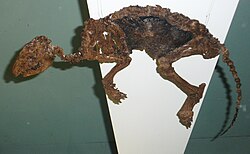
Picture of Dichobunidae
- Source
- Wikipedia/Commons
- Credit
- nobody named on the record
- Licence
- not stated by the source
- Commercial use
- cannot be read from the licence given — check the record
No 3D scan of Dichobunidae was found in Sketchfab.
Smithsonian Open Access and MorphoSource were not reached for this taxon, so this list is what the others held rather than everything there is.
The description on this site
- Licence
- CC BY-SA 4.0
This is what the site found, which is not the same as what exists.
Keep going
What may have been alongside itDichobunoidea through timeFormations of the EoceneThe world it lived on
Occurrence data from the Paleobiology Database, CC BY 4.0. Gill 1872