Diaphus rafinesquii
The white-spotted lantern fish, also called Rafinesque's lanternfish, is a species of fish in the family Myctophidae.

Uncredited · Public Domain · via Wikipedia/Commons. May be a photograph of a specimen, or an artist’s reconstruction — an interpretation of a skeleton, since colour and soft tissue are almost never preserved.
On record
Recorded, not inferred- Sits inside
- DiaphusPBDB
- Diet
- carnivorePBDB, for Myctophiformes
- Life habit
- nektonicPBDB, for Myctophiformes
- Motility
- actively mobilePBDB, for Myctophiformes
Time the record covers
At least 6.4 million years on record.
The record covers at least 7.246 Mya to 774 ka. No occurrence read is dated outside 11.63 Mya to 129 ka.
22 occurrences of Diaphus rafinesquii on record, most of them in the Miocene. The Paleobiology Database records this as a living group, and the chart stops with its fossils rather than at the present. Bar height is expected occurrences, not a count: each fossil is spread across the span it is dated to, so a tall narrow bar means tight dating and a low wide one means loose.
When
22 occurrences- Miocene50%
- Pliocene9%
- Pleistocene41%
These are dates about fossils, not the animal: the record can only begin after it arose and end before it died out, so either end may reach further. Shares are expected occurrences: a fossil dated to a span is counted partly in each period it straddles. More on what this infers.
Found in
2 formations
Loading coastlines…
The named rock units Diaphus rafinesquii has been recovered from, largest first. Drawn where the rock is now, not where it formed. 18 occurrences have no formation on record, which is common for older literature.
Diaphus rafinesquii and its relatives
MioceneWhere Diaphus rafinesquii and its relatives were recorded in the Miocene.
Found in the same rock
241 taxa- Lobianchia dofleini14 sites
- Ceratoscopelus maderensis13 sites
- Diaphus taaningi13 sites
- Lesueurigobius13 sites
- Maurolicus muelleri13 sites
- Deltentosteus12 sites
- Diaphus cavallonis12 sites
- Gadiculus argenteus12 sites
- Hygophum11 sites
- Notoscopelus elongatus11 sites
- Scopelopsis pliocenicus11 sites
- Diaphus splendidus10 sites
- Benthosema glaciale9 sites
- Diaphus holti9 sites
- Hygophum benoiti9 sites
- Myctophum punctatum9 sites
- Otolithus labiatus9 sites
- Dentex8 sites
- Lampanyctus crocodilus8 sites
- Phycis8 sites
- Gobius7 sites
- Arnoglossus kokeni6 sites
- Cepola6 sites
- Hygophum hygomi6 sites
The Paleobiology Database records 21 sites for Diaphus rafinesquii, and this reads all of them. The number is how many of those sites it was catalogued from too. The 24 sharing the most are listed.
This is not a list of everything alive at the time. It is only what has come out of the same ground as this animal and been written down.
Entered from
11 references- Pleistocene marine fish invasions and paleoenvironmental reconstructions in the eastern Mediterranean3
- Connectivity controls on the late Miocene eastern Mediterranean fish fauna3
- Fish otoliths from the pre-evaporitic (Early Messinian) sediments of northern Italy: their stratigraphic and palaeobiogeographic significance3
- Pleistocene fish otoliths from the Mediterranean Basin: a synthesis3
- The fossil otolith record of fishes (Vertebrata: Teleostei) in Greece2
- Tortonian teleost otoliths from northern Italy: taxonomic synthesis and stratigraphic significance2
- Paleobathymetric interpretation of the fish otoliths from the lower - middle quaternary deposits of Kephallonia and Zakynthos islands (Ionian Sea, Western Greece)2
- The Zanclean marine fish fauna and palaeoenvironmental reconstruction of a coastal marine setting in the eastern Mediterranean1
- A record of the Messinian salinity crisis in the eastern Ionian tectonically active domain1
- Tortonian fish otoliths from turbiditic deposits in Northern Italy: Taxonomic and stratigraphic significance1
- Paleobathymetry of a Late Pliocene Voutes coast (Heraklion basin, Crete)1
Each of the 22 occurrences read was entered from one of these publications, ordered by how many each accounts for. This is not a search for papers mentioning the name. Entries link to doi.org where the Paleobiology Database holds an identifier, and to its own record where it does not. Relayed as the Paleobiology Database holds them, not checked against what they resolve to.
Media and terms
Media content1
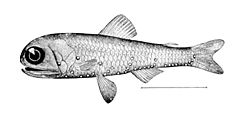
Picture of Diaphus rafinesquii
- Source
- Wikipedia/Commons
- Credit
- nobody named on the record
- Licence
- Public Domain
- Commercial use
- the licence allows it
No 3D scan of Diaphus rafinesquii was found in MorphoSource and Sketchfab.
Smithsonian Open Access was not reached for this taxon, so this list is what the others held rather than everything there is.
The description on this site
- Licence
- CC BY-SA 4.0
This is what the site found, which is not the same as what exists.
Keep going
What may have been alongside itDiaphus through timeFormations of the MioceneThe world it lived on
Occurrence data from the Paleobiology Database, CC BY 4.0. (Cocco 1838)