Dechenella verneuili
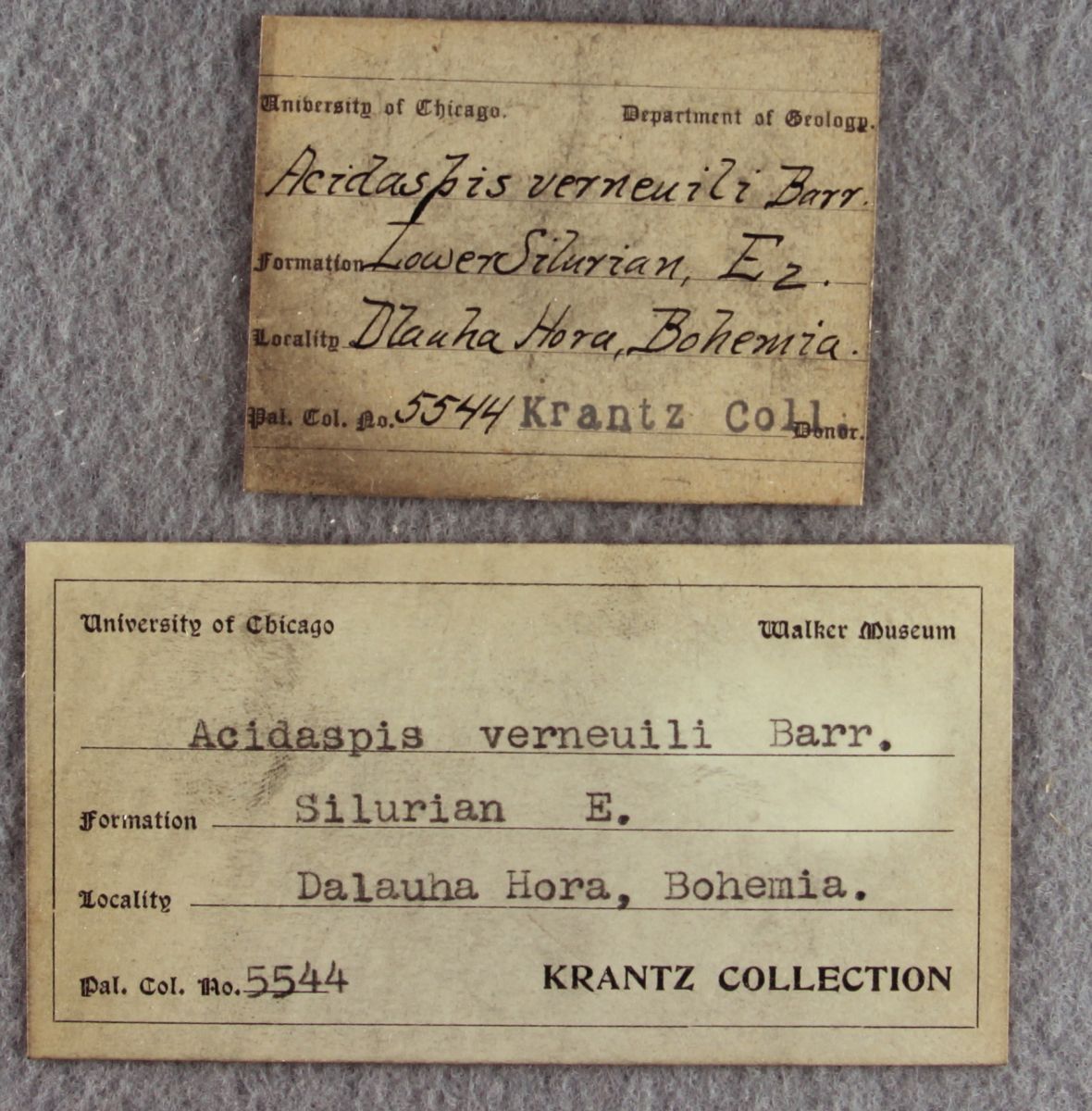
via iDigBio · via iDigBio. May be a photograph of a specimen, or an artist’s reconstruction — an interpretation of a skeleton, since colour and soft tissue are almost never preserved.
On record
Recorded, not inferred- Sits inside
- DechenellaPBDB
- Diet
- deposit feederPBDB, for Proetida
- Life habit
- low-level epifaunalPBDB, for Trilobita
- Motility
- fast-movingPBDB, for Trilobita
- Vision
- well-developedPBDB, for Proetidae
- Environment
- marinePBDB, for Trilobita
Time the record covers
At least 5.6 million years on record.
The record covers at least 387.95 Mya to 382.31 Mya. No occurrence read is dated outside 393.47 Mya to 372.15 Mya.
15 occurrences of Dechenella verneuili on record, most of them in the Devonian. Bar height is expected occurrences, not a count: each fossil is spread across the span it is dated to, so a tall narrow bar means tight dating and a low wide one means loose.
When
15 occurrences- Devonian100%
These are dates about fossils, not the animal: the record can only begin after it arose and end before it died out, so either end may reach further. Shares are expected occurrences: a fossil dated to a span is counted partly in each period it straddles. More on what this infers.
Found in
6 formations
- Hanonet Formation5
- Loogh Formation4
- Grevenstein Formation2
- Chernaya Bay Horizon Formation1
- Oberen Newberrien Formation1
- Flinz Formation1
Loading coastlines…
The named rock units Dechenella verneuili has been recovered from, largest first. Drawn where the rock is now, not where it formed. 1 occurrence has no formation on record, which is common for older literature.
Dechenella verneuili and its relatives
DevonianWhere Dechenella verneuili and its relatives were recorded in the Devonian.
Found in the same rock
82 taxa- Atrypa4 sites
- Cystiphylloides3 sites
- Favosites goldfussi3 sites
- Invertrypa3 sites
- Invertrypa kelusiana3 sites
- Nyterops nyter3 sites
- Scutellum3 sites
- Thamnophyllum3 sites
- Acanthophyllum2 sites
- Aristiphyllum luetti2 sites
- Atryparia2 sites
- Calceola2 sites
- Chonetes2 sites
- Cyrtodechenella cyrto2 sites
- Paracyclas2 sites
- Polygnathus2 sites
- Polygnathus linguiformis linguiformis2 sites
- Productella2 sites
- Archiacoceras1 site
- Australophyllum1 site
- Aviculopecten1 site
- Bifida1 site
- Buchiola1 site
- Calceola sandalina1 site
The Paleobiology Database records 15 sites for Dechenella verneuili, and this reads all of them. The number is how many of those sites it was catalogued from too. The 24 sharing the most are listed.
This is not a list of everything alive at the time. It is only what has come out of the same ground as this animal and been written down.
Entered from
7 references- The Eifelian-Givetian boundary and Struve's Middle Devonian Great Gap in the Couvin area (Ardennes, southern Belgium)5
- Geologie der Blankenheimer Mulde (Devon, Eifel)4
- Trilobiten aus mittlerem Devon des Rhenohercynikums: I. Corynexochida und Proetida (1)2
- Trilobiten aus mittlerem Devon des Rhenohercynikums: II. Proetida (2), Ptychopariida, Phacopida (1)1
- Lower and Middle Devonian marine deposits of the Soviet arctic and the correlation with arctic Canada1
- Rotasaccus dentifer n. g. n. sp. ein devonischer Ophiocistoide (Echinodermata) mit holothuroiden Wandskleriten und echinoidem Kauapparat1
- Richter and Richter, 19281
Each of the 15 occurrences read was entered from one of these publications, ordered by how many each accounts for. This is not a search for papers mentioning the name. Entries link to doi.org where the Paleobiology Database holds an identifier, and to its own record where it does not. Relayed as the Paleobiology Database holds them, not checked against what they resolve to.
Media and terms
Media content1
Picture of Dechenella verneuili
- Source
- iDigBio
- Credit
- via iDigBio
- Licence
- not stated by the source
- Commercial use
- cannot be read from the licence given — check the record
No 3D scan of Dechenella verneuili was found in Sketchfab.
Smithsonian Open Access and MorphoSource were not reached for this taxon, so this list is what the others held rather than everything there is.
This is what the site found, which is not the same as what exists.
Keep going
What may have been alongside itDechenella through timeFormations of the DevonianThe world it lived on
Occurrence data from the Paleobiology Database, CC BY 4.0. (Barrande 1852)