Cyrenidae
Cyrenidae is a family of clams in the order Venerida.

USGS · Public Domain · via Wikipedia/Commons. May be a photograph of a specimen, or an artist’s reconstruction — an interpretation of a skeleton, since colour and soft tissue are almost never preserved.
On record
Recorded, not inferred- Sits inside
- CyrenoideaPBDB
- Diet
- suspension feederPBDB, for Venerida
- Life habit
- infaunalPBDB, for Venerida
- Motility
- facultatively mobilePBDB, for Venerida
- Vision
- blindPBDB, for Bivalvia
Time the record covers
At least 198 million years on record.
The record covers at least 201.4 Mya to 2.58 Mya. No occurrence read is dated outside 205.7 Mya to 11.7 ka.
126 occurrences of Cyrenidae on record, most of them in the Eocene. The Paleobiology Database records this as a living group. Bar height is expected occurrences, not a count: each fossil is spread across the span it is dated to, so a tall narrow bar means tight dating and a low wide one means loose.
When
126 occurrences- Late Triassic2%
- Early Jurassicunder 1%
- Late Jurassic2%
- Early Cretaceous6%
- Late Cretaceous9%
- Paleocene3%
- Eocene48%
- Oligocene20%
- Miocene7%
- Pleistocene2%
These are dates about fossils, not the animal: the record can only begin after it arose and end before it died out, so either end may reach further. Shares are expected occurrences: a fossil dated to a span is counted partly in each period it straddles. More on what this infers.
Found in
35 formations
- Headon Beds Formation16
- Bembridge Marls Formation16
- Arcadia Formation · Hawthorn Group12
- Mera Formation10
- Osborne Beds Formation6
- Barton Beds Formation4
Loading coastlines…
The named rock units Cyrenidae has been recovered from, largest first. Drawn where the rock is now, not where it formed. 11 further formations hold fewer occurrences each and are not listed. 25 occurrences have no formation on record, which is common for older literature.
Cyrenidae and its relatives
EoceneWhere Cyrenidae and its relatives were recorded in the Eocene.
Found in the same rock
1,158 taxa- Cyrena89 sites
- Potamides19 sites
- Thiara19 sites
- Melanopsis16 sites
- Paludina16 sites
- Cerithium13 sites
- Corbula12 sites
- Ostrea12 sites
- Turritella12 sites
- Planorbis10 sites
- Limnaea9 sites
- Natica9 sites
- Ampullina (Ampullinopsis) amphora8 sites
- Fusus8 sites
- Pyrazisinus campanulatus8 sites
- Cardium7 sites
- Ancilla6 sites
- Calyptraea (Trochita) aperta6 sites
- Cytherea (Amiantis) incrassata6 sites
- Erodona6 sites
- Nerita6 sites
- Neritina6 sites
- Panope (Panope)6 sites
- Pitar6 sites
The Paleobiology Database records 102 sites for Cyrenidae, and this reads all of them. The number is how many of those sites it was catalogued from too. The 24 sharing the most are listed.
This is not a list of everything alive at the time. It is only what has come out of the same ground as this animal and been written down.
Entered from
45 references- On the Tertiary fluvio-marine formation of the Isle of Wight25
- On the Tertiary or SupraCretaceous Formations of the Isle of Wight as exhibited in the sections at Alum Bay and White Cliff Bay14
- Molluscs of the Tampa and Suwannee Limestones12
- Fauna de moluste a depozitelor Paleogene din nord-vestul Transilvaniei [Molluscan fauna from Paleogene deposits from NW Transilvania]11
- On the discovery of an alligator and of several new Mammalia in the Hordwell Cliff; with observations upon the geological phenomena of that locality7
- Fauna Fosila din Oligocenul de la Piatra Neamt6
- Fauna i stratygrafia paleocenu srodkowej Wisly3
- Faunal Horizons of the Barton Beds in Hampshire3
- Das Westliche Süd-Tirol: geologisch dargestellt3
- Semilla Sandstone, a new member of the Mancos Shale in the southeastern part of the San Juan Basin, New Mexico2
- Estudio geológico del sector del prepirineo comprendido entre los ríos Segre y Noguera Ribagorzana (Provincia de Lérida) [Geological study of the pre-Pyrenean sector between the Segre and Noguera Ribagorzana rivers (Lérida province)]2
- Karagyuleva, 19642
Each of the 126 occurrences read was entered from one of these publications, ordered by how many each accounts for. This is not a search for papers mentioning the name. 33 further references are not listed. Entries link to doi.org where the Paleobiology Database holds an identifier, and to its own record where it does not. Relayed as the Paleobiology Database holds them, not checked against what they resolve to.
Media and terms
Media content2
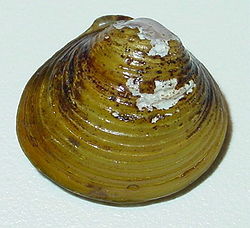
Picture of Cyrenidae
- Source
- Wikipedia/Commons
- Credit
- USGS
- Licence
- Public Domain
- Commercial use
- the licence allows it
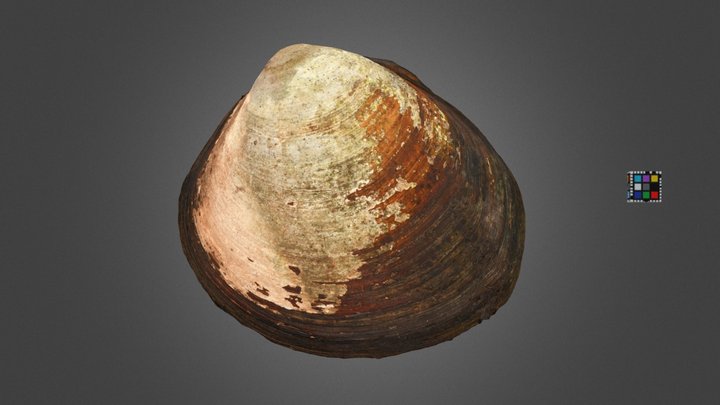
3D model
- Source
- Sketchfab
- Licence
- CC0 Public Domain
- Commercial use
- the licence allows it
Smithsonian Open Access was not reached for this taxon, so this list is what the others held rather than everything there is.
The description on this site
- Source
- Wikipedia, “Cyrenidae”
- Licence
- CC BY-SA 4.0
This is what the site found, which is not the same as what exists.
Keep going
What may have been alongside itCyrenoidea through timeFormations of the EoceneThe world it lived on
Occurrence data from the Paleobiology Database, CC BY 4.0. Gray 1840