Cupedidae
The Cupedidae are a small family of beetles, notable for the square pattern of "windows" on their elytra, which give the family their common name of reticulated beetles.

me · Public Domain · via Wikipedia/Commons. May be a photograph of a specimen, or an artist’s reconstruction — an interpretation of a skeleton, since colour and soft tissue are almost never preserved.
On record
Recorded, not inferred- Also called
- reticulated beetlePBDB
- Sits inside
- CupedoideaPBDB
- Motility
- actively mobilePBDB, for Arthropoda
- Environment
- terrestrialPBDB, for Insecta
Time the record covers
At least 233 million years on record.
The record covers at least 237 Mya to 3.6 Mya. No occurrence read is dated outside 241.464 Mya to 2.58 Mya.
132 occurrences of Cupedidae on record, most of them in the Eocene. The Paleobiology Database records this as a living group, and the chart stops with its fossils rather than at the present. Bar height is expected occurrences, not a count: each fossil is spread across the span it is dated to, so a tall narrow bar means tight dating and a low wide one means loose.
When
132 occurrences- Middle Triassic6%
- Late Triassicunder 1%
- Early Jurassicunder 1%
- Middle Jurassic2%
- Late Jurassic14%
- Early Cretaceous21%
- Late Cretaceous10%
- Paleocene17%
- Eocene26%
- Oligoceneunder 1%
- Miocene2%
- Plioceneunder 1%
These are dates about fossils, not the animal: the record can only begin after it arose and end before it died out, so either end may reach further. Shares are expected occurrences: a fossil dated to a span is counted partly in each period it straddles. More on what this infers.
Found in
31 formations
- Menat Formation22
- Karabastau Formation11
- Yixian Formation · Jehol Group8
- Madygen Formation8
- Eifel Formation8
- Daohugou Formation6
Loading coastlines…
The named rock units Cupedidae has been recovered from, largest first. Drawn where the rock is now, not where it formed. 7 further formations hold fewer occurrences each and are not listed. 32 occurrences have no formation on record, which is common for older literature.
Cupedidae and its relatives
EoceneWhere Cupedidae and its relatives were recorded in the Eocene.
Found in the same rock
4,195 taxa- Cupedinae9 sites
- Blattodea5 sites
- Cerambycidae5 sites
- Coleoptera5 sites
- Cupes rohdendorfi5 sites
- Heteroptera5 sites
- Orthoptera5 sites
- Procramptonomyia kovalevi5 sites
- Adorator hispidus4 sites
- Allophalerus bontsaganensis4 sites
- Araneae4 sites
- Archirhyphus asiaticus4 sites
- Archizelmira kazachstanica4 sites
- Arvernineura insignis4 sites
- Balticoroma serafinorum4 sites
- Hydrokhoohydra aquabella4 sites
- Lygaeidae4 sites
- Mizalia4 sites
- Notocupes elegans4 sites
- Opiliones4 sites
- Paramesopsocus adibi4 sites
- Raptophasma kerneggeri4 sites
- Spatiator praeceps4 sites
- Tenebrionidae4 sites
The Paleobiology Database records 74 sites for Cupedidae, and this reads all of them. Of that, one read hit the database's own return limit, so every count below is a floor rather than a total. The number is how many of those sites it was catalogued from too. The 24 sharing the most are listed.
This is not a list of everything alive at the time. It is only what has come out of the same ground as this animal and been written down.
Entered from
51 references- Taxonomy of the reticulate beetles of the subfamily Cupedinae (Coleoptera: Archostemata), with a review of the historical development21
- A revision of the genus Cupes Fabricius, 1801 from Baltic amber and some notes on taxonomy and composition of the family Cupedidae (Coleoptera, Archostemata)16
- Noviye zhuki semeistva Cupedidae iz Yurskikh otlozheniy Karatau8
- Taxonomic review of fossil coleopterous families (Insecta, Coleoptera). Suborder Archostemata: Superfamilies Coleopseoidea and Cupedoidea6
- New beetles of the family Cupedidae from the Mesozoic of Mongoloa. Ommatini, Mesocupedini, Priacmini5
- Zhuki semeystva Cupedidae iz nizhnego Triasa sredney Azii5
- First record of fossil Mesocupes from China (Coleoptera: Archostemata: Cupedidae)4
- First record of fossil Priacma (Coleoptera: Archostemata: Cupedidae) from the Jehol Biota of western Liaoning, China4
- Systematik, Phylogenie, Taphonomie und Paläoökologie der Insekten aus dem Mittel-Eozän des Eckfelder Maares, Vulkaneifel4
- Upper Jurassic Lagerstätte Shar Teg, southwestern Mongolia3
- New Archostemata (Insecta: Coleoptera) from the French Paleocene and Early Eocene, with a note on the composition of the suborder3
- New cupedid beetles from the Lower Cretaceous of Spain and the palaeogeography of the family3
Each of the 132 occurrences read was entered from one of these publications, ordered by how many each accounts for. This is not a search for papers mentioning the name. 39 further references are not listed. Entries link to doi.org where the Paleobiology Database holds an identifier, and to its own record where it does not. Relayed as the Paleobiology Database holds them, not checked against what they resolve to.
Media and terms
Media content1
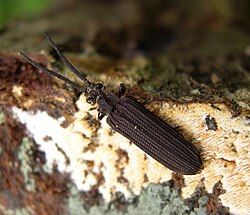
Picture of Cupedidae
- Source
- Wikipedia/Commons
- Credit
- me
- Licence
- Public Domain
- Commercial use
- the licence allows it
No 3D scan was found. Smithsonian Open Access, MorphoSource and Sketchfab were all searched.
The description on this site
- Source
- Wikipedia, “Cupedidae”
- Licence
- CC BY-SA 4.0
This is what the site found, which is not the same as what exists.
Keep going
What may have been alongside itCupedoidea through timeFormations of the EoceneThe world it lived on
Occurrence data from the Paleobiology Database, CC BY 4.0. Laporte 1836