Crassostrea patagonica

via iDigBio · CC0 · via iDigBio. May be a photograph of a specimen, or an artist’s reconstruction — an interpretation of a skeleton, since colour and soft tissue are almost never preserved.
On record
Recorded, not inferred- Sits inside
- CrassostreaPBDB
- Diet
- suspension feederPBDB, for Crassostrea
- Life habit
- epifaunalPBDB, for Crassostrea
- Motility
- stationary, attachedPBDB, for Crassostrea
- Vision
- blindPBDB, for Bivalvia
- Environment
- hypersaline,marine,brackishPBDB, for Ostreidae
Time the record covers
At least 15 million years on record.
The record covers at least 21 Mya to 5.333 Mya. No occurrence read is dated outside 29 Mya to 11.7 ka.
18 occurrences of Crassostrea patagonica on record, most of them in the Miocene. Bar height is expected occurrences, not a count: each fossil is spread across the span it is dated to, so a tall narrow bar means tight dating and a low wide one means loose.
When
18 occurrences- Oligocene4%
- Miocene66%
- Pliocene29%
- Pleistoceneunder 1%
These are dates about fossils, not the animal: the record can only begin after it arose and end before it died out, so either end may reach further. Shares are expected occurrences: a fossil dated to a span is counted partly in each period it straddles. More on what this infers.
Found in
6 formations
- Puerto Madryn Formation6
- Estratos de Agua Amarga Formation3
- Formación Coquimbo Formation2
- Entre Rios Formation1
- Monte Leon Formation1
- Bahía Inglesa Formation1
Loading coastlines…
The named rock units Crassostrea patagonica has been recovered from, largest first. Drawn where the rock is now, not where it formed. 4 occurrences have no formation on record, which is common for older literature.
Crassostrea patagonica and its relatives
MioceneWhere Crassostrea patagonica and its relatives were recorded in the Miocene.
Found in the same rock
108 taxa- Aequipecten paranensis6 sites
- Anomia6 sites
- Chlamys6 sites
- Ostrea6 sites
- Balanus4 sites
- Amusium paris2 sites
- Chaceon peruvianus2 sites
- Chlamys hupeanus2 sites
- Chorus2 sites
- Cubitostrea alvarezii2 sites
- Mytilus2 sites
- Ostrea cf. maxima2 sites
- Potiarca bonplandiana2 sites
- Scalaria2 sites
- Venus2 sites
- Zygochlamys actinodes2 sites
- Acesta excavata1 site
- Adelomelon alta1 site
- Amusium darwinianum1 site
- Arca1 site
- Arthrodytes andrewsi1 site
- Asterias1 site
- Balaenidae1 site
- Bryozoa1 site
The Paleobiology Database records 15 sites for Crassostrea patagonica, and this reads all of them. The number is how many of those sites it was catalogued from too. The 24 sharing the most are listed.
This is not a list of everything alive at the time. It is only what has come out of the same ground as this animal and been written down.
Entered from
7 references- 87Sr/86Sr Late Miocene age of fossil molluscs in the 'Entrerriense' of the Valdes Peninsula (Chubut, Argentina)5
- Monografia de los terrenos marinos terciarios, de las cercanias del Parana5
- Carta Caldera, Región de Atacama. Servicio Nacional de Geología y Minería, Carta Geológica de Chile, Serie Geología Básica, No. 76, 38 p. 1 mapa escala 1:100.0004
- Geología del Área Carrizalillo-El Tofo, Regiones de Atacama y Coquimbo1
- Geología del Área de Adacollo-Puerto Aldea, Región de Coquimbo, Carta No. 961
- Miocene fossil Decapoda (Crustacea: Brachyura) from Patagonia, Argentina, and their paleoecological setting1
- Note sur la géologie et la paléontologie de la Patagonie1
Each of the 18 occurrences read was entered from one of these publications, ordered by how many each accounts for. This is not a search for papers mentioning the name. Entries link to doi.org where the Paleobiology Database holds an identifier, and to its own record where it does not. Relayed as the Paleobiology Database holds them, not checked against what they resolve to.
Media and terms
Media content2
Picture of Crassostrea patagonica
- Source
- iDigBio
- Credit
- via iDigBio
- Licence
- CC0
- Commercial use
- the licence allows it
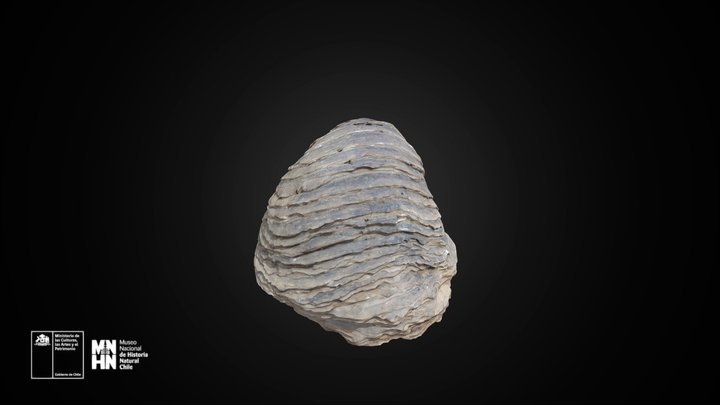
3D model
- Source
- Sketchfab
- Licence
- CC Attribution
- Commercial use
- cannot be read from the licence given — check the record
Smithsonian Open Access was not reached for this taxon, so this list is what the others held rather than everything there is.
This is what the site found, which is not the same as what exists.
Keep going
What may have been alongside itCrassostrea through timeFormations of the MioceneThe world it lived on
Occurrence data from the Paleobiology Database, CC BY 4.0. (d'Orbigny 1842)