Crassostrea gigas
The Pacific oyster, also called the Japanese oyster, is an oyster native to the Pacific coast of Asia. It has become an introduced species in North America, Australia, Europe, and New Zealand.

No machine-readable author provided. BetacommandBot assumed (based on copyright claims). · CC BY-SA 3.0 · via Wikipedia/Commons. May be a photograph of a specimen, or an artist’s reconstruction — an interpretation of a skeleton, since colour and soft tissue are almost never preserved.
On record
Recorded, not inferred- Also called
- giant Pacific oysterPBDB
- Sits inside
- CrassostreaPBDB
- Diet
- suspension feederPBDB, for Crassostrea
- Life habit
- epifaunalPBDB, for Crassostrea
- Motility
- stationary, attachedPBDB, for Crassostrea
- Vision
- blindPBDB, for Bivalvia
- Environment
- hypersaline,marine,brackishPBDB, for Ostreidae
Time the record covers
At least 11 million years on record.
The record covers at least 11.63 Mya to 11.7 ka. No occurrence read is dated outside 13.82 Mya to 0 Mya.
12 occurrences of Crassostrea gigas on record, most of them in the Pleistocene. The Paleobiology Database records this as a living group. Bar height is expected occurrences, not a count: each fossil is spread across the span it is dated to, so a tall narrow bar means tight dating and a low wide one means loose.
When
12 occurrences- Miocene8%
- Pliocene11%
- Pleistocene47%
- Holocene33%
These are dates about fossils, not the animal: the record can only begin after it arose and end before it died out, so either end may reach further. Shares are expected occurrences: a fossil dated to a span is counted partly in each period it straddles. More on what this infers.
Found in
7 formations
- Sakuragicho Formation1
- Kisagata shell bed Formation1
- Tomioka Formation · Taga Group1
- Cholan Formation · Miaoli Group1
- Toukoshan Formation · Miaoli Group1
- Akasawa Silt Formation · Toyohashi Group1
Loading coastlines…
The named rock units Crassostrea gigas has been recovered from, largest first. Drawn where the rock is now, not where it formed. 5 occurrences have no formation on record, which is common for older literature.
Crassostrea gigas and its relatives
PleistoceneWhere Crassostrea gigas and its relatives were recorded in the Pleistocene.
Found in the same rock
362 taxa- Anomia8 sites
- Anadara7 sites
- Batillaria7 sites
- Glossaulax didyma6 sites
- Rapana5 sites
- Glycymeris4 sites
- Nassarius4 sites
- Arcopagia3 sites
- Babylonia japonica3 sites
- Dosinia japonica3 sites
- Leukoma3 sites
- Mya (Arenomya) arenaria3 sites
- Olivella3 sites
- Paphia3 sites
- Scapharca satowi3 sites
- Serpulorbis imbricatus3 sites
- Sydaphera3 sites
- Venerupis3 sites
- Volema (Hemifusus) ternatanus3 sites
- Acmaea2 sites
- Anadara (Tegillarca) granosa2 sites
- Arcopsis symmetrica2 sites
- Astyris2 sites
- Boreotrophon2 sites
The Paleobiology Database records 12 sites for Crassostrea gigas, and this reads all of them. The number is how many of those sites it was catalogued from too. The 24 sharing the most are listed.
This is not a list of everything alive at the time. It is only what has come out of the same ground as this animal and been written down.
Entered from
9 references- Faunal analysis of the Upper Miaoli Group in the Tunghsiao area, Miaoli Province, Formosa, China2
- Summary of the geology and paleontology of the Atsumi Peninsula, Aichi Prefecture, Japan2
- Mollusca from the raised beach deposits of the Kwantô region2
- Palaeoenvironment inferred from stable isotopes of archaeological Crassostrea gigas shells unearthed from Tainan Science Park, Taiwan since middle Holocene1
- Povoado muculmano na Ponta do Castelo (Aljezur)1
- Pectinids from the Taga Group of the Joban Coalfield1
- Characteristics of the Miocene molluscan assemblages from central San-in District, Southwest Honshu, Japan1
- The discovery of the right whale skull in the Kisagata shell bed1
- Fossil vertebrae of humpback whale from alluvial deposite in Yokohama City1
Each of the 12 occurrences read was entered from one of these publications, ordered by how many each accounts for. This is not a search for papers mentioning the name. Each entry links to the Paleobiology Database's own record for the work.
Media and terms
Media content2

Picture of Crassostrea gigas
- Source
- Wikipedia/Commons
- Credit
- No machine-readable author provided. BetacommandBot assumed (based on copyright claims).
- Licence
- CC BY-SA 3.0
- Commercial use
- the licence allows it
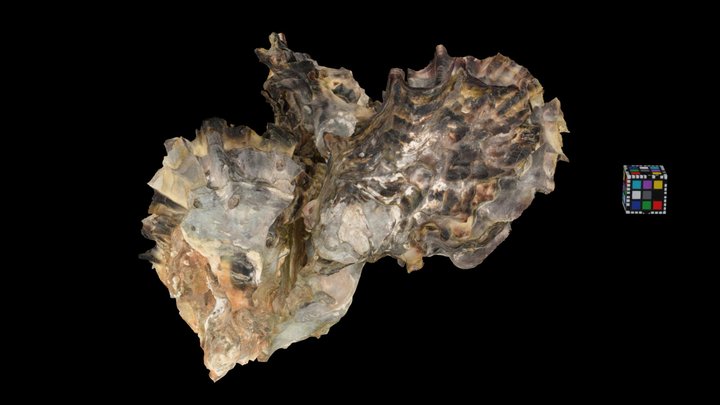
3D model
- Source
- Sketchfab
- Licence
- CC0 Public Domain
- Commercial use
- the licence allows it
Smithsonian Open Access and MorphoSource were not reached for this taxon, so this list is what the others held rather than everything there is.
The description on this site
- Licence
- CC BY-SA 4.0
This is what the site found, which is not the same as what exists.
Keep going
What may have been alongside itCrassostrea through timeFormations of the PleistoceneThe world it lived on
Occurrence data from the Paleobiology Database, CC BY 4.0. (Thunberg 1793)