Conodonta
Conodonts are an extinct group of marine jawless vertebrates belonging to the class Conodonta. They are primarily known from their hard, mineralised tooth-like structures called "conodont elements" that in life were present in the oral cavity and used to process food. Rare soft tissue remains suggest that they had elongate eel-like bodies with large eyes. Conodonts were a long-lasting group with over 300 million years of existence from the Cambrian to the beginning of the Jurassic. Conodont elements are highly distinctive to particular species and are widely used in biostratigraphy as indicative of particular periods of geological time.

Rexroad, Carl Buckner, 1925- · No restrictions · via Wikipedia/Commons. May be a photograph of a specimen, or an artist’s reconstruction — an interpretation of a skeleton, since colour and soft tissue are almost never preserved.
On record
Recorded, not inferred- Also called
- conodontPBDB
- Sits inside
- ConodontophoridaPBDB
- Diet
- carnivorePBDB
- Life habit
- nektonicPBDB
- Motility
- actively mobilePBDB
- Vision
- well-developedPBDB
Time the record covers
At least 326 million years on record.
The record covers at least 525.5 Mya to 199.5 Mya. No occurrence read is dated outside 538.8 Mya to 184.2 Mya.
12,000+ occurrences of Conodonta on record. Bar height is expected occurrences, not a count: each fossil is spread across the span it is dated to, so a tall narrow bar means tight dating and a low wide one means loose.
When
12,000 occurrences read- Cambrian2%
- Ordovician21%
- Silurian13%
- Devonian42%
- Carboniferous7%
- Permian1%
- Early Triassic3%
- Middle Triassic4%
- Late Triassic6%
- Early Jurassicunder 1%
These are dates about fossils, not the animal: the record can only begin after it arose and end before it died out, so either end may reach further. Shares are expected occurrences: a fossil dated to a span is counted partly in each period it straddles. The read hit its cap, so every figure above is a floor and the shares are of the occurrences read. More on what this infers.
Found in
at least 544 formations
- Comabella Formation512
- Wuzhishan Formation507
- Rauchkofel Formation483
- Gun River Formation385
- Becscie Formation370
- Hohe Warte Formation249
Loading coastlines…
The named rock units Conodonta has been recovered from, largest first. Drawn where the rock is now, not where it formed. The read hit its cap, so each count is a floor. 520 further formations hold fewer occurrences each and are not listed. 1,840 occurrences have no formation on record, which is common for older literature.
Found in the same rock
903 taxa- Panderodus unicostatus68 sites
- Wurmiella excavata48 sites
- Polygnathus41 sites
- Ozarkodina35 sites
- Pseudooneotodus bicornis35 sites
- Belodella34 sites
- Oulodus29 sites
- Pelekysgnathus26 sites
- Ozarkodina sagitta25 sites
- Walliserodus sancticlairi23 sites
- Warrenella23 sites
- Palmatolepis22 sites
- Panderodus21 sites
- Icriodus18 sites
- Oulodus equirectus17 sites
- Rugosa17 sites
- Tortodus14 sites
- Brachiopoda13 sites
- Nicollidina remscheidensis13 sites
- Ozarkodina confluens13 sites
- Polygnathus costatus13 sites
- Wurmiella polinclinata12 sites
- Carniodus carnulus11 sites
- Conodontophorida11 sites
The Paleobiology Database records at least 469 sites for Conodonta, and this reads 240 of them. The number is how many of those sites it was catalogued from too. The 24 sharing the most are listed.
This is not a list of everything alive at the time. It is only what has come out of the same ground as this animal and been written down.
Entered from
at least 450 references- The Lali Section: An Excellent Reference Section for Upper Devonian in South China921
- Conodont Stratigraphy, Facies-Related Distribution Patterns and Stable Isotopes (Carbon and Oxygen)of the Uppermost Silurian to Lower Devonian Seewarte Section(Carnic Alps, Carinthia, Austria)784
- A New Llandovery (Early Silurian) Conodont Biozonation and Conodonts from the Becscie,Merrimack, and Gun River Formations, Anticosti Island, Québec755
- Biostratigraphy of the Yangtze Gorge Area. Part (2) Early Paleozoic Era298
- Conodont biostratigraphy of shallow marine Givetian deposits from the Radom-Lublin area, SE Poland289
- Givetian and early Frasnian conodonts from the Compte section (Middle–Upper Devonian, Spanish Central Pyrenees)280
- Eifelian (Middle Devonian) to lower Frasnian (Upper Devonian) conodont biostratigraphy in the Villech section, Spanish Central Pyrenees232
- Distribution comparée de Conodontes et Goniatites dévoniens des plaines du Dra, du Ma'der et du Tafilalt219
- Conodont biostratigraphy of the upper part of the Clinton Group and the Lockport Group (Silurian) in the Niagara Gorge region, New York and Ontario205
- Devonian Transgressive-Regressive Cycles and Biostratigraphy, Northern Antelope Range, Nevada: Establishment of Reference Horizons for Global Cycles200
- Late Ordovician - Early Silurian conodont biostratigraphy of the Gaspé Peninsula - a preliminary report180
- Late Emsian to early Givetian Conodont succession in the Tiflet area (north-western Meseta, Central Morocco)171
Each of the 12,000 occurrences read was entered from one of these publications, ordered by how many each accounts for. This is not a search for papers mentioning the name. That read hit its cap, so each count is a floor. 438 further references are not listed. Entries link to doi.org where the Paleobiology Database holds an identifier, and to its own record where it does not. Relayed as the Paleobiology Database holds them, not checked against what they resolve to.
Media and terms
Media content2

Picture of Conodonta
- Source
- Wikipedia/Commons
- Credit
- Rexroad, Carl Buckner, 1925-
- Licence
- No restrictions
- Commercial use
- cannot be read from the licence given — check the record
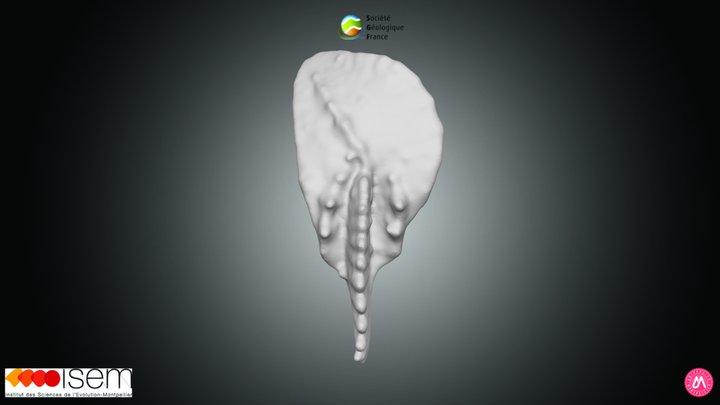
3D model
- Source
- Sketchfab
- Licence
- CC Attribution-NonCommercial-ShareAlike
- Commercial use
- the licence does not allow it
The description on this site
- Source
- Wikipedia, “Conodont”
- Licence
- CC BY-SA 4.0
This is what the site found, which is not the same as what exists.
Keep going
What may have been alongside itConodontophorida through timeThe world it lived on
Occurrence data from the Paleobiology Database, CC BY 4.0. (Pander 1856)