Cladium
Cladium is a genus of large sedges, with a nearly worldwide distribution in tropical and temperate regions. These are plants characterized by long, narrow (grass-like) leaves having sharp, often serrated (sawtooth-like) margins, and flowering stems 1–3 m tall bearing a much-branched inflorescence. Like many plants found in wet habitats, it has deeply buried rhizomes that can produce tall shoots with dense canopies.

Kristian Peters -- Fabelfroh 15:47, 20 October 2006 (UTC) · CC BY-SA 3.0 · via Wikipedia/Commons. May be a photograph of a specimen, or an artist’s reconstruction — an interpretation of a skeleton, since colour and soft tissue are almost never preserved.
On record
Recorded, not inferred- Sits inside
- CyperaceaePBDB
- Diet
- "photoautotroph"PBDB, for Angiospermae
Time the record covers
At least 22 million years on record.
The record covers at least 23.04 Mya to 129 ka. No occurrence read is dated outside 66 Mya to 0 Mya.
52 occurrences of Cladium on record, most of them in the Miocene. The Paleobiology Database records this as a living group. Bar height is expected occurrences, not a count: each fossil is spread across the span it is dated to, so a tall narrow bar means tight dating and a low wide one means loose.
When
52 occurrencesThese are dates about fossils, not the animal: the record can only begin after it arose and end before it died out, so either end may reach further. Shares are expected occurrences: a fossil dated to a span is counted partly in each period it straddles. More on what this infers.
Found in
2 formations
Loading coastlines…
The named rock units Cladium has been recovered from, largest first. Drawn where the rock is now, not where it formed. 48 occurrences have no formation on record, which is common for older literature.
Cladium and its relatives
MioceneWhere Cladium and its relatives were recorded in the Miocene.
Found in the same rock
280 taxa- Chenopodiaceae12 sites
- Cyperaceae12 sites
- Poaceae12 sites
- Acacia11 sites
- Agathis11 sites
- Araucaria11 sites
- Argyrodendron11 sites
- Dacrydium11 sites
- Dodonaea11 sites
- Elaeocarpus11 sites
- Eucalyptus11 sites
- Helicia11 sites
- Leptospermum11 sites
- Macaranga11 sites
- Machaerina11 sites
- Mallotus11 sites
- Monolete11 sites
- Podocarpus11 sites
- Proteaceae11 sites
- Rapanea11 sites
- Rutaceae11 sites
- Sapindaceae11 sites
- Trema11 sites
- Urticaceae11 sites
The Paleobiology Database records 14 sites for Cladium, and this reads all of them. The number is how many of those sites it was catalogued from too. The 24 sharing the most are listed.
This is not a list of everything alive at the time. It is only what has come out of the same ground as this animal and been written down.
Entered from
13 references- Tretichnye Flory Zapadnoi Sibiri14
- Die mittelmiozaenen und obermiozaenen Floren aus der Meuroer und Raunoer Folge in der Lausitz. III. Fundstellen und Palaeobiologie7
- A complete pollen record of the last 230 ka from Lynch's Crater, north-eastern Australia6
- A Late Pleistocene and Holocene pollen diagram from Lynch’s Crater, northeastern Queensland, Australia5
- Miocene floras in the lower Rhenish basin and their ecological interpretation4
- Allochthonous seed and fruit floras from the Pliocene of the Lower Rhine Basin4
- The Damgaard flora: A new Middle Miocene flora from Denmark3
- Die oberoligozanen Floren am Nordrand der Sachsischen Lausitz2
- Kleinsäugerstratigraphie in der miozänen Hörnlischüttung (Ostschweiz); (Biostratigraphy of small mammals in the Hörnlischüttung of Miocene age (East Switzerland))2
- Die pliozaenen Floren von Thueringen, Deutsche Demokratische Republik2
- Pharyngeal Teeth, Lateral Ethmoids, and Jaw Teeth of Fishes and Additional Fossils From the Late Miocene (Late Khersonian / Early Maeotian) of Eastern Paratethys (Yalova, Near Istanbul, Turkey)1
- Palaeocarpological investigations in the Villafranchian (Pliocene) of Italy1
Each of the 52 occurrences read was entered from one of these publications, ordered by how many each accounts for. This is not a search for papers mentioning the name. 1 further reference is not listed. Entries link to doi.org where the Paleobiology Database holds an identifier, and to its own record where it does not. Relayed as the Paleobiology Database holds them, not checked against what they resolve to.
Media and terms
Media content1
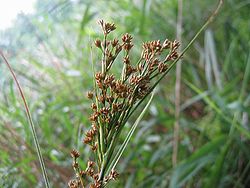
Picture of Cladium
- Source
- Wikipedia/Commons
- Credit
- Kristian Peters -- Fabelfroh 15:47, 20 October 2006 (UTC)
- Licence
- CC BY-SA 3.0
- Commercial use
- the licence allows it
No 3D scan of Cladium was found in Sketchfab.
Smithsonian Open Access and MorphoSource were not reached for this taxon, so this list is what the others held rather than everything there is.
The description on this site
- Source
- Wikipedia, “Cladium”
- Licence
- CC BY-SA 4.0
This is what the site found, which is not the same as what exists.
Keep going
What may have been alongside itCyperaceae through timeFormations of the MioceneThe world it lived on
Occurrence data from the Paleobiology Database, CC BY 4.0. Browne