Charonia
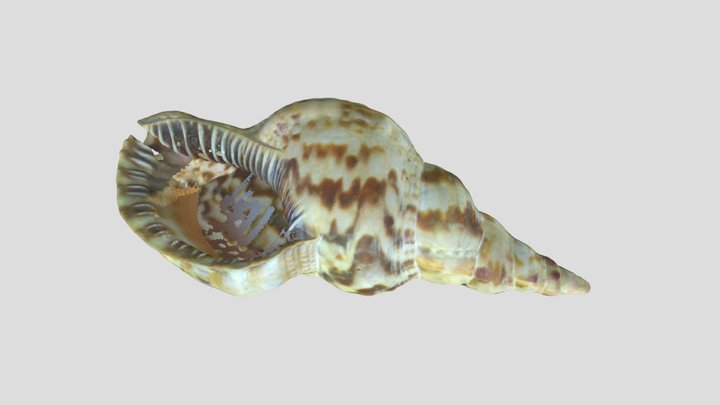
Charonia is a genus of very large sea snail, commonly known as Triton's trumpet or Triton snail. They are marine gastropod mollusks in the monotypic family Charoniidae. They are one of the few natural predators of the crown-of-thorns starfish.

Retama · GPL · via Wikipedia/Commons. May be a photograph of a specimen, or an artist’s reconstruction — an interpretation of a skeleton, since colour and soft tissue are almost never preserved.
On record
Recorded, not inferred- Also called
- tritonPBDB
- Sits inside
- CymatiinaePBDB
- Diet
- carnivorePBDB
- Life habit
- epifaunalPBDB
- Motility
- actively mobilePBDB
- Vision
- limitedPBDB, for Gastropoda
- Environment
- marinePBDB
Time the record covers
At least 121 million years on record.
The record covers at least 121.4 Mya to 11.7 ka. No occurrence read is dated outside 125.77 Mya to 0 Mya.
103 occurrences of Charonia on record, most of them in the Miocene. The Paleobiology Database records this as a living group. Bar height is expected occurrences, not a count: each fossil is spread across the span it is dated to, so a tall narrow bar means tight dating and a low wide one means loose.
When
103 occurrences- Early Cretaceous2%
- Late Cretaceous15%
- Paleocene19%
- Eocene6%
- Oligocene3%
- Miocene30%
- Pliocene13%
- Pleistocene11%
- Holocene2%
These are dates about fossils, not the animal: the record can only begin after it arose and end before it died out, so either end may reach further. Shares are expected occurrences: a fossil dated to a span is counted partly in each period it straddles. More on what this infers.
Found in
39 formations
- Martinez Formation9
- Gurabo Formation9
- Dry Creek Sands Formation8
- Moin Formation · Limon Group4
- Prairie Bluff Formation3
- Ripley Formation · Selma Group3
Loading coastlines…
The named rock units Charonia has been recovered from, largest first. Drawn where the rock is now, not where it formed. 15 further formations hold fewer occurrences each and are not listed. 22 occurrences have no formation on record, which is common for older literature.
Charonia and its relatives
MioceneWhere Charonia and its relatives were recorded in the Miocene.
Found in the same rock
2,813 taxa- Turritella18 sites
- Glycymeris14 sites
- Spondylus14 sites
- Corbula12 sites
- Dentalium12 sites
- Natica12 sites
- Cerithium11 sites
- Limopsis11 sites
- Ostrea10 sites
- Cardium9 sites
- Fusus9 sites
- Tellina9 sites
- Anomia8 sites
- Barbatia8 sites
- Cylichna8 sites
- Diastoma8 sites
- Lima8 sites
- Panopea8 sites
- Pinna8 sites
- Teredo8 sites
- Arca7 sites
- Crassatella7 sites
- Cucullaea7 sites
- Modiolus7 sites
The Paleobiology Database records 65 sites for Charonia, and this reads all of them. The number is how many of those sites it was catalogued from too. The 24 sharing the most are listed.
This is not a list of everything alive at the time. It is only what has come out of the same ground as this animal and been written down.
Entered from
60 references- Neogene Tonnoidean Gastropods of Tropical and South America; contributions to the Dominican Republic and Panama Paleontology Projects and Uplift of the Central American Isthmus16
- The molluscan fauna of the Pliocene strata underlying the Adelaide Plains. Part V - Gastropoda (Eratoidae to Scaphandridae)8
- Fauna of the Martinez Eocene of California7
- Paleontology of the Greenhorn cylcothem (Cretaceous: late Cenomanian to middle Turonian) at Black Mesa, northeastern Arizona3
- Maastrichtian non-cephalopod mollusks: Scaphopoda, Gastropoda and Bivalvia of the Middle Vistula Valley, central Poland3
- Upper Cretaceous (Maestrichtian) Mollusca from the Haustator bilira Assemblage Zone in the East Gulf Coastal Plain3
- Mollusques Pleistocenes de la Cote Francaise des Somalis [Pleistocene molluscs from French Somaliland]3
- Die Fauna der Overwegischichten und der Blätterthone in der libyschen Wüste [The fauna of the Overwegi and Blätterthone Beds in the Libyan Desert]3
- Observations on the Eocene formations, and descriptions of one hundred and five new fossils from that period, from the vicinity of Vicksburg, Mississippi; with an appendix3
- Five shallow benthic mollusc faunas from the Upper Eocene (Baron, Priabona, Garoowe, Nanggulan, Takashima)2
- The Shiobara-type Molluscan Fauna: An ecological analysis of fossil molluscs2
- Geology of the coast ranges immediately north of the San Francisco Bay region, California2
Each of the 103 occurrences read was entered from one of these publications, ordered by how many each accounts for. This is not a search for papers mentioning the name. 48 further references are not listed. Entries link to doi.org where the Paleobiology Database holds an identifier, and to its own record where it does not. Relayed as the Paleobiology Database holds them, not checked against what they resolve to.
Media and terms
Media content3

Picture of Charonia
- Source
- Wikipedia/Commons
- Credit
- Retama
- Licence
- GPL
- Commercial use
- cannot be read from the licence given — check the record
Photogrammetry
- Source
- MorphoSource
- Licence
- In Copyright
- Commercial use
- cannot be read from the licence given — check the record
- Specimen
- Charonia femorale · UF:Invertebrate Zoology:193277-Mollusca
The description on this site
- Source
- Wikipedia, “Charonia”
- Licence
- CC BY-SA 4.0
This is what the site found, which is not the same as what exists.
Keep going
What may have been alongside itCymatiinae through timeFormations of the MioceneThe world it lived on
Occurrence data from the Paleobiology Database, CC BY 4.0. Gistel 1848