Channidae
The snakeheads are members of the freshwater perciform fish family Channidae, native to parts of Africa and Asia. These elongated, predatory fish are distinguished by their long dorsal fins, large mouths, and shiny teeth. They breathe air with gills, which allows them to migrate short distances over land. They have suprabranchial organs, which are primitive forms of labyrinth organs, that develop when they grow older. The two extant genera are Channa in Asia and Parachanna in Africa, consisting of more than 50 species.

Brian Gratwicke · CC BY 2.0 · via Wikipedia/Commons. May be a photograph of a specimen, or an artist’s reconstruction — an interpretation of a skeleton, since colour and soft tissue are almost never preserved.
On record
Recorded, not inferred- Also called
- snakeheadPBDB
- Sits inside
- ChannoideiPBDB
- Motility
- actively mobilePBDB, for Osteichthyes
Time the record covers
At least 37 million years on record.
The record covers at least 41.03 Mya to 3.6 Mya. No occurrence read is dated outside 48.07 Mya to 2.58 Mya.
16 occurrences of Channidae on record, most of them in the Miocene. The Paleobiology Database records this as a living group, and the chart stops with its fossils rather than at the present. Bar height is expected occurrences, not a count: each fossil is spread across the span it is dated to, so a tall narrow bar means tight dating and a low wide one means loose.
When
16 occurrencesThese are dates about fossils, not the animal: the record can only begin after it arose and end before it died out, so either end may reach further. Shares are expected occurrences: a fossil dated to a span is counted partly in each period it straddles. More on what this infers.
Found in
3 formations
- Upper Freshwater Molasse Formation · Molasse Group6
- Brackwater Molasse Formation · Molasse Group2
- Kuldana Formation1
Loading coastlines…
The named rock units Channidae has been recovered from, largest first. Drawn where the rock is now, not where it formed. 7 occurrences have no formation on record, which is common for older literature.
Channidae and its relatives
MioceneWhere Channidae and its relatives were recorded in the Miocene.
Found in the same rock
326 taxa- Channa10 sites
- Lacerta7 sites
- Testudo7 sites
- Ophisaurus6 sites
- Palaeocarassius6 sites
- Prolagus oeningensis6 sites
- Trionyx6 sites
- Geochelone5 sites
- Latonia gigantea5 sites
- Mauremys5 sites
- Palaeoleuciscus5 sites
- Anguidae4 sites
- Chamaeleo4 sites
- Channa elliptica4 sites
- Chelotriton4 sites
- Colubrinae4 sites
- Democricetodon mutilus4 sites
- Diplocynodon4 sites
- Diplocynodon ungeri4 sites
- Keramidomys thaleri4 sites
- Lymnaea dilatata4 sites
- Miodyromys aegercii4 sites
- Mioproteus caucasicus4 sites
- Pseudochloritis incrassata4 sites
The Paleobiology Database records 15 sites for Channidae, and this reads all of them. The number is how many of those sites it was catalogued from too. The 24 sharing the most are listed.
This is not a list of everything alive at the time. It is only what has come out of the same ground as this animal and been written down.
Entered from
10 references- Vertebrate microfossils from the Upper Freshwater Molasse in the Swiss Molasse Basin: Implications for the evolution of the North Alpine Foreland Basin during the Miocene Climate Optimum3
- Miocene vertebrates from the Siwalik Group, Western Nepal3
- Snakes from Griesbeckerzell (Langhian, Early Badenian), North Alpine Foreland Basin (Germany), with comments on the evolution of snake faunas in Central Europe during the Miocene Climatic Optimum2
- Stratigraphy and mammal faunas of the Brackwassermolasse in the surroundings of Ulm (Southwest Germany)2
- Pliocene otoliths from NW India reveal first fossil osphronemid and structure of a Himalayan freshwater ecosystem1
- Ectothermic vertebrates (Actinopterygii, Allocaudata, Urodela, Anura, Crocodylia, Squamata) from the Miocene of Sandelzhausen (Germany, Bavaria) and their implications for environment reconstruction and palaeoclimate1
- Einmal Miozän und zurück – Zeitreise am Maurerkopf bei Edelbeuren1
- Biostratigraphy and palaeoecology of a Middle Miocene (Karpathian, MN 5) fauna from the northern margin of the North Alpine Foreland Basin (Oggenhausen 2, SW' Germany)1
- Biostratigraphy and sedimentology of the Fluviatile Untere Serie (Early and Middle Miocene) in the central part of the North Alpine Foreland Basin: implications for palaeoenvironment and climate1
- Eocene actinopterygian fishes from Pakistan, with a description of a new genus and species of channid (Channiformes)1
Each of the 16 occurrences read was entered from one of these publications, ordered by how many each accounts for. This is not a search for papers mentioning the name. Entries link to doi.org where the Paleobiology Database holds an identifier, and to its own record where it does not. Relayed as the Paleobiology Database holds them, not checked against what they resolve to.
Media and terms
Media content1
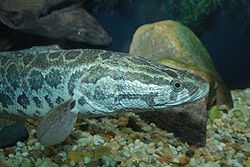
Picture of Channidae
- Source
- Wikipedia/Commons
- Credit
- Brian Gratwicke
- Licence
- CC BY 2.0
- Commercial use
- the licence allows it
No 3D scan of Channidae was found in MorphoSource and Sketchfab.
Smithsonian Open Access was not reached for this taxon, so this list is what the others held rather than everything there is.
The description on this site
- Licence
- CC BY-SA 4.0
This is what the site found, which is not the same as what exists.
Keep going
What may have been alongside itChannoidei through timeFormations of the MioceneThe world it lived on
Occurrence data from the Paleobiology Database, CC BY 4.0. Berg 1940