Callopterus
Ainia is an extinct genus of prehistoric ray-finned fish that lived during the Kimmeridgian stage of the Late Jurassic epoch. It contains a single species, A. armata, known from the famous Solnhofen Limestone of Germany. It is a distant relative of the bowfin, although it is more closely related to genera such as Caturus and Osteorachis.

Ghedoghedo · CC BY-SA 3.0 · via Wikipedia/Commons. May be a photograph of a specimen, or an artist’s reconstruction — an interpretation of a skeleton, since colour and soft tissue are almost never preserved.
On record
Recorded, not inferred- Sits inside
- FuridaePBDB
- Motility
- actively mobilePBDB, for Osteichthyes
Time the record covers
At least 23 million years on record.
The record covers at least 149.2 Mya to 125.77 Mya. No occurrence read is dated outside 152.21 Mya to 119.57 Mya.
3 occurrences of Callopterus on record, most of them in the Early Cretaceous. Bar height is expected occurrences, not a count: each fossil is spread across the span it is dated to, so a tall narrow bar means tight dating and a low wide one means loose.
When
3 occurrencesThese are dates about fossils, not the animal: the record can only begin after it arose and end before it died out, so either end may reach further. Shares are expected occurrences: a fossil dated to a span is counted partly in each period it straddles. More on what this infers.
Found in
2 formations
- Bückeberg Formation1
- Sainte-Barbe Clays Formation · Wealden Group1
Loading coastlines…
The named rock units Callopterus has been recovered from, largest first. Drawn where the rock is now, not where it formed. 1 occurrence has no formation on record, which is common for older literature.
Callopterus and its relatives
Early CretaceousWhere Callopterus and its relatives were recorded in the Early Cretaceous.
Found in the same rock
77 taxa- Caturus2 sites
- Crocodylia2 sites
- Lepidotes2 sites
- Theropoda2 sites
- Adiantites1 site
- Aethalion robustus1 site
- Algites1 site
- Amiopsis dolloi1 site
- Anteophthalmosuchus epikrator1 site
- Anteophthalmosuchus hooleyi1 site
- Ascarites gerus1 site
- Ascarites priscus1 site
- Belonostomus1 site
- Bernissartia fagesii1 site
- Brancasaurus brancai1 site
- Cassiopidae1 site
- Chitracephalus dumonii1 site
- Cladophlebis ungeri1 site
- Coccolepis macropterus1 site
- Coelodus1 site
- Conites1 site
- Corbula1 site
- Cyrena1 site
- Desmemys1 site
The Paleobiology Database records 2 sites for Callopterus, and this reads all of them. The number is how many of those sites it was catalogued from too. The 24 sharing the most are listed.
This is not a list of everything alive at the time. It is only what has come out of the same ground as this animal and been written down.
Entered from
3 references- The forgotten remains of a leptocleidid plesiosaur (Sauropterygia: Plesiosauroidea) from the Early Cretaceous of Gronau (Münsterland, Westphalia, Germany)1
- The Wattendorf Plattenkalk (Upper Kimmeridgian) - a new conservation lagerstätte from the northern Franconian Alb, southern Germany1
- Les poissons wealdiens de Bernissart.1
Each of the 3 occurrences read was entered from one of these publications, ordered by how many each accounts for. This is not a search for papers mentioning the name. Entries link to doi.org where the Paleobiology Database holds an identifier, and to its own record where it does not. Relayed as the Paleobiology Database holds them, not checked against what they resolve to.
Media and terms
Media content2
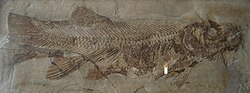
Picture of Callopterus
- Source
- Wikipedia/Commons
- Credit
- Ghedoghedo
- Licence
- CC BY-SA 3.0
- Commercial use
- the licence allows it
CT scan
- Source
- MorphoSource
- Licence
- In Copyright
- Commercial use
- cannot be read from the licence given — check the record
- Specimen
- Cypselurus callopterus · OS:Fishes:3400
The description on this site
- Licence
- CC BY-SA 4.0
This is what the site found, which is not the same as what exists.
Keep going
What may have been alongside itFuridae through timeFormations of the Early CretaceousThe world it lived on
Occurrence data from the Paleobiology Database, CC BY 4.0. Thollière 1854