Cacatua
Cacatua is a subgenus of the white cockatoos. They are found in wooded habitats from Wallacea east to the Bismarck Archipelago and south to Australia. With the exception of the yellow-crested cockatoo, all are relatively large cockatoos with a total length of 45–55 cm (18–22 in). Their plumage is mainly white, and the underwing and -tail have a yellowish tinge. Their crest is expressive and brightly coloured in most species. Unlike the members of the subgenus Licmetis, the members of the subgenus Cacatua have a black bill.

Cacatua_galerita_-perching_on_branch_-crest-8a.jpg : Duncan Rawlinson This image is a derivative work cropped from th… · CC BY 2.0 · via Wikipedia/Commons. May be a photograph of a specimen, or an artist’s reconstruction — an interpretation of a skeleton, since colour and soft tissue are almost never preserved.
On record
Recorded, not inferred- Sits inside
- CacatuidaePBDB
- Diet
- carnivorePBDB, for Coelurosauria
- Life habit
- ground dwelling, solitaryPBDB, for Theropoda
- Motility
- actively mobilePBDB, for Theropoda
- Environment
- terrestrialPBDB, for Theropoda
Time the record covers
At most 129 thousand years on record.
Every occurrence read is dated to somewhere between 129 ka and 0 Mya, and nothing in the dating separates them, so that window is what the record shows rather than a span.
3 occurrences of Cacatua on record, most of them in the Pleistocene. The Paleobiology Database records this as a living group. Bar height is expected occurrences, not a count: each fossil is spread across the span it is dated to, so a tall narrow bar means tight dating and a low wide one means loose.
When
3 occurrences- Pleistocene64%
- Holocene36%
These are dates about fossils, not the animal: the record can only begin after it arose and end before it died out, so either end may reach further. Shares are expected occurrences: a fossil dated to a span is counted partly in each period it straddles. More on what this infers.
Cacatua and its relatives
PleistoceneWhere Cacatua and its relatives were recorded in the Pleistocene.
Found in the same rock
72 taxa- Corvus3 sites
- Dasyornis broadbenti2 sites
- Gallirallus philippensis2 sites
- Hirundinidae2 sites
- Passeriformes2 sites
- Phaps chalcoptera2 sites
- Tribonyx mortierii2 sites
- Accipiter1 site
- Accipiter fasciatus1 site
- Accipiter novaehollandiae1 site
- Accipitridae1 site
- Alcedo atthis1 site
- Alopecoenas beccarii1 site
- Amaurornis olivacea1 site
- Anatidae1 site
- Anthochaera carunculata1 site
- Anthochaera chrysoptera1 site
- Aves1 site
- Cacatuidae1 site
- Callocephalon fimbriatum1 site
- Caloenas nicobarica1 site
- Calyptorhynchus banksii1 site
- Calyptorhynchus lathami1 site
- Centropus1 site
The Paleobiology Database records 3 sites for Cacatua, and this reads all of them. The number is how many of those sites it was catalogued from too. The 24 sharing the most are listed.
This is not a list of everything alive at the time. It is only what has come out of the same ground as this animal and been written down.
Entered from
3 references- Prehistoric birds from New Ireland, Papua New Guinea: extinctions on a large Melanesian island1
- Fossil avian assemblage of Pitfall Origin from Holocene sediments in Amphitheatre Cave (G-2), South-western Victoria, Australia1
- Avian fossils from Quaternary deposits in 'Green Waterhole Cave', south-eastern South Australia1
Each of the 3 occurrences read was entered from one of these publications, ordered by how many each accounts for. This is not a search for papers mentioning the name. Each entry links to doi.org. Relayed as the Paleobiology Database holds them, not checked against what they resolve to.
Media and terms
Media content2
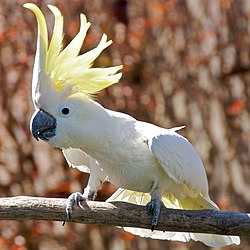
Picture of Cacatua
- Source
- Wikipedia/Commons
- Credit
- Cacatua_galerita_-perching_on_branch_-crest-8a.jpg : Duncan Rawlinson This image is a derivative work cropped from th…
- Licence
- CC BY 2.0
- Commercial use
- the licence allows it
CT scan
- Source
- MorphoSource
- Licence
- not stated by the source
- Commercial use
- cannot be read from the licence given — check the record
- Specimen
- Cacatua tenuirostris · SAMA:Ornithology:B31140
Smithsonian Open Access was not reached for this taxon, so this list is what the others held rather than everything there is.
The description on this site
- Licence
- CC BY-SA 4.0
This is what the site found, which is not the same as what exists.
Keep going
What may have been alongside itCacatuidae through timeFormations of the PleistoceneThe world it lived on
Occurrence data from the Paleobiology Database, CC BY 4.0. Vieillot 1817