Byrrhidae
Byrrhidae, the pill beetles, is a family of beetles in the superfamily Byrrhoidea. They are generally found in damp habitats within cooler-high latitude regions of both hemispheres. Most byrrhids feed on moss, lichens and algae, though some species feed on vascular plants. The oldest undoubted record of the family is Lidryops from the earliest Late Cretaceous Charentese amber of France, with other less certain records going back to the Middle Jurassic, but these possibly belong to Byrrhoidea. There around 500 extant species in 40 genera.

AfroBrazilian · CC BY-SA 4.0 · via Wikipedia/Commons. May be a photograph of a specimen, or an artist’s reconstruction — an interpretation of a skeleton, since colour and soft tissue are almost never preserved.
On record
Recorded, not inferred- Also called
- pill beetlePBDB
- Sits inside
- ByrrhoideaPBDB
- Motility
- actively mobilePBDB, for Arthropoda
- Environment
- terrestrialPBDB, for Insecta
Time the record covers
At least 199 million years on record.
The record covers at least 199.5 Mya to 11.7 ka. No occurrence read is dated outside 201.4 Mya to 0 Mya.
182 occurrences of Byrrhidae on record, most of them in the Pleistocene. The Paleobiology Database records this as a living group. Bar height is expected occurrences, not a count: each fossil is spread across the span it is dated to, so a tall narrow bar means tight dating and a low wide one means loose.
When
182 occurrences- Early Jurassic1%
- Late Jurassic1%
- Early Cretaceous4%
- Eocene8%
- Oligocene1%
- Miocene3%
- Pleistocene75%
- Holocene7%
These are dates about fossils, not the animal: the record can only begin after it arose and end before it died out, so either end may reach further. Shares are expected occurrences: a fossil dated to a span is counted partly in each period it straddles. More on what this infers.
Found in
19 formations
- Kap København Formation15
- Florissant Formation12
- Keremesit Formation12
- Edoma Formation11
- Highbury Silts and Sands Formation10
- Titusville Till Formation7
Loading coastlines…
The named rock units Byrrhidae has been recovered from, largest first. Drawn where the rock is now, not where it formed. 84 occurrences have no formation on record, which is common for older literature.
Byrrhidae and its relatives
PleistoceneWhere Byrrhidae and its relatives were recorded in the Pleistocene.
Found in the same rock
2,618 taxa- Morychus viridis48 sites
- Pterostichus (Cryobius)47 sites
- Aphodius44 sites
- Phyllobius42 sites
- Curtonotus alpinus40 sites
- Bembidion37 sites
- Stenus36 sites
- Stephanocleonus eruditus34 sites
- Poecilus nearcticus33 sites
- Aleocharinae31 sites
- Chrysolina rufilabris24 sites
- Hypera ornata24 sites
- Cholevinus sibiricus21 sites
- Helophorus20 sites
- Stephanocleonus foveifrons20 sites
- Bledius18 sites
- Coniocleonus ferrugineus17 sites
- Troglocollops arcticus17 sites
- Lepyrus nordenskioldi16 sites
- Stephanocleonus fossulatus15 sites
- Dyschirius14 sites
- Hydroporus14 sites
- Tachinus arcticus14 sites
- Chrysolina subsulcata13 sites
The Paleobiology Database records 123 sites for Byrrhidae, and this reads all of them. The number is how many of those sites it was catalogued from too. The 24 sharing the most are listed.
This is not a list of everything alive at the time. It is only what has come out of the same ground as this animal and been written down.
Entered from
31 references- Late Cenozoic insects of northern Eurasia59
- Pill beetles (Coleoptera, Byrrhidae) in late Pleistocene deposits in the south of the west Siberia20
- Palaeoentomology of the Kap København Formation, a Plio-Pleistocene sequence in Peary Land, North Greenland15
- Marine Isotope Stage 9 environments of fluvial deposits at Hackney, north London, UK10
- Palaeoenvironmental interpretation of Middle and Late Wisconsinan fossil coleopteran assemblages from western Olympic Peninsula, Washington, USA9
- A Late Pleistocene fauna and flora from Upton Warren, Worcestershire8
- Fossil Beetle Evidence for a Short Warm Interval near 40,000 yr B.P. at Titusville, Pennsylvania7
- The paleoenvironment of the Olympia beds based on fossil beetles from Discovery Park, Seattle, Washington, U.S.A.6
- Adephagous and clavicorn Coleoptera from the Tertiary deposits at Florissant, Colorado with descriptions of a few other forms and a systematic list of the non-rhynchophorus Tertiary Coleoptera of North America6
- Environmental interpretation of fossil insect assemblages from MIS 5 at Ziegler Reservoir, Snowmass Village, Colorado4
- Beetles, Scarabaeida, in Pozdne-Mezozoyskie Nasekomye Vostochnogo Zabaykal'ya4
- Pre-Vashon fossil Coleoptera of Fraser age from the Fraser Lowland, British Columbia4
Each of the 182 occurrences read was entered from one of these publications, ordered by how many each accounts for. This is not a search for papers mentioning the name. 19 further references are not listed. Entries link to doi.org where the Paleobiology Database holds an identifier, and to its own record where it does not. Relayed as the Paleobiology Database holds them, not checked against what they resolve to.
Media and terms
Media content1
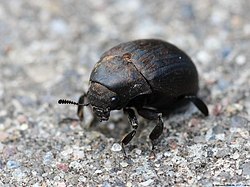
Picture of Byrrhidae
- Source
- Wikipedia/Commons
- Credit
- AfroBrazilian
- Licence
- CC BY-SA 4.0
- Commercial use
- the licence allows it
No 3D scan of Byrrhidae was found in MorphoSource and Sketchfab.
Smithsonian Open Access was not reached for this taxon, so this list is what the others held rather than everything there is.
The description on this site
- Source
- Wikipedia, “Byrrhidae”
- Licence
- CC BY-SA 4.0
This is what the site found, which is not the same as what exists.
Keep going
What may have been alongside itByrrhoidea through timeFormations of the PleistoceneThe world it lived on
Occurrence data from the Paleobiology Database, CC BY 4.0. Latreille 1804