Bischofia javanica
Bischofia javanica, or bishop wood, is a plant species of the family Phyllanthaceae. It and the related Bischofia polycarpa are the only two members of genus Bischofia and tribe Bischofieae. These species are distributed throughout southern and southeast Asia to Australia and Polynesia also in North America. The tree is commonly used by tigers to scratch-mark territory in the jungles of Assam where it is locally called uriam. They also occur in southwestern, central, eastern, and southern China, and also Taiwan, where the indigenous people consider it a sacred tree.

Geographer · CC BY-SA 3.0 · via Wikipedia/Commons. May be a photograph of a specimen, or an artist’s reconstruction — an interpretation of a skeleton, since colour and soft tissue are almost never preserved.
On record
Recorded, not inferred- Sits inside
- BischofiaPBDB
- Diet
- "photoautotroph"PBDB, for Angiospermae
Time the record covers
At most 24 million years on record.
Every occurrence read is dated to somewhere between 23.04 Mya and 0 Mya, and nothing in the dating separates them, so that window is what the record shows rather than a span.
2 occurrences of Bischofia javanica on record, most of them in the Pleistocene. The Paleobiology Database records this as a living group. Bar height is expected occurrences, not a count: each fossil is spread across the span it is dated to, so a tall narrow bar means tight dating and a low wide one means loose.
When
2 occurrences- Miocene44%
- Pliocene7%
- Pleistocene50%
These are dates about fossils, not the animal: the record can only begin after it arose and end before it died out, so either end may reach further. Shares are expected occurrences: a fossil dated to a span is counted partly in each period it straddles. More on what this infers.
Bischofia javanica and its relatives
PleistoceneWhere Bischofia javanica and its relatives were recorded in the Pleistocene.
Found in the same rock
70 taxa- Fabaceae2 sites
- Adhatoda1 site
- Albizia1 site
- Alnus1 site
- Anacardiaceae1 site
- Apiaceae1 site
- Apocynaceae1 site
- Artemisia1 site
- Asteraceae1 site
- Baliospermum1 site
- Bombacaceae1 site
- Brassicaceae1 site
- Caesalpinaceae1 site
- Calamus tenuis1 site
- Caryophyllaceae1 site
- Celastraceae1 site
- Combretaceae1 site
- Cyperaceae1 site
- Elaeagnaceae1 site
- Engelhardia1 site
- Eranthemum1 site
- Euodia1 site
- Euphorbia1 site
- Euphorbiaceae1 site
The Paleobiology Database records 2 sites for Bischofia javanica, and this reads all of them. The number is how many of those sites it was catalogued from too. The 24 sharing the most are listed.
This is not a list of everything alive at the time. It is only what has come out of the same ground as this animal and been written down.
Entered from
2 references- A catalogue of Cenozoic megafossil plants in China1
- A Catalogue of Fossil Plants from India Part 6: Cenozoic (Quaternary) Palynology and Palaeobotany1
Each of the 2 occurrences read was entered from one of these publications, ordered by how many each accounts for. This is not a search for papers mentioning the name. Each entry links to the Paleobiology Database's own record for the work.
Media and terms
Media content1
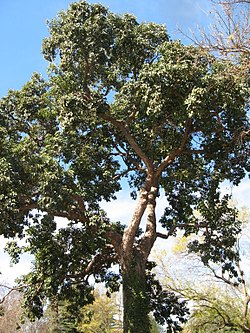
Picture of Bischofia javanica
- Source
- Wikipedia/Commons
- Credit
- Geographer
- Licence
- CC BY-SA 3.0
- Commercial use
- the licence allows it
No 3D scan of Bischofia javanica was found in MorphoSource and Sketchfab.
Smithsonian Open Access was not reached for this taxon, so this list is what the others held rather than everything there is.
The description on this site
- Licence
- CC BY-SA 4.0
This is what the site found, which is not the same as what exists.
Keep going
What may have been alongside itBischofia through timeFormations of the PleistoceneThe world it lived on
Occurrence data from the Paleobiology Database, CC BY 4.0. Blume 1827