Axestemys
Axestemys is an extinct genus of softshell turtle that lived from the Late Cretaceous to the Eocene in western North America and Europe.

NPS · Public Domain · via Wikipedia/Commons. May be a photograph of a specimen, or an artist’s reconstruction — an interpretation of a skeleton, since colour and soft tissue are almost never preserved.
On record
Recorded, not inferred- Sits inside
- TrionychinaePBDB
- Diet
- piscivore, carnivorePBDB, for Trionychidae
- Life habit
- aquatic, solitaryPBDB, for Trionychidae
- Motility
- actively mobilePBDB, for Trionychidae
- Environment
- brackish,freshwaterPBDB, for Trionychidae
Time the record covers
At least 49 million years on record.
The record covers at least 72.2 Mya to 23.04 Mya. No occurrence read is dated outside 83.6 Mya to 20.45 Mya.
65 occurrences of Axestemys on record, most of them in the Late Cretaceous. The Paleobiology Database records this as a living group, and the chart stops with its fossils rather than at the present. Bar height is expected occurrences, not a count: each fossil is spread across the span it is dated to, so a tall narrow bar means tight dating and a low wide one means loose.
When
65 occurrences- Late Cretaceous34%
- Paleocene31%
- Eocene34%
- Miocene2%
These are dates about fossils, not the animal: the record can only begin after it arose and end before it died out, so either end may reach further. Shares are expected occurrences: a fossil dated to a span is counted partly in each period it straddles. More on what this infers.
Found in
17 formations
- Denver Formation14
- Hell Creek Formation · Montana Group9
- Tienen Formation · Landen Group6
- Judith River Formation · Montana Group4
- Bridger Formation2
- Willwood Formation2
Loading coastlines…
The named rock units Axestemys has been recovered from, largest first. Drawn where the rock is now, not where it formed. 14 occurrences have no formation on record, which is common for older literature.
Axestemys and its relatives
Late CretaceousWhere Axestemys and its relatives were recorded in the Late Cretaceous.
Found in the same rock
424 taxa- Allaeochelys7 sites
- Neochelys eocaenica7 sites
- Trionyx7 sites
- Asiatosuchus depressifrons6 sites
- Baenidae6 sites
- Trionychidae6 sites
- Calamagras gallicus5 sites
- Diacodexis varleti5 sites
- Dunnophis matronensis5 sites
- Tinosaurus europeocaenus5 sites
- Arcius lapparenti4 sites
- Champsosaurus4 sites
- Eolacerta4 sites
- Geiseltaliellus longicaudus4 sites
- Theropoda4 sites
- Amiidae3 sites
- Anguini3 sites
- Apatemys sigogneaui3 sites
- Arcius fuscus3 sites
- Aspideretoides foveatus3 sites
- Crocodylia3 sites
- Eurodexis russelli3 sites
- Gilmoremys lancensis3 sites
- Helodermatidae3 sites
The Paleobiology Database records 63 sites for Axestemys, and this reads all of them. The number is how many of those sites it was catalogued from too. The 24 sharing the most are listed.
This is not a list of everything alive at the time. It is only what has come out of the same ground as this animal and been written down.
Entered from
21 references- Exceptional continental record of biotic recovery after the Cretaceous–Paleogene mass extinction14
- Contribution a l'etude des Cheloniens. Cheloniens continentaux due Cretace et du Tertiare de France12
- A new species of trionychid turtle, Axestemys infernalis sp. nov., from the Late Cretaceous (Maastrichtian) Hell Creek and Lance formations of the Northern Great Plains, USA9
- Giant fossil soft-shelled turtles of North America6
- Systematics and taxonomy of soft-shelled turtles (Family Trionychidae) from the Judith River Group (mid-Campanian) of North America5
- Systematics and diversity of the giant soft-shelled turtles (Cryptodira, Trionychidae) from the earliest Eocene of Belgium2
- The trionychid turtle Axestemys montinsana from the Paleocene Nacimiento Formation, San Juan Basin, New Mexico2
- The fossil vertebrates of Belgium2
- Filling the Bearpaw gap: evidence for palaeoenvironment-driven taxon distribution in a diverse, non-marine ecosystem from the late Campanian of west-central Alberta, Canada1
- The paleontology, geology and taphonomy of the Tooth Draw Deposit; Hell Creek Formation (Maastrictian), Butte County, South Dakota1
- The furculae of the dromaeosaurid dinosaur Dakotaraptor steini are trionychid turtle entoplastra1
- New cranial material of Gilmoremys lancensis (Testudines, Trionychidae) from the Hell Creek Formation of southeastern Montana, U.S.A1
Each of the 65 occurrences read was entered from one of these publications, ordered by how many each accounts for. This is not a search for papers mentioning the name. 9 further references are not listed. Entries link to doi.org where the Paleobiology Database holds an identifier, and to its own record where it does not. Relayed as the Paleobiology Database holds them, not checked against what they resolve to.
Media and terms
Media content2
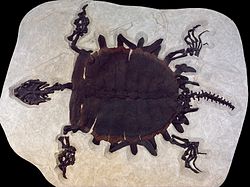
Picture of Axestemys
- Source
- Wikipedia/Commons
- Credit
- NPS
- Licence
- Public Domain
- Commercial use
- the licence allows it
Structured light scan
- Source
- MorphoSource
- Licence
- In Copyright
- Commercial use
- cannot be read from the licence given — check the record
- Specimen
- Axestemys infernalis · ypm:vp:3755
The description on this site
- Source
- Wikipedia, “Axestemys”
- Licence
- CC BY-SA 4.0
This is what the site found, which is not the same as what exists.
Keep going
What may have been alongside itTrionychinae through timeFormations of the Late CretaceousThe world it lived on
Occurrence data from the Paleobiology Database, CC BY 4.0. (Hay 1899)