Aptyxiella

via iDigBio · CC BY-NC-ND · via iDigBio. May be a photograph of a specimen, or an artist’s reconstruction — an interpretation of a skeleton, since colour and soft tissue are almost never preserved.
On record
Recorded, not inferred- Sits inside
- NerinellidaePBDB
- Life habit
- epifaunalPBDB, for Gastropoda
- Motility
- actively mobilePBDB, for Gastropoda
- Vision
- limitedPBDB, for Gastropoda
Time the record covers
At least 107 million years on record.
The record covers at least 192.9 Mya to 85.7 Mya. No occurrence read is dated outside 199.5 Mya to 83.6 Mya.
19 occurrences of Aptyxiella on record, most of them in the Late Jurassic. Bar height is expected occurrences, not a count: each fossil is spread across the span it is dated to, so a tall narrow bar means tight dating and a low wide one means loose.
When
19 occurrencesThese are dates about fossils, not the animal: the record can only begin after it arose and end before it died out, so either end may reach further. Shares are expected occurrences: a fossil dated to a span is counted partly in each period it straddles. More on what this infers.
Found in
11 formations
- Hanifa Formation · Shaqra Group3
- Alisitos Formation2
- Encino Formation2
- Trigonia clavellata Formation1
- Coralline Oolite Formation1
- Coral Rag de Trouville Formation1
Loading coastlines…
The named rock units Aptyxiella has been recovered from, largest first. Drawn where the rock is now, not where it formed. 4 occurrences have no formation on record, which is common for older literature.
Aptyxiella and its relatives
Late JurassicWhere Aptyxiella and its relatives were recorded in the Late Jurassic.
Found in the same rock
269 taxa- Multiptyxis5 sites
- Nerinella5 sites
- Nanogyra (Nanogyra) nana4 sites
- Pseudomelania4 sites
- Cossmannea3 sites
- Diptyxis3 sites
- Discohelix3 sites
- Isognomon3 sites
- Nerinea3 sites
- Ornithella3 sites
- Trocholina3 sites
- Trochus3 sites
- Acesta2 sites
- Actinostreon gregarea2 sites
- Ammobaculites2 sites
- Ampullina2 sites
- Ampullospira2 sites
- Anchura2 sites
- Anchura (Perissoptera) hannai2 sites
- Aporrhais2 sites
- Astrocoenia2 sites
- Caprinuloidea2 sites
- Cidaris2 sites
- Cimolithium eleanorae2 sites
The Paleobiology Database records 17 sites for Aptyxiella, and this reads all of them. The number is how many of those sites it was catalogued from too. The 24 sharing the most are listed.
This is not a list of everything alive at the time. It is only what has come out of the same ground as this animal and been written down.
Entered from
13 references- Unpublished data3
- Le Jurassique D`Arabie Centrale3
- Mollusk gastropods in a Lower Cretaceous rudist-bearing formation of Jalisco, west central Mexico2
- Middle Cretaceous gastropoda from Punta China, Baja California, Mexico2
- Moscoso, R.; Mpodozis, C.; Nasi, C.; Ribba, L.; Arévalo, C. (compilador) 2010. Geología de la Hoja El Tránsito, Región de Atacama. Servicio Nacional de Geología y Minería, Carta Geológica de Chile, Serie Preliminar 7: 3 anexos, 1 mapa escala 1:250.000. Santiago1
- Late Cretaceous macrofossils from Sinai, Egypt1
- Sinemurian gastropods from Monte Cucco (Umbria-Marche Apennines, Central Italy)1
- Nerineaceans from the Ernstbrunn Limestone (Tithonian, Austria)1
- Diptyxis Oppenheim (Nerineacea, Gastropoda) from the Lower Cretaceous of Albania. On the distribution of the genus Diptyxis1
- Adaptyxis n.gen. (Umboniidae, Nerineacea, Gastropoda) from the Mirdita Zone of Albania; remarks on the early phylogeny of the Nerineacea1
- Rudist distribution in the Lower Aptian shallow platform of La Mola de Xert, Eastern Iberian Range, NE Spain1
- Faziesverteilung und Fossilvergesellschaftungen im karbonatischen Flachwassser-Milieu der alpinen Oberkreide (Gosau-Formation) [Facies and fossils from the Upper Cretaceous carbonate shallow water deposits of the Eastern Alps (Gosau Formation)]1
Each of the 19 occurrences read was entered from one of these publications, ordered by how many each accounts for. This is not a search for papers mentioning the name. 1 further reference is not listed. Entries link to doi.org where the Paleobiology Database holds an identifier, and to its own record where it does not. Relayed as the Paleobiology Database holds them, not checked against what they resolve to.
Media and terms
Media content2
Picture of Aptyxiella
- Source
- iDigBio
- Credit
- via iDigBio
- Licence
- CC BY-NC-ND
- Commercial use
- the licence does not allow it
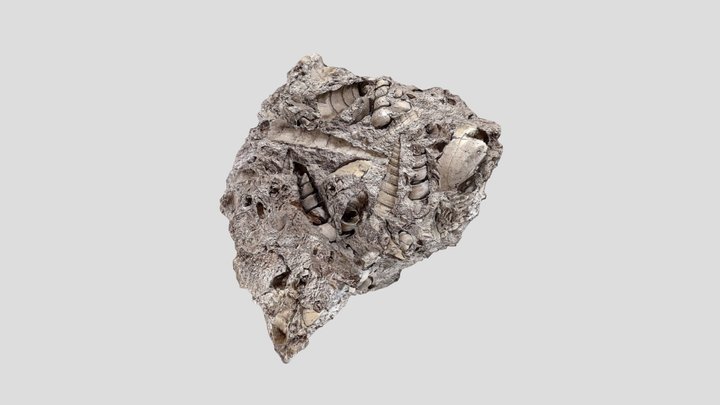
3D model
- Source
- Sketchfab
- Credit
- Portland Museum
- Licence
- CC Attribution
- Commercial use
- cannot be read from the licence given — check the record
Smithsonian Open Access and MorphoSource were not reached for this taxon, so this list is what the others held rather than everything there is.
This is what the site found, which is not the same as what exists.
Keep going
What may have been alongside itNerinellidae through timeFormations of the Late JurassicThe world it lived on
Occurrence data from the Paleobiology Database, CC BY 4.0. Fischer 1885