Apocrita
Apocrita is a suborder of insects in the order Hymenoptera. It includes wasps, bees, and ants, and consists of many families. It contains the most advanced hymenopterans and is distinguished from Symphyta by the narrow "waist" (petiole) formed between the first two segments of the actual abdomen; the first abdominal segment is fused to the thorax, and is called the propodeum. Therefore, it is general practice, when discussing the body of an apocritan in a technical sense, to refer to the mesosoma and metasoma rather than the "thorax" and "abdomen", respectively. The evolution of a constricted waist was an important adaption for the parasitoid lifestyle of the ancestral apocritan, allowing more maneuverability of the female's ovipositor. The ovipositor either extends freely or is retracted, and may be developed into a stinger for both defense and paralyzing prey. Larvae are legless and blind, and either feed inside a host or in a nest cell provisioned by their mothers.

Cornelis van Achterberg & Ewald Altenhofer · CC BY-SA 3.0 · via Wikipedia/Commons. May be a photograph of a specimen, or an artist’s reconstruction — an interpretation of a skeleton, since colour and soft tissue are almost never preserved.
On record
Recorded, not inferred- Also called
- waspPBDB
- Sits inside
- UnicalcaridaPBDB
- Motility
- actively mobilePBDB, for Arthropoda
- Environment
- terrestrialPBDB, for Insecta
Time the record covers
At least 469 million years on record.
The record covers at least 469.1 Mya to 11.7 ka. No occurrence read is dated outside 471.3 Mya to 0 Mya.
5,847 occurrences of Apocrita on record, most of them in the Eocene. The Paleobiology Database records this as a living group. Bar height is expected occurrences, not a count: each fossil is spread across the span it is dated to, so a tall narrow bar means tight dating and a low wide one means loose.
When
5,847 occurrences- Ordovicianunder 1%
- Early Jurassicunder 1%
- Middle Jurassicunder 1%
- Late Jurassic4%
- Early Cretaceous9%
- Late Cretaceous14%
- Paleoceneunder 1%
- Eocene44%
- Oligocene6%
- Miocene17%
- Plioceneunder 1%
- Pleistocene2%
- Holocene2%
These are dates about fossils, not the animal: the record can only begin after it arose and end before it died out, so either end may reach further. Shares are expected occurrences: a fossil dated to a span is counted partly in each period it straddles. More on what this infers.
Found in
152 formations
- Florissant Formation377
- Karabastau Formation166
- Bouldnor Formation · Solent Group136
- Shanwang Formation119
- Daohugou Formation103
- Yixian Formation · Jehol Group99
Loading coastlines…
The named rock units Apocrita has been recovered from, largest first. Drawn where the rock is now, not where it formed. 128 further formations hold fewer occurrences each and are not listed. 3,339 occurrences have no formation on record, which is common for older literature.
Apocrita and its relatives
EoceneWhere Apocrita and its relatives were recorded in the Eocene.
Found in the same rock
7,789 taxa- Coleoptera15 sites
- Diptera14 sites
- Curculionidae12 sites
- Culicoides filipalpis11 sites
- Formicidae10 sites
- Serphites paradoxus10 sites
- Atriculicoides globosus8 sites
- Gesomyrmex hoernesi8 sites
- Plecia foersteri8 sites
- Prosphyracephala succini8 sites
- Protoscelis jurassica8 sites
- Yantaromyrmex geinitzi8 sites
- Araneae7 sites
- Archirhyphus asiaticus7 sites
- Bibionidae7 sites
- Carabidae7 sites
- Cydnus brevicollis7 sites
- Ellinaphidinae7 sites
- Glyptapis fuscula7 sites
- Liassothrips crassipes7 sites
- Paramesopsocus adibi7 sites
- Peronehelea chrimikalydia7 sites
- Plagiolepis klinsmanni7 sites
- Plecia7 sites
The Paleobiology Database records at least 329 sites for Apocrita, and this reads 240 of them. Of that, one read hit the database's own return limit, so every count below is a floor rather than a total. The number is how many of those sites it was catalogued from too. The 24 sharing the most are listed.
This is not a list of everything alive at the time. It is only what has come out of the same ground as this animal and been written down.
Entered from
1,240 references- Die Ameisen des baltischen Bernsteins169
- Hymenoptera Apocrita of Mesozoic148
- The Fossil Ants of North America146
- The Parasitic Hymenoptera of the Baltic Amber142
- The parasitic Hymenoptera of the Tertiary of Florissant, Colorado123
- The Ants of the Baltic Amber115
- Les insectes fossiles des terrains oligocènes de France110
- Heer, 184993
- A monograph of the Baltic amber bees and evolution of the Apoidea (Hymenoptera)84
- Zhang, 198984
- The wasps, bees and ants (Insecta: Vespida=Hymenoptera) from the Insect Limestone (Late Eocene) of the Isle of Wight, UK78
- Modernisation of the Hymenoptera: ants, bees, wasps, and sawflies of the early Eocene Okanagan Highlands of western North America69
Each of the 5,847 occurrences read was entered from one of these publications, ordered by how many each accounts for. This is not a search for papers mentioning the name. 1,228 further references are not listed. Entries link to doi.org where the Paleobiology Database holds an identifier, and to its own record where it does not. Relayed as the Paleobiology Database holds them, not checked against what they resolve to.
Media and terms
Media content1
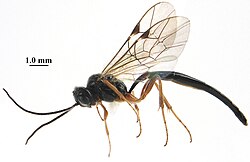
Picture of Apocrita
- Source
- Wikipedia/Commons
- Credit
- Cornelis van Achterberg & Ewald Altenhofer
- Licence
- CC BY-SA 3.0
- Commercial use
- the licence allows it
No 3D scan of Apocrita was found in MorphoSource and Sketchfab.
Smithsonian Open Access was not reached for this taxon, so this list is what the others held rather than everything there is.
The description on this site
- Source
- Wikipedia, “Apocrita”
- Licence
- CC BY-SA 4.0
This is what the site found, which is not the same as what exists.
Keep going
What may have been alongside itUnicalcarida through timeFormations of the EoceneThe world it lived on
Occurrence data from the Paleobiology Database, CC BY 4.0. Gerstaecker 1867