Anthracotherium
Anthracotherium is an extinct genus of anthracotheriid artiodactyls characterized by having 44 teeth, with five semi-crescentic cusps on the crowns of the upper molars. The genus ranged from the middle Eocene period until the early Miocene, having a distribution throughout Eurasia probably even reaching South East Asia. Material subjectively assigned to Anthracotherium from Pakistan suggests the last species died out soon after the start of the Miocene.

Ghedoghedo · CC BY-SA 3.0 · via Wikipedia/Commons. May be a photograph of a specimen, or an artist’s reconstruction — an interpretation of a skeleton, since colour and soft tissue are almost never preserved.
On record
Recorded, not inferred- Sits inside
- AnthracotheriinaePBDB
- Diet
- browserPBDB, for Anthracotheriidae
- Life habit
- ground dwellingPBDB, for Anthracotheriidae
- Motility
- actively mobilePBDB, for Osteichthyes
- Environment
- terrestrialPBDB, for Artiodactyla
Time the record covers
At least 21 million years on record.
The record covers at least 37.71 Mya to 15.98 Mya. No occurrence read is dated outside 48.07 Mya to 11.63 Mya.
70 occurrences of Anthracotherium on record, most of them in the Oligocene. Bar height is expected occurrences, not a count: each fossil is spread across the span it is dated to, so a tall narrow bar means tight dating and a low wide one means loose.
When
70 occurrencesThese are dates about fossils, not the animal: the record can only begin after it arose and end before it died out, so either end may reach further. Shares are expected occurrences: a fossil dated to a span is counted partly in each period it straddles. More on what this infers.
Found in
15 formations
- Pondaung Formation21
- Yongning Formation4
- Manchar Formation3
- Chitarwata Formation3
- Breitheid Formation2
- Headon Hill Formation1
Loading coastlines…
The named rock units Anthracotherium has been recovered from, largest first. Drawn where the rock is now, not where it formed. 27 occurrences have no formation on record, which is common for older literature.
Anthracotherium and its relatives
OligoceneWhere Anthracotherium and its relatives were recorded in the Oligocene.
Found in the same rock
568 taxa- Brontotheriidae6 sites
- Crocodylia6 sites
- Hyaenodon5 sites
- Nimravus intermedius5 sites
- Paramynodon5 sites
- Testudinidae5 sites
- Allaeochelys magnifica4 sites
- Amphicyon4 sites
- Bachitherium curtum4 sites
- Dugongidae4 sites
- Entelodon4 sites
- Hyaenodon leptorhynchus4 sites
- Indomeryx cotteri4 sites
- Metamynodon4 sites
- Rhinocerotidae4 sites
- Trionychidae4 sites
- Amphisbaenidae3 sites
- Anthracokeryx tenuis3 sites
- Anthracotheriidae3 sites
- Blainvillimys helmeri3 sites
- Conohyus sindiensis3 sites
- Egatochoerus jaegeri3 sites
- Emydidae3 sites
- Geniokeryx thailandicus3 sites
The Paleobiology Database records 61 sites for Anthracotherium, and this reads all of them. The number is how many of those sites it was catalogued from too. The 24 sharing the most are listed.
This is not a list of everything alive at the time. It is only what has come out of the same ground as this animal and been written down.
Entered from
31 references- To split or not to split Anthracotherium? A phylogeny of Anthracotheriinae (Cetartiodactyla: Hippopotamoidea) and its palaeobiogeographical implications10
- The Artiodactyla of the Eocene of Burma9
- Fossil mammals from Burma in the American Museum of Natural History7
- Two New Genera of Anthracotheriidae from Kwangsi5
- Prominatherium dalmatinum from the late Eocene of Grancona (Vicenza, NE Italy). The oldest terrestrial mammal of the Italian peninsula3
- New basal selenodont artiodactyls from the Pondaung Formation (late middle Eocene, Myanmar) and the phylogenetic relationships of early ruminants3
- Preliminary report on the geology and vertebrate fauna of the Miocene Manchar Formation, Sind, Pakistan3
- New fossil remains from Bang Mark locality, Krabi Basin, southern Thailand2
- Late Oligocene ambient temperatures reconstructed by stable isotope analysis of terrestrial and aquatic vertebrate fossils of Enspel, Germany2
- Large mammals from Rickenbach (Switzerland, reference locality MP29, Late Oligocene): biostratigraphic and palaeoenvironmental implications2
- Mise en évidence de l'Oligocène sur le territoire des Bugti (Balouchistan, Pakistan)2
- New anthracothere materials from the Paleogene of Guangxi2
Each of the 70 occurrences read was entered from one of these publications, ordered by how many each accounts for. This is not a search for papers mentioning the name. 19 further references are not listed. Entries link to doi.org where the Paleobiology Database holds an identifier, and to its own record where it does not. Relayed as the Paleobiology Database holds them, not checked against what they resolve to.
Media and terms
Media content1
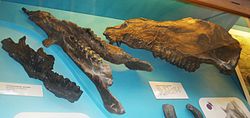
Picture of Anthracotherium
- Source
- Wikipedia/Commons
- Credit
- Ghedoghedo
- Licence
- CC BY-SA 3.0
- Commercial use
- the licence allows it
No 3D scan of Anthracotherium was found in Sketchfab.
Smithsonian Open Access and MorphoSource were not reached for this taxon, so this list is what the others held rather than everything there is.
The description on this site
- Licence
- CC BY-SA 4.0
This is what the site found, which is not the same as what exists.
Keep going
What may have been alongside itAnthracotheriinae through timeFormations of the OligoceneThe world it lived on
Occurrence data from the Paleobiology Database, CC BY 4.0. Cuvier 1822