Annonaceae
The Annonaceae are a family of flowering plants consisting of trees, shrubs, or rarely lianas commonly known as the custard apple family or soursop family. With 108 accepted genera and about 2400 known species, it is the largest family in the Magnoliales. Several genera produce edible fruit, most notably Annona, Anonidium, Asimina, Rollinia, and Uvaria. Its type genus is Annona. The family is concentrated in the tropics, with the only temperate genus being Asimina. Other than Asimina, 900 species are Neotropical, 450 are Afrotropical, and the remaining are Indomalayan.

Uncredited · CC BY-SA 3.0 · via Wikipedia/Commons. May be a photograph of a specimen, or an artist’s reconstruction — an interpretation of a skeleton, since colour and soft tissue are almost never preserved.
On record
Recorded, not inferred- Also called
- custard applePBDB
- Sits inside
- MagnolialesPBDB
- Diet
- "photoautotroph"PBDB, for Angiospermae
Time the record covers
At least 65 million years on record.
The record covers at least 66 Mya to 11.7 ka. No occurrence read is dated outside 72.2 Mya to 0 Mya.
127 occurrences of Annonaceae on record, most of them in the Miocene. The Paleobiology Database records this as a living group. Bar height is expected occurrences, not a count: each fossil is spread across the span it is dated to, so a tall narrow bar means tight dating and a low wide one means loose.
When
127 occurrences- Late Cretaceous2%
- Paleocene3%
- Eocene26%
- Oligocene7%
- Miocene50%
- Pliocene3%
- Pleistocene7%
- Holoceneunder 1%
These are dates about fossils, not the animal: the record can only begin after it arose and end before it died out, so either end may reach further. Shares are expected occurrences: a fossil dated to a span is counted partly in each period it straddles. More on what this infers.
Found in
25 formations
- London Clay Formation17
- Lower Churia Formation · Siwalik Group10
- Lower Formation · Siwalik Group8
- Changsheling Formation5
- Ngorora Formation4
- Olduvai Formation · Vogel River Series Group3
Loading coastlines…
The named rock units Annonaceae has been recovered from, largest first. Drawn where the rock is now, not where it formed. One further formation holds fewer occurrences and is not listed. 52 occurrences have no formation on record, which is common for older literature.
Annonaceae and its relatives
MioceneWhere Annonaceae and its relatives were recorded in the Miocene.
Found in the same rock
1,293 taxa- Annona25 sites
- Ficus13 sites
- Cassia8 sites
- Fabaceae7 sites
- Magnolia7 sites
- Poaceae7 sites
- Podocarpus7 sites
- Rhus7 sites
- Cinnamomum6 sites
- Nectandra6 sites
- Phyllites6 sites
- Quercus6 sites
- Tapirira6 sites
- Terminalia6 sites
- Trigonia varians6 sites
- Arecaceae5 sites
- Asteraceae5 sites
- Coussapoa5 sites
- Dipterocarpus siwalicus5 sites
- Lithocarpus5 sites
- Myrcia5 sites
- Persea5 sites
- Styrax5 sites
- Acacia4 sites
The Paleobiology Database records 66 sites for Annonaceae, and this reads all of them. The number is how many of those sites it was catalogued from too. The 24 sharing the most are listed.
This is not a list of everything alive at the time. It is only what has come out of the same ground as this animal and been written down.
Entered from
50 references- Angiospermous fossil leaves from the Siwalik foreland basins and their palaeoclimatic implications21
- Chandler, 196117
- A catalogue of Cenozoic megafossil plants in China12
- Tertiary plants from Venezuela7
- Middle Miocene flora from Siwalik foreland basin of Uttarakhand, India and its phytogeographic and palaeoclimatic implications5
- Miocene floras in the lower Rhenish basin and their ecological interpretation4
- Late Paleocene fossils from the Cerrejón Formation, Colombia, are the earliest record of Neotropical rainforest3
- Fruits and seeds of the Middle Eocene Nut Beds Flora, Clarno Formation, Oregon3
- Localidades fossiliferas da Formacao Pirabas (Mioceno Inferior)2
- Plant fossils from Arung Khola and Binai Khola Formations of Churia Group (Siwalik), west central Nepal and their palaeoecological and phytogeographical significance2
- A Catalogue of Fossil Plants from India Part 4: Cenozoic (Tertiary) Megafossils2
- A middle Miocene (12.2 my old) forest in the East African Rift Valley, Keny2
Each of the 127 occurrences read was entered from one of these publications, ordered by how many each accounts for. This is not a search for papers mentioning the name. 38 further references are not listed. Entries link to doi.org where the Paleobiology Database holds an identifier, and to its own record where it does not. Relayed as the Paleobiology Database holds them, not checked against what they resolve to.
Media and terms
Media content1
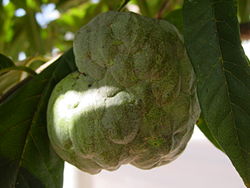
Picture of Annonaceae
- Source
- Wikipedia/Commons
- Credit
- nobody named on the record
- Licence
- CC BY-SA 3.0
- Commercial use
- the licence allows it
No 3D scan was found. Smithsonian Open Access, MorphoSource and Sketchfab were all searched.
The description on this site
- Source
- Wikipedia, “Annonaceae”
- Licence
- CC BY-SA 4.0
This is what the site found, which is not the same as what exists.
Keep going
What may have been alongside itMagnoliales through timeFormations of the MioceneThe world it lived on
Occurrence data from the Paleobiology Database, CC BY 4.0. de Jussieu 1789