Allactaga
The genus Allactaga contains the five-toed jerboas of Asia. They are small mammals belonging to the order of rodents. They are characteristically known as the hopping rodents of the desert and semi-arid regions. They have long hind feet, short forelimbs, and walk upright. They have large ears in comparison to their body size and a large tail. The tail assists and serves as support when the jerboa is standing upright. The jerboa body length ranges from 5–15 cm and has a tail ranging from 7–25 cm. The "forelimbs of the jerboa serve as a pair of hands for feeding, grooming, etc." Jerboas use their nose to burrow and push the dirt when looking for food. The male jerboa is usually larger in size and weight in comparison to the female jerboa. The pelt of the jerboa is either silky or velvety in texture and light in color, the coloration helps camouflage into surroundings to avoid predators. All members of the genus have five toes.

Mariomassone at en.wikipedia · CC BY-SA 3.0 · via Wikipedia/Commons. May be a photograph of a specimen, or an artist’s reconstruction — an interpretation of a skeleton, since colour and soft tissue are almost never preserved.
On record
Recorded, not inferred- Also called
- jerboaPBDB
- Sits inside
- DipodidaePBDB
- Diet
- herbivorePBDB
- Life habit
- saltatorialPBDB
- Motility
- actively mobilePBDB, for Osteichthyes
- Environment
- terrestrialPBDB, for Eutheria
Time the record covers
At least 4 million years on record.
The record covers at least 4.16 Mya to 129 ka. No occurrence read is dated outside 5.333 Mya to 11.7 ka.
12 occurrences of Allactaga on record, most of them in the Pleistocene. The Paleobiology Database records this as a living group. Bar height is expected occurrences, not a count: each fossil is spread across the span it is dated to, so a tall narrow bar means tight dating and a low wide one means loose.
When
12 occurrences- Pliocene25%
- Pleistocene75%
These are dates about fossils, not the animal: the record can only begin after it arose and end before it died out, so either end may reach further. Shares are expected occurrences: a fossil dated to a span is counted partly in each period it straddles. More on what this infers.
Found in
3 formations
Loading coastlines…
The named rock units Allactaga has been recovered from, largest first. Drawn where the rock is now, not where it formed. 9 occurrences have no formation on record, which is common for older literature.
Allactaga and its relatives
PleistoceneWhere Allactaga and its relatives were recorded in the Pleistocene.
Found in the same rock
222 taxa- Ochotona7 sites
- Citellus6 sites
- Microtus5 sites
- Mimomys5 sites
- Spalax5 sites
- Equus4 sites
- Lagurus4 sites
- Apodemus3 sites
- Gazella3 sites
- Lepus3 sites
- Trogontherium3 sites
- Allophaiomys pliocaenicus2 sites
- Bison2 sites
- Bison priscus2 sites
- Bos primigenius2 sites
- Canis lupus2 sites
- Castor fiber2 sites
- Cervus elaphus2 sites
- Chiroptera2 sites
- Coelodonta antiquitatis2 sites
- Cricetulus2 sites
- Cricetulus migratorius2 sites
- Desmana nehringi2 sites
- Dolomys2 sites
The Paleobiology Database records 12 sites for Allactaga, and this reads all of them. The number is how many of those sites it was catalogued from too. The 24 sharing the most are listed.
This is not a list of everything alive at the time. It is only what has come out of the same ground as this animal and been written down.
Entered from
12 references- New carnivoran remains from the Early Pleistocene Shanshenmiaozui site in Nihewan Basin, northern China1
- A new species of jerboa (Mammalia, Rodentia, Allactaga) from the late Miocene of Ukraine1
- Early Pleistocene equids (Mammalia, Perissodactyla) of Nalaikha, Mongolia, and the emergence of modern Equus Linnaeus, 17581
- Dursunlu - a new Lower Pleistocene faunal and artifact-bearing locality in southern Anatolia.1
- The sequence of Early Pleistocene small-mammal faunas from the South Russian Plain.1
- Pleistocene vertebrate faunas of Hungary1
- The Late Cenozoic two-humped (Bactrian) camels of Asia1
- Succession des Mammiferes Plio-Pleistocenes dans le Bassin Dacique (Roumanie)1
- Biostratigraphie (micromammiferes) des depots plio-pleistocenes de la zone de Slatina (dep. d'Olt).1
- Eine Mittelpleistozäne Nager-Fauna von der Insel Chios, Ägais (Mammalia, Rodentia)1
- Fossil Teriofauna of the Liventzovka sand-pit1
- Taphonomie der Fundstellen von Kleinsäugerresten des Anthropogens in Westtranbaikalien (Taphonomy of sites of small mammal remains in the Quaternary of western Transbaikalia)1
Each of the 12 occurrences read was entered from one of these publications, ordered by how many each accounts for. This is not a search for papers mentioning the name. Entries link to doi.org where the Paleobiology Database holds an identifier, and to its own record where it does not. Relayed as the Paleobiology Database holds them, not checked against what they resolve to.
Media and terms
Media content2
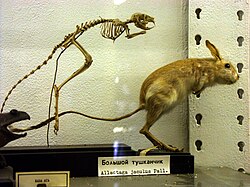
Picture of Allactaga
- Source
- Wikipedia/Commons
- Credit
- Mariomassone at en.wikipedia
- Licence
- CC BY-SA 3.0
- Commercial use
- the licence allows it
CT scan
- Source
- MorphoSource
- Credit
- AMNH Mammal Collections
- Licence
- not stated by the source
- Commercial use
- cannot be read from the licence given — check the record
- Specimen
- Allactaga major · amnh:mammals:227
The description on this site
- Source
- Wikipedia, “Allactaga”
- Licence
- CC BY-SA 4.0
This is what the site found, which is not the same as what exists.
Keep going
What may have been alongside itDipodidae through timeFormations of the PleistoceneThe world it lived on
Occurrence data from the Paleobiology Database, CC BY 4.0.