Albulidae
Albulidae is a family of fish, commonly known as the bonefishes, that are popular as game fish in Florida, select locations in the South Pacific and the Bahamas and elsewhere. The family is small, with 11 species in 3 genera. Presently, the bonefishes are in their own order: Albuliformes. The families Halosauridae and Notacanthidae were previously classified in this order, but are now, according to FishBase, given their own order Notacanthiformes. The largest bonefish caught in the Western Hemisphere is a 16-pound, 3 ounce example caught off Islamorada, Florida, on March 19, 2007.

Brian Gratwicke · CC BY 2.0 · via Wikipedia/Commons. May be a photograph of a specimen, or an artist’s reconstruction — an interpretation of a skeleton, since colour and soft tissue are almost never preserved.
On record
Recorded, not inferred- Sits inside
- AlbuliformesPBDB
- Motility
- actively mobilePBDB, for Osteichthyes
Time the record covers
At least 119 million years on record.
The record covers at least 119.57 Mya to 11.7 ka. No occurrence read is dated outside 121.4 Mya to 0 Mya.
274 occurrences of Albulidae on record, most of them in the Late Cretaceous. The Paleobiology Database records this as a living group. Bar height is expected occurrences, not a count: each fossil is spread across the span it is dated to, so a tall narrow bar means tight dating and a low wide one means loose.
When
274 occurrences- Early Cretaceous3%
- Late Cretaceous46%
- Paleocene6%
- Eocene27%
- Oligocene7%
- Miocene8%
- Pliocene1%
- Pleistocene1%
- Holoceneunder 1%
These are dates about fossils, not the animal: the record can only begin after it arose and end before it died out, so either end may reach further. Shares are expected occurrences: a fossil dated to a span is counted partly in each period it straddles. More on what this infers.
Found in
94 formations
- Dinosaur Park Formation · Belly River Group27
- Oldman Formation · Belly River Group18
- Hell Creek Formation · Montana Group14
- Tallahatta Formation · Claiborne Group8
- Ahlen Formation7
- Greenhorn Limestone Formation · Colorado Group6
Loading coastlines…
The named rock units Albulidae has been recovered from, largest first. Drawn where the rock is now, not where it formed. 70 further formations hold fewer occurrences each and are not listed. 59 occurrences have no formation on record, which is common for older literature.
Albulidae and its relatives
Late CretaceousWhere Albulidae and its relatives were recorded in the Late Cretaceous.
Found in the same rock
3,826 taxa- Teleostei70 sites
- Scapherpeton tectum57 sites
- Myledaphus bipartitus55 sites
- Coriops amnicolus54 sites
- Anura53 sites
- Opisthotriton kayi53 sites
- Hadrosauridae52 sites
- Paralbula casei51 sites
- Baenidae48 sites
- Chelydridae47 sites
- Trionychidae43 sites
- Ceratopsidae42 sites
- Lepisosteus40 sites
- Amiidae39 sites
- Belonostomus longirostris38 sites
- Multituberculata38 sites
- Saurornitholestes langstoni38 sites
- Holostei36 sites
- Crocodylia34 sites
- Lepisosteus occidentalis34 sites
- Paronychodon33 sites
- Tyrannosauridae32 sites
- Aves31 sites
- Champsosaurus natator31 sites
The Paleobiology Database records 238 sites for Albulidae, and this reads all of them. Of that, one read hit the database's own return limit, so every count below is a floor rather than a total. The number is how many of those sites it was catalogued from too. The 24 sharing the most are listed.
This is not a list of everything alive at the time. It is only what has come out of the same ground as this animal and been written down.
Entered from
132 references- Vertebrate microsite assemblages (exclusive of mammals) from the Foremost and Oldman Formations of the Judith River Group (Campanian) of southeastern Alberta: an illustrated guide17
- Paleontology of the Judith River Formation (Campanian) of Dinosaur National Park, Alberta, Canada: evidence from vertebrate microfossil locality17
- Middle and late Eocene fish otoliths from the eastern and southern USA11
- Paleoecology of an estuarine, incised-valley fill in the Dinosaur Park Formation (Judith River Group, Upper Cretaceous) of southern Alberta, Canada11
- Taxonomy and biostratigraphy of the elasmobranchs and bony fishes (Chondrichthyes and Osteichthyes) of the lower-to-middle Eocene (Ypresian to Bartonian) Claiborne Group in Alabama, USA, including an analysis of otoliths10
- Diversity and paleoecology of actinopterygian fish from vertebrate microfossil localities of the Maastrichtian Hell Creek Formation of Montana8
- Reconstruction of the fossil marine bony fish fauna (Teleostei) from the Eocene to Pleistocene of New Zealand by means of otoliths. With studies of Recent congroid, morid and trachinoid otoliths5
- Otolithes de poissons du paléocanyon de saubrigues (chattien à langhien), aquitaine méridionale, France5
- The Selsey Division (Bracklesham Group) at Lee-on-the-Solent, Gosport, (Hants)5
- Redkie kostnye ryby, nazemiye yashcheritsy i mlekopitayushchie zony limanov i primorskikh nizmennostey mela Kyzylkumov [Rare bony fishes, terrestrial lizards, and mammals in the estuarine and coastal lowland zone of the Kyzyl-Kum Cretaceous]5
- Les otolithes des téléostéens de l'oligo-miocène Belge5
- Early Eocene fish otoliths from the eastern and southern USA4
Each of the 274 occurrences read was entered from one of these publications, ordered by how many each accounts for. This is not a search for papers mentioning the name. 120 further references are not listed. Entries link to doi.org where the Paleobiology Database holds an identifier, and to its own record where it does not. Relayed as the Paleobiology Database holds them, not checked against what they resolve to.
Media and terms
Media content1
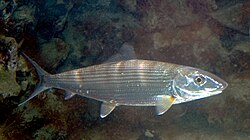
Picture of Albulidae
- Source
- Wikipedia/Commons
- Credit
- Brian Gratwicke
- Licence
- CC BY 2.0
- Commercial use
- the licence allows it
No 3D scan of Albulidae was found in Sketchfab.
Smithsonian Open Access and MorphoSource were not reached for this taxon, so this list is what the others held rather than everything there is.
The description on this site
- Source
- Wikipedia, “Bonefishes”
- Licence
- CC BY-SA 4.0
This is what the site found, which is not the same as what exists.
Keep going
What may have been alongside itAlbuliformes through timeFormations of the Late CretaceousThe world it lived on
Occurrence data from the Paleobiology Database, CC BY 4.0. Bleeker 1859