Xiphactinus
Xiphactinus is an extinct genus of large predatory marine ray-finned fish that lived during the late Albian to the late Maastrichtian. The genus grew up to 5–6 metres (16–20 ft) in length, and superficially resembled a gargantuan, fanged tarpon. It is a member of the extinct order Ichthyodectiformes, which represent close relatives of modern teleosts.

Jonathan Chen · CC BY-SA 4.0 · via Wikipedia/Commons. May be a photograph of a specimen, or an artist’s reconstruction — an interpretation of a skeleton, since colour and soft tissue are almost never preserved.
On record
Recorded, not inferred- Sits inside
- IchthyodectidaePBDB
- Diet
- carnivorePBDB, for Ichthyodectiformes
- Life habit
- nektonicPBDB, for Ichthyodectiformes
- Motility
- actively mobilePBDB, for Ichthyodectiformes
- Length
- 5.1 mWikidata
Time the record covers
At least 47 million years on record.
The record covers at least 119.57 Mya to 72.2 Mya. No occurrence read is dated outside 121.4 Mya to 66 Mya.
59 occurrences of Xiphactinus on record, most of them in the Late Cretaceous. Bar height is expected occurrences, not a count: each fossil is spread across the span it is dated to, so a tall narrow bar means tight dating and a low wide one means loose.
When
59 occurrencesThese are dates about fossils, not the animal: the record can only begin after it arose and end before it died out, so either end may reach further. Shares are expected occurrences: a fossil dated to a span is counted partly in each period it straddles. More on what this infers.
Found in
27 formations
- Greenhorn Limestone Formation · Colorado Group10
- Mooreville Chalk Formation · Selma Group5
- Niobrara Formation · Colorado Group5
- Carlile Shale Formation · Colorado Group4
- Tar Heel Formation · Black Creek Group3
- Mesaverde Formation3
Loading coastlines…
The named rock units Xiphactinus has been recovered from, largest first. Drawn where the rock is now, not where it formed. 3 further formations hold fewer occurrences each and are not listed. 6 occurrences have no formation on record, which is common for older literature.
Xiphactinus and its relatives
Late CretaceousWhere Xiphactinus and its relatives were recorded in the Late Cretaceous.
Found in the same rock
593 taxa- Cretalamna appendiculata21 sites
- Squalicorax falcatus20 sites
- Cretoxyrhina mantelli19 sites
- Enchodus petrosus15 sites
- Protosphyraena15 sites
- Ischyrhiza mira14 sites
- Pachyrhizodus minimus14 sites
- Enchodus gladiolus12 sites
- Scapanorhynchus texanus12 sites
- Archaeolamna kopingensis11 sites
- Squalicorax kaupi11 sites
- Anomoeodus phaseolus10 sites
- Brachyrhizodus wichitaensis10 sites
- Hybodus10 sites
- Paralbula casei10 sites
- Rhombodus levis10 sites
- Squalicorax10 sites
- Enchodus shumardi9 sites
- Ptychodus anonymus9 sites
- Ptychodus occidentalis9 sites
- Squalicorax curvatus9 sites
- Cretomanta canadensis8 sites
- Ptychodus decurrens8 sites
- Squalicorax pristodontus8 sites
The Paleobiology Database records 58 sites for Xiphactinus, and this reads all of them. The number is how many of those sites it was catalogued from too. The 24 sharing the most are listed.
This is not a list of everything alive at the time. It is only what has come out of the same ground as this animal and been written down.
Entered from
46 references- The vertebrate fauna of the Selma Formation of Alabama, part VIII, the fishes7
- Fossil fishes from the basal Greenhorn Limestone (Upper Cretaceous, Late Cenomanian) in Russell County, Kansas5
- Cenomanian bonebed faunas from the northeastern margin, Western Interior Seaway2
- The nonmammalian vertebrate microfossil assemblages of the Mesaverde Formation (Upper Cretaceous, Campanian) of the Wind River and Bighorn Basins, Wyoming2
- Cretaceous vertebrate fauna from Phoebus Landing, North Carolina2
- Terrestrial and aquatic vertebrate paleocommunities of the Mesaverde Formation (Upper Cretaceous, Campanian) of the Wind River and Bighorn Basins, Wyoming, USA1
- Cenomanian (Late Cretaceous) reptiles from northwestern Russell County, Kansas1
- A middle Turonian marine fish fauna from the Blue Hill Shale Member, Carlile Shale, of north central Kansas1
- Late Cretaceous marine vertebrates from the basal Greenhorn Limestone in southeastern Colorado1
- Faunal changes across the Cretaceous-Tertiary (K-T) boundary in the Atlantic coastal plain of New Jersey: restructuring the marine community after the K-T mass-extinction event1
- Hesperornis (Aves) from Ellesmere Island and palynological correlation of known Canadian localities1
- Taxonomy and systematics of the Late Cretaceous pterosaur Pteranodon (Pterosauria, Pterodactyloidea)1
Each of the 59 occurrences read was entered from one of these publications, ordered by how many each accounts for. This is not a search for papers mentioning the name. 34 further references are not listed. Entries link to doi.org where the Paleobiology Database holds an identifier, and to its own record where it does not. Relayed as the Paleobiology Database holds them, not checked against what they resolve to.
Media and terms
Media content3

Picture of Xiphactinus
- Source
- Wikipedia/Commons
- Credit
- Jonathan Chen
- Licence
- CC BY-SA 4.0
- Commercial use
- the licence allows it
Laser scan
- Source
- MorphoSource
- Licence
- In Copyright
- Commercial use
- cannot be read from the licence given — check the record
- Specimen
- Xiphactinus sp. · YPM:VP:YPM VP 042230
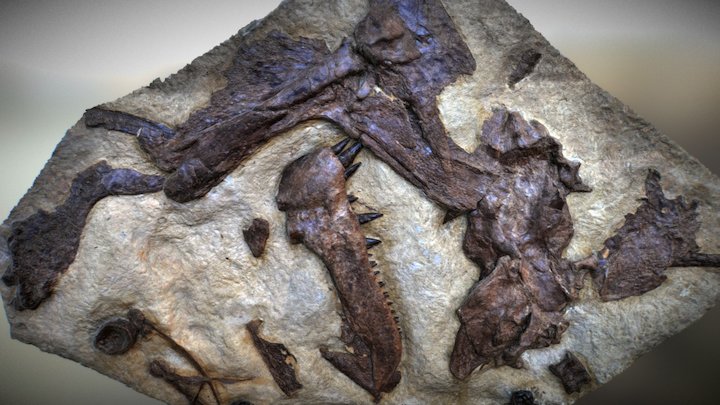
3D model
- Source
- Sketchfab
- Credit
- Gaming Assets
- Licence
- CC Attribution
- Commercial use
- cannot be read from the licence given — check the record
Smithsonian Open Access was not reached for this taxon, so this list is what the others held rather than everything there is.
The description on this site
- Source
- Wikipedia, “Xiphactinus”
- Licence
- CC BY-SA 4.0
This is what the site found, which is not the same as what exists.
Keep going
What may have been alongside itIchthyodectidae through timeFormations of the Late CretaceousThe world it lived on
Occurrence data from the Paleobiology Database, CC BY 4.0. Leidy 1870