Urocyon littoralis
The island fox is a small fox species that is endemic to six of the eight Channel Islands of California. They evolved from their larger mainland gray fox ancestor and have diversified into six subspecies, each confined to its own island and all exhibiting insular dwarfism. Island foxes are generally docile, show little fear of humans, and are easily tamed. Island foxes have played an important role in the spiritual lives of native Channel Islanders. They were likely semi-domesticated as pets, for their pelts, or other functions, like pest control. Genetic and archaeological evidence suggests that the foxes arrived on the islands around 7,000 years ago, probably with the assistance of early human populations.

Pacific Southwest Region USFWS from Sacramento, US · CC BY 2.0 · via Wikipedia/Commons. May be a photograph of a specimen, or an artist’s reconstruction — an interpretation of a skeleton, since colour and soft tissue are almost never preserved.
On record
Recorded, not inferred- Also called
- island gray foxPBDB
- Sits inside
- UrocyonPBDB
- Diet
- carnivore, omnivorePBDB, for Canidae
- Life habit
- scansorialPBDB, for Urocyon
- Motility
- actively mobilePBDB, for Osteichthyes
- Environment
- terrestrialPBDB, for Eutheria
Time the record covers
At most 210 thousand years on record.
Every occurrence read is dated to somewhere between 210 ka and 0 Mya, and nothing in the dating separates them, so that window is what the record shows rather than a span.
3 occurrences of Urocyon littoralis on record, most of them in the Holocene. The Paleobiology Database records this as a living group. Bar height is expected occurrences, not a count: each fossil is spread across the span it is dated to, so a tall narrow bar means tight dating and a low wide one means loose.
When
3 occurrences- Pleistocene31%
- Holocene69%
These are dates about fossils, not the animal: the record can only begin after it arose and end before it died out, so either end may reach further. Shares are expected occurrences: a fossil dated to a span is counted partly in each period it straddles. More on what this infers.
Urocyon littoralis and its relatives
HoloceneWhere Urocyon littoralis and its relatives were recorded in the Holocene.
Found in the same rock
44 taxa- Anser caerulescens1 site
- Arctocephalus townsendi1 site
- Ardea herodias1 site
- Ardenna grisea1 site
- Asio priscus1 site
- Branta canadensis1 site
- Buteo jamaicensis1 site
- Calidris mauri1 site
- Cepphus columba1 site
- Cerorhinca1 site
- Chendytes lawi1 site
- Corvus corax1 site
- Crotalus viridis1 site
- Enhydra lutris1 site
- Falco sparverius1 site
- Fulmarus glacialis1 site
- Gavia pacifica1 site
- Gerrhonotus1 site
- Gymnogyps californianus1 site
- Haliaeetus leucocephalus1 site
- Larus californicus1 site
- Larus delawarensis1 site
- Larus occidentalis1 site
- Melanitta fusca1 site
The Paleobiology Database records 3 sites for Urocyon littoralis, and this reads all of them. The number is how many of those sites it was catalogued from too. The 24 sharing the most are listed.
This is not a list of everything alive at the time. It is only what has come out of the same ground as this animal and been written down.
Entered from
1 referenceEach of the 3 occurrences read was entered from one of these publications, ordered by how many each accounts for. This is not a search for papers mentioning the name. Each entry links to doi.org. Relayed as the Paleobiology Database holds them, not checked against what they resolve to.
Media and terms
Media content2

Picture of Urocyon littoralis
- Source
- Wikipedia/Commons
- Credit
- Pacific Southwest Region USFWS from Sacramento, US
- Licence
- CC BY 2.0
- Commercial use
- the licence allows it
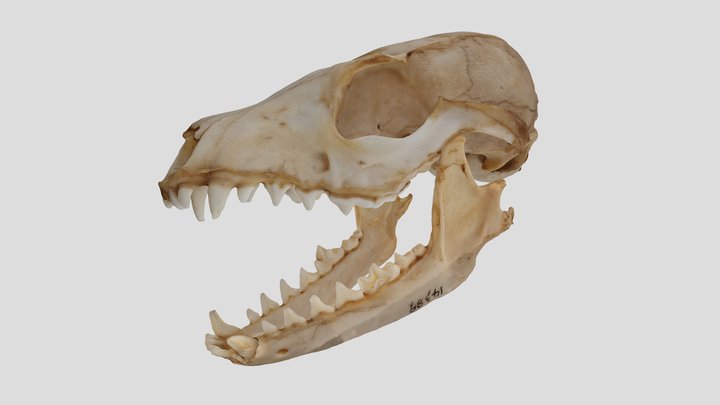
3D model
- Source
- Sketchfab
- Credit
- Yale Peabody Museum
- Licence
- CC Attribution
- Commercial use
- cannot be read from the licence given — check the record
Smithsonian Open Access and MorphoSource were not reached for this taxon, so this list is what the others held rather than everything there is.
The description on this site
- Source
- Wikipedia, “Island fox”
- Licence
- CC BY-SA 4.0
This is what the site found, which is not the same as what exists.
Keep going
What may have been alongside itUrocyon through timeFormations of the HoloceneThe world it lived on
Occurrence data from the Paleobiology Database, CC BY 4.0. (Baird 1857)