Turritella (Turritella) tricarinata
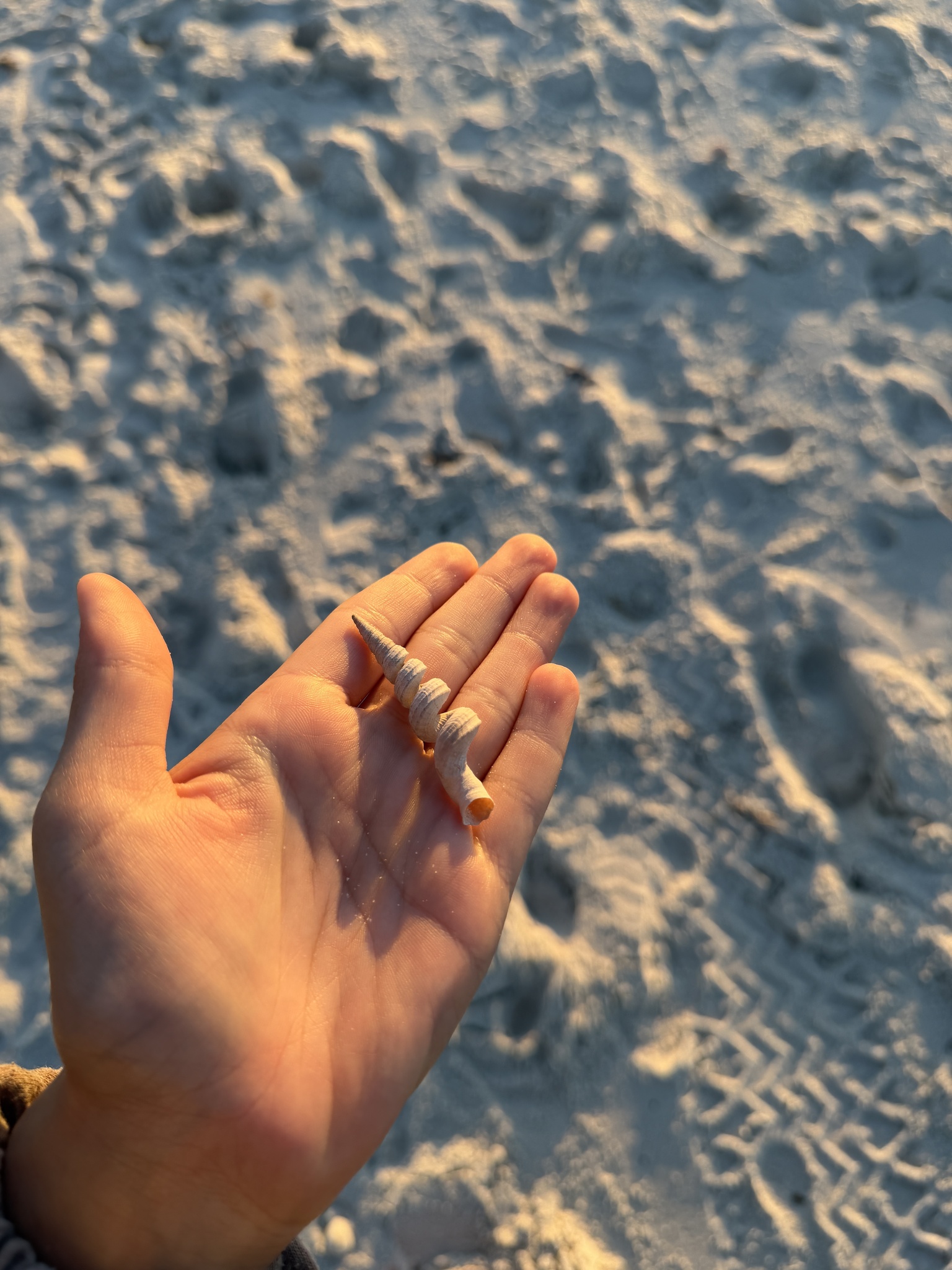
Not Turritella (Turritella) tricarinata. This is Vermicularia fargoi Olsson, 1951, a relative — both are Turritellidae.
Chloe Lynn · CC BY 4.0 · via GBIF. May be a photograph of a specimen, or an artist’s reconstruction — an interpretation of a skeleton, since colour and soft tissue are almost never preserved.
On record
Recorded, not inferred- Sits inside
- Turritella (Turritella)PBDB
- Diet
- suspension feederPBDB, for Turritella
- Life habit
- semi-infaunalPBDB, for Turritella
- Motility
- facultatively mobilePBDB, for Turritella
- Vision
- limitedPBDB, for Gastropoda
Time the record covers
At least 14 million years on record.
The record covers at least 15.98 Mya to 1.8 Mya. No occurrence read is dated outside 23.04 Mya to 774 ka.
18 occurrences of Turritella (Turritella) tricarinata on record, most of them in the Pliocene. Bar height is expected occurrences, not a count: each fossil is spread across the span it is dated to, so a tall narrow bar means tight dating and a low wide one means loose.
When
18 occurrences- Miocene39%
- Pliocene44%
- Pleistocene17%
These are dates about fossils, not the animal: the record can only begin after it arose and end before it died out, so either end may reach further. Shares are expected occurrences: a fossil dated to a span is counted partly in each period it straddles. More on what this infers.
Found in
11 formations
- Lillo Formation3
- Sabbie di Asti Formation2
- Gavdos Formation1
- Apostoli Formation1
- Kattendijk Formation1
- Alexandria Formation1
Loading coastlines…
The named rock units Turritella (Turritella) tricarinata has been recovered from, largest first. Drawn where the rock is now, not where it formed. 4 occurrences have no formation on record, which is common for older literature.
Turritella (Turritella) tricarinata and its relatives
PlioceneWhere Turritella (Turritella) tricarinata and its relatives were recorded in the Pliocene.
Found in the same rock
713 taxa- Aequipecten opercularis6 sites
- Bittium reticulatum6 sites
- Neverita josephinia6 sites
- Scapharca (Scapharca) diluvii6 sites
- Anomia ephippium5 sites
- Arca noae5 sites
- Chlamys (Chlamys) varia5 sites
- Diodora (Diodora) italica5 sites
- Natica (Natica) millepunctata5 sites
- Neopycnodonte navicularis5 sites
- Ostrea5 sites
- Pecten5 sites
- Persististrombus coronatus5 sites
- Talochlamys multistriata5 sites
- Xenophora5 sites
- Amusium4 sites
- Aporrhais4 sites
- Bolma4 sites
- Bolma rugosus4 sites
- Calyptraea chinensis4 sites
- Capulus ungaricus4 sites
- Chama gryphoides4 sites
- Chlamys4 sites
- Chlamys scabrellus4 sites
The Paleobiology Database records 10 sites for Turritella (Turritella) tricarinata, and this reads all of them. The number is how many of those sites it was catalogued from too. The 24 sharing the most are listed.
This is not a list of everything alive at the time. It is only what has come out of the same ground as this animal and been written down.
Entered from
12 references- Pliocene gastropod faunas from Kallo (Oost-Vlaanderen, Belgium) - Part 2. Caenogastropoda: Potamididae-Tornidae4
- Biozonation of the Neogene invertebrate megafauna of the Hellenic area3
- Les Mesogastropoda Fossiles du Cenozoïque étranger des Collections de L'Institute Royale des Sciences Naturelles de Belgique: Cyclophoridae à Stilifetidae2
- Paleobiology from Museum collections: comparing historical and novel data on Upper Miocene molluscs of the Livorno Hills1
- Lower to Middle Miocene Mollusc assemblages from the Torino Hills (NW Italy): Synthesis of new data and chronostratigraphical arrangement1
- First Emilian record of the boreal-affinity bivalve Portlandia impressa Perri, 1975 from Montefiore dell'Aso (Marche, Italy)1
- Nuove specie di Gasteropodi del Piacenziano di rio Crevalese, Castell’Arquato (Piacenza, Italia)1
- The Marine Gram Formation at Gram, Denmark: Late Miocene Geology and Palaeontology1
- Kasaba Miyosen havzasinin Gastropoda faunasi (Bati Toroslar, GB Türkiye)1
- Palaeoecology of some Mollusca from the Tielrode Sands (Pliocene, Belgium)1
- The Tertiary limestone of the southern coastal regions of Cape Province, South Africa1
- La faune Miocène de l'Île du Prince1
Each of the 18 occurrences read was entered from one of these publications, ordered by how many each accounts for. This is not a search for papers mentioning the name. Entries link to doi.org where the Paleobiology Database holds an identifier, and to its own record where it does not. Relayed as the Paleobiology Database holds them, not checked against what they resolve to.
Media and terms
Media content2
Picture of Vermicularia fargoi Olsson, 1951
- Source
- GBIF
- Credit
- Chloe Lynn
- Licence
- CC BY 4.0
- Commercial use
- the licence allows it
Photogrammetry
- Source
- MorphoSource
- Licence
- not stated by the source
- Commercial use
- cannot be read from the licence given — check the record
- Specimen
- turritella plebia · MST:PALEO:MST-SP-2935
This is what the site found, which is not the same as what exists.
Keep going
What may have been alongside itTurritella (Turritella) through timeFormations of the PlioceneThe world it lived on
Occurrence data from the Paleobiology Database, CC BY 4.0. (Brocchi 1814)