Torreya
Torreya is a genus of conifers comprising six or seven species placed in the family Taxaceae, though sometimes formerly placed in Cephalotaxaceae. Four species are native to eastern Asia; the other two are native to North America. They are small to medium-sized trees reaching 5–20 m, rarely 25 m, tall. Common names include nutmeg yew.

No machine-readable author provided. Bogdan assumed (based on copyright claims). · CC BY-SA 3.0 · via Wikipedia/Commons. May be a photograph of a specimen, or an artist’s reconstruction — an interpretation of a skeleton, since colour and soft tissue are almost never preserved.
On record
Recorded, not inferred- Sits inside
- TaxaceaePBDB
- Diet
- "photoautotroph"PBDB, for Streptophyta
Time the record covers
At least 167 million years on record.
The record covers at least 170.9 Mya to 3.55 Mya. No occurrence read is dated outside 174.7 Mya to 1.8 Mya.
25 occurrences of Torreya on record, most of them in the Middle Jurassic. The Paleobiology Database records this as a living group, and the chart stops with its fossils rather than at the present. Bar height is expected occurrences, not a count: each fossil is spread across the span it is dated to, so a tall narrow bar means tight dating and a low wide one means loose.
When
25 occurrences- Middle Jurassic32%
- Late Jurassic4%
- Late Cretaceous4%
- Eocene20%
- Oligocene24%
- Miocene8%
- Pliocene6%
- Pleistocene2%
These are dates about fossils, not the animal: the record can only begin after it arose and end before it died out, so either end may reach further. Shares are expected occurrences: a fossil dated to a span is counted partly in each period it straddles. More on what this infers.
Found in
15 formations
- John Day Formation4
- Lower Saltwick Formation · Ravenscar Group1
- Saltwick Formation · Ravenscar Group1
- Cloughton Formation · Ravenscar Group1
- Scalby Formation · Ravenscar Group1
- Tochikubo Formation1
Loading coastlines…
The named rock units Torreya has been recovered from, largest first. Drawn where the rock is now, not where it formed. 7 occurrences have no formation on record, which is common for older literature.
Torreya and its relatives
Middle JurassicWhere Torreya and its relatives were recorded in the Middle Jurassic.
Found in the same rock
426 taxa- Nilsonia9 sites
- Coniopteris7 sites
- Ctenis7 sites
- Czekanowskia7 sites
- Ginkgo7 sites
- Otozamites7 sites
- Quercus7 sites
- Brachyphyllum6 sites
- Cladophlebis6 sites
- Nilssoniopteris6 sites
- Picea6 sites
- Pseudoctenis6 sites
- Ptilophyllum6 sites
- Abies5 sites
- Baiera5 sites
- Eboracia5 sites
- Elatides5 sites
- Equisetum5 sites
- Eretmophyllum5 sites
- Phlebopteris5 sites
- Pterophyllum5 sites
- Sagenopteris5 sites
- Salix5 sites
- Acer4 sites
The Paleobiology Database records 17 sites for Torreya, and this reads all of them. The number is how many of those sites it was catalogued from too. The 24 sharing the most are listed.
This is not a list of everything alive at the time. It is only what has come out of the same ground as this animal and been written down.
Entered from
15 references- The Oligocene Bridge Creek flora of the John Day Formation, Oregon5
- The Yorkshire Jurassic Flora V. Coniferales4
- About the Middle Asia Jurassic flora2
- On stratigraphy of Jurassic continental deposits of the Yakkabag Mountain (Middle Asia)2
- Mio-Pliocene floras from west-central Nevada2
- The Eocene Thomas Ranch flora, Allenby Formation, Princeton, British Columbia, Canada1
- The McAbee flora of British Columbia and its relation to the Early-Middle Eocene Okanagan Highlands flora of the Pacific Northwest1
- Taxodium wallisii sp. nov.: First occurence of Taxodium from the Upper Cretaceous1
- The Oligocene Volcanic Flora of Kundratice near Litomerice, Ceske Stredohori Volcanic Complex (Czech Republic) - A review1
- A catalogue of Cenozoic megafossil plants in China1
- Fruits and seeds of the Middle Eocene Nut Beds Flora, Clarno Formation, Oregon1
- Neues aus dem Villafranchium von Hajnacka bei Filakovo (Slowakei, cssr)1
Each of the 25 occurrences read was entered from one of these publications, ordered by how many each accounts for. This is not a search for papers mentioning the name. 3 further references are not listed. Entries link to doi.org where the Paleobiology Database holds an identifier, and to its own record where it does not. Relayed as the Paleobiology Database holds them, not checked against what they resolve to.
Media and terms
Media content2
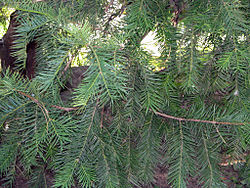
Picture of Torreya
- Source
- Wikipedia/Commons
- Credit
- No machine-readable author provided. Bogdan assumed (based on copyright claims).
- Licence
- CC BY-SA 3.0
- Commercial use
- the licence allows it
3D model
- Source
- Sketchfab
- Licence
- CC Attribution-NonCommercial-ShareAlike
- Commercial use
- the licence does not allow it
Smithsonian Open Access was not reached for this taxon, so this list is what the others held rather than everything there is.
The description on this site
- Source
- Wikipedia, “Torreya”
- Licence
- CC BY-SA 4.0
This is what the site found, which is not the same as what exists.
Keep going
What may have been alongside itTaxaceae through timeFormations of the Middle JurassicThe world it lived on
Occurrence data from the Paleobiology Database, CC BY 4.0. Arnott 1838