Tissotia
Tissotia is a genus of ammonites belonging to the family Tissotiidae.

Hectonichus · CC BY-SA 3.0 · via Wikipedia/Commons. May be a photograph of a specimen, or an artist’s reconstruction — an interpretation of a skeleton, since colour and soft tissue are almost never preserved.
On record
Recorded, not inferred- Sits inside
- TissotiidaePBDB
- Diet
- carnivorePBDB, for Ammonoidea
- Life habit
- nektonicPBDB, for Ammonoidea
- Motility
- fast-movingPBDB, for Ammonoidea
- Vision
- well-developedPBDB, for Cephalopoda
- Environment
- marinePBDB, for Cephalopoda
Time the record covers
At least 4.1 million years on record.
The record covers at least 89.8 Mya to 85.7 Mya. No occurrence read is dated outside 93.9 Mya to 83.6 Mya.
35 occurrences of Tissotia on record, most of them in the Late Cretaceous. Bar height is expected occurrences, not a count: each fossil is spread across the span it is dated to, so a tall narrow bar means tight dating and a low wide one means loose.
When
35 occurrences- Late Cretaceous100%
These are dates about fossils, not the animal: the record can only begin after it arose and end before it died out, so either end may reach further. Shares are expected occurrences: a fossil dated to a span is counted partly in each period it straddles. More on what this infers.
Found in
6 formations
- Chonta Formation14
- Mungo River Formation11
- Awgu Ndeaboh Shale Formation4
- Celendín Formation3
- Craie de Villedieu Formation1
- Carregador de Carreu Formation1
Loading coastlines…
The named rock units Tissotia has been recovered from, largest first. Drawn where the rock is now, not where it formed. 1 occurrence has no formation on record, which is common for older literature.
Tissotia and its relatives
Late CretaceousWhere Tissotia and its relatives were recorded in the Late Cretaceous.
Found in the same rock
107 taxa- Peroniceras3 sites
- Solgerites brancoi3 sites
- Barroisiceras2 sites
- Buchiceras bilobatum2 sites
- Eulophoceras2 sites
- Forresteria (Forresteria) camerounensis2 sites
- Gauthiericeras margae2 sites
- Lenticeras2 sites
- Lenticeras baltai2 sites
- Lima (Plagiostoma) grenieri2 sites
- Nicaisolopha nicaisei2 sites
- Paratexanites zeilleri2 sites
- Peroniceras latelobatum2 sites
- Pholadomya2 sites
- Pseudocucullaea lens2 sites
- Venericardia2 sites
- Agelasina plenodonta1 site
- Astarte1 site
- Asteroidea1 site
- Barrioidiceras haberfellneri1 site
- Barroisiceras (Barroisiceras) kayi1 site
- Biradiolites1 site
- Bivalvia1 site
- Brachidontes1 site
The Paleobiology Database records 16 sites for Tissotia, and this reads all of them. The number is how many of those sites it was catalogued from too. The 24 sharing the most are listed.
This is not a list of everything alive at the time. It is only what has come out of the same ground as this animal and been written down.
Entered from
9 references- Geological reconnaissance of the Contamana region, Peru14
- The Cretaceous Ammonoidea of southern Nigeria and the southern Cameroons8
- Cretaceous system in northern Peru3
- The stratigraphy of the southern Cameroons3
- Die Oberkreide vom Mungofluß in Kamerun und ihre Fauna2
- Die Fossilien der Mungokreide in Kamerun und ihre geologische Bedeutung, mit besonderer Berücksichtigung der Ammoniten2
- Coniacian-Maastrichtian of the Tremp Area (South Central Pyrenees)1
- Litho- and biostratigraphical observations on the type sections of the Craie de Villedieu Formation (Upper Cretaceous, western France)1
- Biogeography of the Saharan Cretaceous and Paleocene epicontinental transgressions1
Each of the 35 occurrences read was entered from one of these publications, ordered by how many each accounts for. This is not a search for papers mentioning the name. Entries link to doi.org where the Paleobiology Database holds an identifier, and to its own record where it does not. Relayed as the Paleobiology Database holds them, not checked against what they resolve to.
Media and terms
Media content2

Picture of Tissotia
- Source
- Wikipedia/Commons
- Credit
- Hectonichus
- Licence
- CC BY-SA 3.0
- Commercial use
- the licence allows it
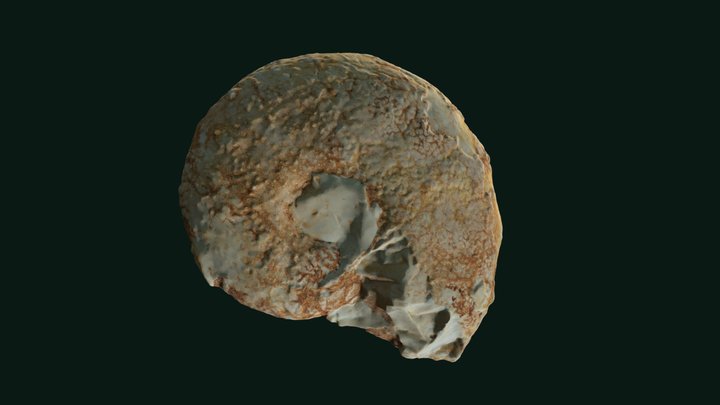
3D model
- Source
- Sketchfab
- Credit
- Shellie Luallin
- Licence
- CC Attribution
- Commercial use
- cannot be read from the licence given — check the record
The description on this site
- Source
- Wikipedia, “Tissotia”
- Licence
- CC BY-SA 4.0
This is what the site found, which is not the same as what exists.
Keep going
What may have been alongside itTissotiidae through timeFormations of the Late CretaceousThe world it lived on
Occurrence data from the Paleobiology Database, CC BY 4.0. Douvillé 1890