Thalattosuchia
Thalattosuchia is a clade of mostly marine crocodylomorphs from the Early Jurassic to the Early Cretaceous that had a cosmopolitan distribution. They are colloquially referred to as marine crocodiles or sea crocodiles, though they are not members of Crocodilia and records from Thailand and China suggest that some members lived in freshwater. The clade contains two major subgroupings, the Teleosauroidea and Metriorhynchoidea. Teleosauroids are not greatly specialised for oceanic life, with back osteoderms similar to other crocodyliformes. Within Metriorhynchoidea, the Metriorhynchidae displayed extreme adaptions for life in the open ocean, including the transformation of limbs into flippers, the development of a tail fluke, and smooth, scaleless skin, and probably gave live birth, seemingly uniquely among archosaurs.

Ghedoghedo · CC BY-SA 3.0 · via Wikipedia/Commons. May be a photograph of a specimen, or an artist’s reconstruction — an interpretation of a skeleton, since colour and soft tissue are almost never preserved.
On record
Recorded, not inferred- Also called
- marine crocodilePBDB
- Sits inside
- CrocodylomorphaPBDB
- Diet
- carnivorePBDB
- Life habit
- nektonicPBDB
- Motility
- actively mobilePBDB
- Environment
- marinePBDB
Time the record covers
At least 73 million years on record.
The record covers at least 192.9 Mya to 119.57 Mya. No occurrence read is dated outside 201.4 Mya to 100.5 Mya.
463 occurrences of Thalattosuchia on record, most of them in the Late Jurassic. The Paleobiology Database records this as a living group, and the chart stops with its fossils rather than at the present. Bar height is expected occurrences, not a count: each fossil is spread across the span it is dated to, so a tall narrow bar means tight dating and a low wide one means loose.
When
463 occurrencesThese are dates about fossils, not the animal: the record can only begin after it arose and end before it died out, so either end may reach further. Shares are expected occurrences: a fossil dated to a span is counted partly in each period it straddles. More on what this infers.
Found in
105 formations
- Oxford Clay Formation · Ancholme Group33
- Kimmeridge Clay Formation · Ancholme Group30
- Posidonia Shale Formation19
- Vaca Muerta Formation16
- El Mers Formation11
- Alum Shale Formation9
Loading coastlines…
The named rock units Thalattosuchia has been recovered from, largest first. Drawn where the rock is now, not where it formed. 81 further formations hold fewer occurrences each and are not listed. 137 occurrences have no formation on record, which is common for older literature.
Thalattosuchia and its relatives
Late JurassicWhere Thalattosuchia and its relatives were recorded in the Late Jurassic.
Found in the same rock
932 taxa- Steneosaurus46 sites
- Macrospondylus bollensis19 sites
- Metriorhynchidae18 sites
- Machimosaurus hugii17 sites
- Theropoda16 sites
- Ichthyosauria15 sites
- Lepidotes15 sites
- Plesiosauria14 sites
- Machimosaurus13 sites
- Sauropoda13 sites
- Dakosaurus12 sites
- Dakosaurus maximus12 sites
- Pterosauria11 sites
- Pliosauridae10 sites
- Teleosauridae10 sites
- Teleosaurus10 sites
- Hybodus9 sites
- Caturus8 sites
- Geosaurus8 sites
- Goniopholis8 sites
- Metriorhynchus8 sites
- Megalosaurus7 sites
- Osteichthyes7 sites
- Pliosaurus7 sites
The Paleobiology Database records 323 sites for Thalattosuchia, and this reads 240 of them. The number is how many of those sites it was catalogued from too. The 24 sharing the most are listed.
This is not a list of everything alive at the time. It is only what has come out of the same ground as this animal and been written down.
Entered from
179 references- Die Krokodilier des Deutschen und Englischen Oberen Lias [The crocodiles of the German and English Upper Lias]28
- Revision of the Late Jurassic teleosaurid genus Machimosaurus (Crocodylomorpha, Thalattosuchia)17
- Note sur le Squelette et la Restauration du Teleosaurus cadomensis [Note on the skeleton and restoration of Teleosaurus cadomensis]15
- The mystery of Mystriosaurus: Redescribing the poorly known Early Jurassic teleosauroid thalattosuchians Mystriosaurus laurillardi and Steneosaurus brevior14
- Mémoire sur les dinosauriens et les crocodiliens des terrains jurassiques de Boulogne-sur-Mer [Memoir on the dinosaurs and crocodilians of the Jurassic deposits of Boulogne-sur-mer]12
- A new species of Cricosaurus (Thalattosuchia: Crocodylomorpha) from southern Germany: the first three-dimensionally preserved Cricosaurus skull from the Solnhofen Archipelago11
- Kimmeridgian metriorhynchid crocodiles from England11
- Étude paléontologique des vertébrés du Jurassique d'El Mers (Moyen Atlas) [Paleontological study of the Jurassic veretebrates from El Mers (Middle Atlas)]11
- Andrews, 191311
- The cranial osteology and feeding ecology of the metriorhynchid crocodylomorph genera Dakosaurus and Plesiosuchus from the Late Jurassic of Europe10
- A catalogue of teleosauroids (Crocodylomorpha: Thalattosuchia) from the Toarcian and Bajocian (Jurassic) of southern Luxembourg9
- The evolution of extreme hypercarnivory in Metriorhynchidae (Mesoeucrocodylia: Thalattosuchia) based on evidence from microscopic denticle morphology9
Each of the 463 occurrences read was entered from one of these publications, ordered by how many each accounts for. This is not a search for papers mentioning the name. 167 further references are not listed. Entries link to doi.org where the Paleobiology Database holds an identifier, and to its own record where it does not. Relayed as the Paleobiology Database holds them, not checked against what they resolve to.
Media and terms
Media content3
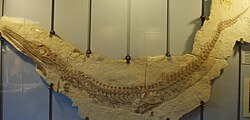
Picture of Thalattosuchia
- Source
- Wikipedia/Commons
- Credit
- Ghedoghedo
- Licence
- CC BY-SA 3.0
- Commercial use
- the licence allows it

CT scan
- Source
- MorphoSource
- Licence
- In Copyright
- Commercial use
- cannot be read from the licence given — check the record
- Specimen
- Thalattosuchia indet. · UNIBA:AČ:DE-vPAL 9 in situ
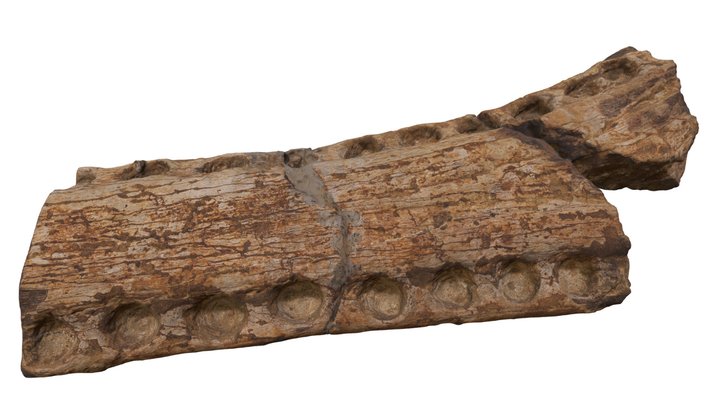
3D model
- Source
- Sketchfab
- Licence
- CC Attribution
- Commercial use
- cannot be read from the licence given — check the record
Smithsonian Open Access was not reached for this taxon, so this list is what the others held rather than everything there is.
The description on this site
- Licence
- CC BY-SA 4.0
This is what the site found, which is not the same as what exists.
Keep going
What may have been alongside itCrocodylomorpha through timeFormations of the Late JurassicThe world it lived on
Occurrence data from the Paleobiology Database, CC BY 4.0. (Fraas 1901)