Metriorhynchidae
Metriorhynchidae is an extinct family of specialized, aquatic metriorhynchoid crocodyliforms from the Middle Jurassic to the Early Cretaceous period of Europe, North America and South America. The name Metriorhynchidae was coined by the Austrian zoologist Leopold Fitzinger in 1843. The group contains two subfamilies, the Metriorhynchinae and the Geosaurinae. They represent the most marine adapted of all archosaurs.

Uncredited · via Wikipedia/Commons. May be a photograph of a specimen, or an artist’s reconstruction — an interpretation of a skeleton, since colour and soft tissue are almost never preserved.
On record
Recorded, not inferred- Sits inside
- EuthalattosuchiaPBDB
- Diet
- carnivorePBDB, for Thalattosuchia
- Life habit
- nektonicPBDB, for Thalattosuchia
- Motility
- actively mobilePBDB, for Thalattosuchia
- Environment
- marinePBDB, for Thalattosuchia
Time the record covers
At least 45 million years on record.
The record covers at least 165.3 Mya to 119.57 Mya. No occurrence read is dated outside 170.9 Mya to 113.2 Mya.
183 occurrences of Metriorhynchidae on record, most of them in the Late Jurassic. Bar height is expected occurrences, not a count: each fossil is spread across the span it is dated to, so a tall narrow bar means tight dating and a low wide one means loose.
When
183 occurrencesThese are dates about fossils, not the animal: the record can only begin after it arose and end before it died out, so either end may reach further. Shares are expected occurrences: a fossil dated to a span is counted partly in each period it straddles. More on what this infers.
Found in
43 formations
- Kimmeridge Clay Formation · Ancholme Group24
- Oxford Clay Formation · Ancholme Group19
- Vaca Muerta Formation16
- Torleite Formation · Weißjura Group6
- Mörnsheim Formation · Weißjura Group6
- Jagua Formation5
Loading coastlines…
The named rock units Metriorhynchidae has been recovered from, largest first. Drawn where the rock is now, not where it formed. 19 further formations hold fewer occurrences each and are not listed. 44 occurrences have no formation on record, which is common for older literature.
Metriorhynchidae and its relatives
Late JurassicWhere Metriorhynchidae and its relatives were recorded in the Late Jurassic.
Found in the same rock
493 taxa- Dakosaurus maximus15 sites
- Dakosaurus12 sites
- Ichthyosauria12 sites
- Plesiosauria10 sites
- Pliosauridae10 sites
- Geosaurus9 sites
- Metriorhynchus9 sites
- Sauropoda7 sites
- Steneosaurus7 sites
- Thalattosuchus superciliosus7 sites
- Dakosaurus andiniensis6 sites
- Metriorhynchinae6 sites
- Metriorhynchus brachyrhynchus6 sites
- Pliosaurus6 sites
- Thalassophonea6 sites
- Cricosaurus5 sites
- Ichthyosaurus5 sites
- Pterosauria5 sites
- Torvoneustes5 sites
- Tyrannoneustes lythrodectikos5 sites
- Cryptoclidus4 sites
- Elasmosauridae4 sites
- Liopleurodon ferox4 sites
- Machimosaurus hugii4 sites
The Paleobiology Database records 132 sites for Metriorhynchidae, and this reads all of them. The number is how many of those sites it was catalogued from too. The 24 sharing the most are listed.
This is not a list of everything alive at the time. It is only what has come out of the same ground as this animal and been written down.
Entered from
92 references- The mystery of Mystriosaurus: Redescribing the poorly known Early Jurassic teleosauroid thalattosuchians Mystriosaurus laurillardi and Steneosaurus brevior12
- A new species of Cricosaurus (Thalattosuchia: Crocodylomorpha) from southern Germany: the first three-dimensionally preserved Cricosaurus skull from the Solnhofen Archipelago11
- Kimmeridgian metriorhynchid crocodiles from England11
- The cranial osteology and feeding ecology of the metriorhynchid crocodylomorph genera Dakosaurus and Plesiosuchus from the Late Jurassic of Europe10
- The evolution of extreme hypercarnivory in Metriorhynchidae (Mesoeucrocodylia: Thalattosuchia) based on evidence from microscopic denticle morphology9
- Re-description of a putative Early Cretaceous "teleosaurid" from France, with implications for the survival of metriorhynchids and teleosaurids across the Jurassic-Cretaceous Boundary8
- Andrews, 19136
- Jurassic marine reptiles of the Neuquen Basin: records, faunas, and their palaeobiogeographic significance4
- Solnhofen tetrapod taphonomy4
- Les Thalattosuchia jurassiques de Normandie des collections Vautier et Morière : contexte histo- rique et redécouverte des plastotypes3
- Postcranial skeleton of Cricosaurus araucanensis (Crocodyliformes: Thalattosuchia): morphology and palaeobiological insights3
- The oldest known metriorhynchid super-predator: a new genus and species from the Middle Jurassic of England, with implications for serration and mandibular evolution in predacious clades3
Each of the 183 occurrences read was entered from one of these publications, ordered by how many each accounts for. This is not a search for papers mentioning the name. 80 further references are not listed. Entries link to doi.org where the Paleobiology Database holds an identifier, and to its own record where it does not. Relayed as the Paleobiology Database holds them, not checked against what they resolve to.
Media and terms
Media content1
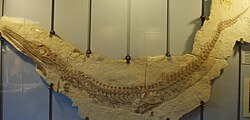
Picture of Metriorhynchidae
- Source
- Wikipedia/Commons
- Credit
- nobody named on the record
- Licence
- not stated by the source
- Commercial use
- cannot be read from the licence given — check the record
No 3D scan of Metriorhynchidae was found in Sketchfab.
Smithsonian Open Access and MorphoSource were not reached for this taxon, so this list is what the others held rather than everything there is.
The description on this site
- Licence
- CC BY-SA 4.0
This is what the site found, which is not the same as what exists.
Keep going
What may have been alongside itEuthalattosuchia through timeFormations of the Late JurassicThe world it lived on
Occurrence data from the Paleobiology Database, CC BY 4.0. Fitzinger 1843