Tetraodontidae
Tetraodontidae is a family of marine and freshwater fish in the order Tetraodontiformes. The family includes many familiar species variously called pufferfishes, puffers, balloonfishes, blowfishes, blowers, blowies, bubblefishes, globefishes, swellfishes, toadfishes, toadies, botetes, toadle, honey toads, sugar toads, and sea squabs. They are morphologically similar to the closely related porcupinefish, which have large external spines. The family name comes from Ancient Greek τετρα- (tetra-), meaning "four", and ὀδούς (odoús), meaning "tooth", referring to the four teeth of the type genus Tetraodon.

National Oceanic and Atmospheric Administration · Public Domain · via Wikipedia/Commons. May be a photograph of a specimen, or an artist’s reconstruction — an interpretation of a skeleton, since colour and soft tissue are almost never preserved.
On record
Recorded, not inferred- Sits inside
- TetraodontoideiPBDB
- Diet
- carnivorePBDB, for Tetraodontiformes
- Life habit
- nektonicPBDB, for Tetraodontiformes
- Motility
- actively mobilePBDB, for Tetraodontiformes
Time the record covers
At least 48 million years on record.
The record covers at least 48.07 Mya to 11.7 ka. No occurrence read is dated outside 56 Mya to 0 Mya.
55 occurrences of Tetraodontidae on record, most of them in the Miocene. The Paleobiology Database records this as a living group. Bar height is expected occurrences, not a count: each fossil is spread across the span it is dated to, so a tall narrow bar means tight dating and a low wide one means loose.
When
55 occurrencesThese are dates about fossils, not the animal: the record can only begin after it arose and end before it died out, so either end may reach further. Shares are expected occurrences: a fossil dated to a span is counted partly in each period it straddles. More on what this infers.
Found in
19 formations
- Koobi Fora Formation7
- Nyabusosi Formation · Albertine Group4
- Nkondo Formation · Albertine Group4
- Nachukui Formation2
- Lagos-Portimão Formation2
- Yorktown Formation · Chesapeake Group1
Loading coastlines…
The named rock units Tetraodontidae has been recovered from, largest first. Drawn where the rock is now, not where it formed. 22 occurrences have no formation on record, which is common for older literature.
Tetraodontidae and its relatives
MioceneWhere Tetraodontidae and its relatives were recorded in the Miocene.
Found in the same rock
1,535 taxa- Tetraodon26 sites
- Hydrocynus15 sites
- Hemipristis serra13 sites
- Synodontis13 sites
- Otodus megalodon11 sites
- Carcharias taurus10 sites
- Gymnarchus10 sites
- Labeo sp.10 sites
- Carcharhinus9 sites
- Dasyatis9 sites
- Sindacharax sp.9 sites
- Barbus8 sites
- Isurus oxyrinchus8 sites
- Lates niloticus8 sites
- Sphyraena8 sites
- Myliobatis7 sites
- Pagrus7 sites
- Polypterus7 sites
- Aetobatus6 sites
- Bunocharax sp.6 sites
- Carcharhinus priscus6 sites
- Carcharodon hastalis6 sites
- Cichlidae6 sites
- Equus6 sites
The Paleobiology Database records 50 sites for Tetraodontidae, and this reads all of them. The number is how many of those sites it was catalogued from too. The 24 sharing the most are listed.
This is not a list of everything alive at the time. It is only what has come out of the same ground as this animal and been written down.
Entered from
40 references- Paleoecology of Late Cenozoic Fishes from the Turkana Basin, Northern Kenya5
- Review of the fossil pufferfish genus Archaeotetraodon (Teleostei, Tetraodontidae), with description of three new taxa from the Miocene of Italy4
- The systematic composition of the Eocene actinopterygian fish fauna from Monte Bolca, northern Italy, as known to date2
- Lothagam: the dawn of humanity in eastern Africa2
- Les vertébrés du Miocène moyen de Contres (Loir-et-Cher, France)2
- Review and reconstructions of the tetraodontiform fishes from the Eocene of Monte Bolca, Italy, with comments on related Tertiary taxa2
- Life on the edge: prehistoric settlement and economy on Utrōk Atoll, northern Marshall Islands2
- Evolution of bovid diversity in the Plio-Pleistocene of Africa2
- Carnivora from Nkondo and Kisegi-Nyabusosi,Western Rift, Uganda2
- Vertébrés (crocodiliens, poissons) du Miocène marin de l'Argarve occidentale2
- Archaeotetraodon cerrinaferoni, sp. nov. (Teleostei: Tetraodontidae), from the Miocene (Messinian) of Chelif Basin, Algeria1
- Badenian palaeoenvironment, faunal succesion and biostratigraphy: A case study from Northern Vienna Basin, Devinska Nova Ves-Bonanza site (Western Carpathians, Slovakia)1
Each of the 55 occurrences read was entered from one of these publications, ordered by how many each accounts for. This is not a search for papers mentioning the name. 28 further references are not listed. Entries link to doi.org where the Paleobiology Database holds an identifier, and to its own record where it does not. Relayed as the Paleobiology Database holds them, not checked against what they resolve to.
Media and terms
Media content2

Picture of Tetraodontidae
- Source
- Wikipedia/Commons
- Credit
- National Oceanic and Atmospheric Administration
- Licence
- Public Domain
- Commercial use
- the licence allows it
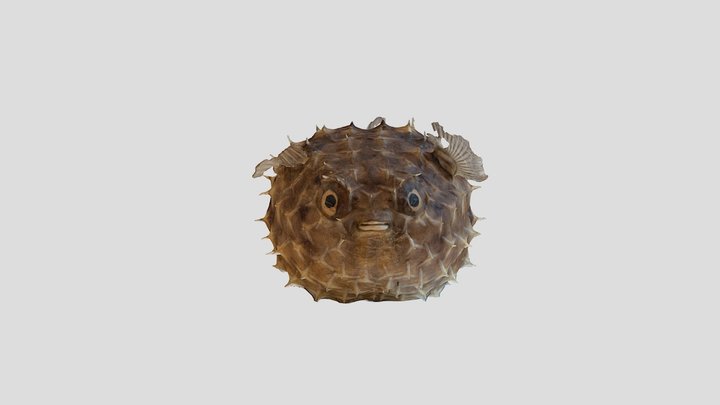
Smithsonian Open Access and MorphoSource were not reached for this taxon, so this list is what the others held rather than everything there is.
The description on this site
- Licence
- CC BY-SA 4.0
This is what the site found, which is not the same as what exists.
Keep going
What may have been alongside itTetraodontoidei through timeFormations of the MioceneThe world it lived on
Occurrence data from the Paleobiology Database, CC BY 4.0.