Tethyaster
Tethyaster is a genus of echinoderms belonging to the family Astropectinidae.

FWC Fish and Wildlife Research Institute · CC BY 2.0 · via Wikipedia/Commons. May be a photograph of a specimen, or an artist’s reconstruction — an interpretation of a skeleton, since colour and soft tissue are almost never preserved.
On record
Recorded, not inferred- Sits inside
- AstropectinidaePBDB
- Diet
- carnivorePBDB, for Astropectinidae
- Life habit
- semi-infaunal, solitaryPBDB, for Astropectinidae
- Motility
- slow-movingPBDB, for Astropectinidae
- Vision
- limitedPBDB, for Asteroidea
- Environment
- marinePBDB, for Astropectinidae
Time the record covers
At least 105 million years on record.
The record covers at least 161.5 Mya to 56 Mya. No occurrence read is dated outside 174.7 Mya to 48.07 Mya.
7 occurrences of Tethyaster on record. The Paleobiology Database records this as a living group, and the chart stops with its fossils rather than at the present. Bar height is expected occurrences, not a count: each fossil is spread across the span it is dated to, so a tall narrow bar means tight dating and a low wide one means loose.
When
7 occurrencesThese are dates about fossils, not the animal: the record can only begin after it arose and end before it died out, so either end may reach further. Shares are expected occurrences: a fossil dated to a span is counted partly in each period it straddles. More on what this infers.
Found in
5 formations
- Marnes de Foncouverte Formation2
- Carmel Formation2
- Le Mans Formation1
- Cardium Formation · Colorado Group1
- Mulichinco Formation · Mendoza Group1
Loading coastlines…
The named rock units Tethyaster has been recovered from, largest first. Drawn where the rock is now, not where it formed.
Found in the same rock
43 taxa- Calliderma atagensis2 sites
- Chlamys2 sites
- Cidaris2 sites
- Conocrinus2 sites
- Crateraster lamberti2 sites
- Exogyra2 sites
- Ostrea2 sites
- Ostrea (Alectryonia)2 sites
- Pycinaster corbaricus2 sites
- Recurvaster migrans2 sites
- Rhabdocidaris2 sites
- Spondylus2 sites
- Teredo2 sites
- Venericardia2 sites
- Vulsella2 sites
- Amblypygus1 site
- Antedon1 site
- Baueria1 site
- Brunnaega labuttensis1 site
- Cardium (Orthocardium) porulosum1 site
- Cenomanaster cenomanensis1 site
- Cenomanocarcinus inflatus1 site
- Chama1 site
- Conoclypeus1 site
The Paleobiology Database records 7 sites for Tethyaster, and this reads all of them. The number is how many of those sites it was catalogued from too. The 24 sharing the most are listed.
This is not a list of everything alive at the time. It is only what has come out of the same ground as this animal and been written down.
Entered from
5 references- Astérides (Echinodermata) de l'Ilerdien moyen (Yprésien) des Corbières (Aude, France) : systématique, relations paléobiogéographiques et évolutives2
- Some new post-Paleozoic sea stars (Asteroidea: Echinodermata) and comments on taxon endurance2
- An Early Cretaceous astropectinid (Echinodermata, Asteroidea) from Patagonia (Argentina): A new species and the oldest record of the family for the Southern Hemisphere1
- Tethyaster guerangeri sp. nov. (Astropectinidae, Asteroidea, Echinodermata) : deux spécimens d'astérides d'une conservation exceptionnelle du cénomanien du Mans (Sarthe, France)1
- ? Tethyaster albertensis, a Late Cretaceous (Turonian) Sea Star from the Cardium Formation,Alberta, Canada1
Each of the 7 occurrences read was entered from one of these publications, ordered by how many each accounts for. This is not a search for papers mentioning the name. Entries link to doi.org where the Paleobiology Database holds an identifier, and to its own record where it does not. Relayed as the Paleobiology Database holds them, not checked against what they resolve to.
Media and terms
Media content1
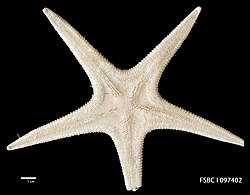
Picture of Tethyaster
- Source
- Wikipedia/Commons
- Credit
- FWC Fish and Wildlife Research Institute
- Licence
- CC BY 2.0
- Commercial use
- the licence allows it
No 3D scan of Tethyaster was found in MorphoSource and Sketchfab.
Smithsonian Open Access was not reached for this taxon, so this list is what the others held rather than everything there is.
The description on this site
- Source
- Wikipedia, “Tethyaster”
- Licence
- CC BY-SA 4.0
This is what the site found, which is not the same as what exists.
Keep going
What may have been alongside itAstropectinidae through timeThe world it lived on
Occurrence data from the Paleobiology Database, CC BY 4.0. Sladen 1889