Terebralia palustris
Terebralia palustris, commonly known as the giant mangrove whelk, is a species of brackish-water snail, a mollusk in the family Potamididae. This tropical species which inhabits mangrove environments of the Indo-West Pacific region, has the widest geographic distribution amongst the potamidids extending from eastern Africa to northern Australia. Terebralia palustris is the largest mangrove gastropod, with a maximum shell length of 190 mm recorded from Arnhem Land, Australia.

Christoph Kühne · CC BY 2.0 · via Wikipedia/Commons. May be a photograph of a specimen, or an artist’s reconstruction — an interpretation of a skeleton, since colour and soft tissue are almost never preserved.
On record
Recorded, not inferred- Sits inside
- TerebraliaPBDB
- Diet
- grazerPBDB, for Potamididae
- Life habit
- epifaunalPBDB, for Potamididae
- Motility
- actively mobilePBDB, for Potamididae
- Vision
- limitedPBDB, for Gastropoda
Time the record covers
At least 2.5 million years on record.
The record covers at least 2.58 Mya to 11.7 ka. No occurrence read is dated outside 3.6 Mya to 0 Mya.
15 occurrences of Terebralia palustris on record, most of them in the Pleistocene. The Paleobiology Database records this as a living group. Bar height is expected occurrences, not a count: each fossil is spread across the span it is dated to, so a tall narrow bar means tight dating and a low wide one means loose.
When
15 occurrences- Pliocene7%
- Pleistocene87%
- Holocene7%
These are dates about fossils, not the animal: the record can only begin after it arose and end before it died out, so either end may reach further. Shares are expected occurrences: a fossil dated to a span is counted partly in each period it straddles. More on what this infers.
Found in
3 formations
- Batuputih Formation · Kupang Group1
- Esprit Limestone Formation1
- Ananai Formation1
Loading coastlines…
The named rock units Terebralia palustris has been recovered from, largest first. Drawn where the rock is now, not where it formed. 12 occurrences have no formation on record, which is common for older literature.
Terebralia palustris and its relatives
PleistoceneWhere Terebralia palustris and its relatives were recorded in the Pleistocene.
Found in the same rock
201 taxa- Codakia tigerina4 sites
- Conus4 sites
- Conus generalis4 sites
- Erosaria turdus4 sites
- Strombus (Gibberulus) gibberulus4 sites
- Anadara (Anadara) antiquata3 sites
- Cerithium3 sites
- Naria erosa3 sites
- Plicatula plicata3 sites
- Tritia3 sites
- Ancilla (Sparella) cinnamomea2 sites
- Arca imbricata arabica2 sites
- Barbatia (Barbatia) lacerata2 sites
- Cardita variegata2 sites
- Clementia (Clementia) papyracea2 sites
- Conus arenatus2 sites
- Conus textile2 sites
- Diplodonta globosa2 sites
- Hyotissa hyotis2 sites
- Macrocallista2 sites
- Mauritia arabica2 sites
- Melongena2 sites
- Mesodesma2 sites
- Nassarius (Nassarius) arcularia2 sites
The Paleobiology Database records 9 sites for Terebralia palustris, and this reads all of them. The number is how many of those sites it was catalogued from too. The 24 sharing the most are listed.
This is not a list of everything alive at the time. It is only what has come out of the same ground as this animal and been written down.
Entered from
10 references- Mollusques Pleistocenes de la Cote Francaise des Somalis [Pleistocene molluscs from French Somaliland]3
- Molluschi delle spiagge emerse del Mar Rosso e dell'Oceano Indiano, introduzione e parte I (gasteropodi) [Mollusks from raised beaches bordering the Red Sea and the Indian Ocean, introduction and part I (gastropods)]3
- Late Pleistocene gastropods from the raised reefal limestone of Jeddah, Saudi Arabia: taxonomic and palaeoenvironmental implications2
- Pleistocene Coral Reef Terraces on the Saudi Arabian Side of the Gulf of Aqaba, Red Sea1
- Occurrence of Hartungia (Gastropoda: Janthinidae) from the Tonohama Group, Kochi Prefecture, Japan1
- Early Pleistocene gastropods from Timor1
- Mandu Mandu Creek Rockshelter: Pleistocene Human Coastal Occupation of North West Cape, Western Australia1
- Late Pleistocene molluscan assemblages from the coral reefs of the Kenya coast1
- Faunal response to the instability of reef habitats: Pleistocene molluscan assemblages of Aldabra Atoll1
- Appendix 1: Fossiliferous limestone of Quaternary age from Nauru1
Each of the 15 occurrences read was entered from one of these publications, ordered by how many each accounts for. This is not a search for papers mentioning the name. Entries link to doi.org where the Paleobiology Database holds an identifier, and to its own record where it does not. Relayed as the Paleobiology Database holds them, not checked against what they resolve to.
Media and terms
Media content2

Picture of Terebralia palustris
- Source
- Wikipedia/Commons
- Credit
- Christoph Kühne
- Licence
- CC BY 2.0
- Commercial use
- the licence allows it
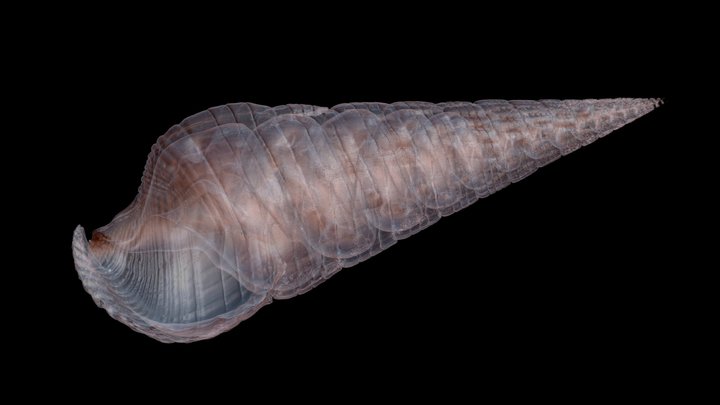
3D model
- Source
- Sketchfab
- Licence
- CC Attribution-NonCommercial-ShareAlike
- Commercial use
- the licence does not allow it
Smithsonian Open Access was not reached for this taxon, so this list is what the others held rather than everything there is.
The description on this site
- Licence
- CC BY-SA 4.0
This is what the site found, which is not the same as what exists.
Keep going
What may have been alongside itTerebralia through timeFormations of the PleistoceneThe world it lived on
Occurrence data from the Paleobiology Database, CC BY 4.0. (Linnaeus 1767)