Telicomys
Telicomys is an extinct genus of rodent from the Solimões Formation, Brazil, South America.

Andrés Rinderknecht, Washington W. Jones, Ney Araújo, Gustavo Grinspan, and R. Ernesto Blanco · CC BY 4.0 · via Wikipedia/Commons. May be a photograph of a specimen, or an artist’s reconstruction — an interpretation of a skeleton, since colour and soft tissue are almost never preserved.
On record
Recorded, not inferred- Sits inside
- DinomyidaePBDB
- Diet
- frugivore, folivorePBDB, for Dinomyidae
- Life habit
- ground dwellingPBDB, for Dinomyidae
- Motility
- actively mobilePBDB, for Osteichthyes
- Environment
- terrestrialPBDB, for Eutheria
Time the record covers
At least 3.4 million years on record.
The record covers at least 7.246 Mya to 3.8 Mya. No occurrence read is dated outside 11.63 Mya to 3 Mya.
8 occurrences of Telicomys on record, most of them in the Miocene. Bar height is expected occurrences, not a count: each fossil is spread across the span it is dated to, so a tall narrow bar means tight dating and a low wide one means loose.
When
8 occurrencesThese are dates about fossils, not the animal: the record can only begin after it arose and end before it died out, so either end may reach further. Shares are expected occurrences: a fossil dated to a span is counted partly in each period it straddles. More on what this infers.
Found in
5 formations
- Solimoes Formation3
- Chapadmalal Formation2
- Solimões Formation1
- Monte Hermoso Formation1
- Puerto Belgrano Formation1
Loading coastlines…
The named rock units Telicomys has been recovered from, largest first. Drawn where the rock is now, not where it formed.
Telicomys and its relatives
MioceneWhere Telicomys and its relatives were recorded in the Miocene.
Found in the same rock
248 taxa- Cardiomys3 sites
- Chorobates3 sites
- Lutreolina tracheia3 sites
- Macrochorobates3 sites
- Microcavia3 sites
- Orthomyctera3 sites
- Plohophoroides3 sites
- Trachycalyptus3 sites
- Xotodon3 sites
- Argyrohyus2 sites
- Argyrolagus2 sites
- Brachytherium2 sites
- Cyonasua2 sites
- Dasyproctidae2 sites
- Diheterocnus2 sites
- Doellotatus2 sites
- Dolicavia2 sites
- Erethizontidae2 sites
- Eucoelophorus2 sites
- Gyriabrus2 sites
- Hyperdidelphys2 sites
- Iniidae2 sites
- Kraglievichimys formosus2 sites
- Lagostomus (Lagostomopsis)2 sites
The Paleobiology Database records 6 sites for Telicomys, and this reads all of them. The number is how many of those sites it was catalogued from too. The 24 sharing the most are listed.
This is not a list of everything alive at the time. It is only what has come out of the same ground as this animal and been written down.
Entered from
5 references- Reassesment of the Pliocene-Pleistocene continental time scale of Southern South America. Correlation of the type Chapadmalalan with Bolivian sections3
- Imigrantes em um continente perdido: O registro fossilífero de roedores Caviomorpha (Mammalia: Rodentia: Ctenohystrica) do Cenozoico do Brasil2
- Late Cenozoic vertebrates from the Southern Pampean region: systematic and bio-chronostratigraphic update1
- The Acre vertebrate fauna: Age, diversity, and geography1
- Late Miocene and Holocene mammals, exclusive of the Notoungulata, of the Rio Acre Region, western Amazonia1
Each of the 8 occurrences read was entered from one of these publications, ordered by how many each accounts for. This is not a search for papers mentioning the name. Each entry links to doi.org. Relayed as the Paleobiology Database holds them, not checked against what they resolve to.
Media and terms
Media content1
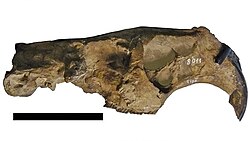
Picture of Telicomys
- Source
- Wikipedia/Commons
- Credit
- Andrés Rinderknecht, Washington W. Jones, Ney Araújo, Gustavo Grinspan, and R. Ernesto Blanco
- Licence
- CC BY 4.0
- Commercial use
- the licence allows it
No 3D scan of Telicomys was found in Sketchfab.
Smithsonian Open Access and MorphoSource were not reached for this taxon, so this list is what the others held rather than everything there is.
The description on this site
- Source
- Wikipedia, “Telicomys”
- Licence
- CC BY-SA 4.0
This is what the site found, which is not the same as what exists.
Keep going
What may have been alongside itDinomyidae through timeFormations of the MioceneThe world it lived on
Occurrence data from the Paleobiology Database, CC BY 4.0. Kraglievich 1926