Tadorna
The shelducks, most species of which are found in the genus Tadorna, are a group of large birds in the tribe Tadornini of the Anatidae, the biological family that includes the ducks and most duck-like waterfowl such as the geese and swans.

Charles J. Sharp · CC BY-SA 4.0 · via Wikipedia/Commons. May be a photograph of a specimen, or an artist’s reconstruction — an interpretation of a skeleton, since colour and soft tissue are almost never preserved.
On record
Recorded, not inferred- Also called
- shelduckPBDB
- Sits inside
- TadorninaePBDB
- Diet
- herbivorePBDB, for Anseriformes
- Life habit
- volantPBDB, for Anseriformes
- Motility
- actively mobilePBDB, for Theropoda
- Environment
- terrestrialPBDB, for Theropoda
Time the record covers
At least 2.5 million years on record.
The record covers at least 2.58 Mya to 11.7 ka. No occurrence read is dated outside 3.6 Mya to 0 Mya.
51 occurrences of Tadorna on record, most of them in the Pleistocene. The Paleobiology Database records this as a living group. Bar height is expected occurrences, not a count: each fossil is spread across the span it is dated to, so a tall narrow bar means tight dating and a low wide one means loose.
When
51 occurrences- Pliocene2%
- Pleistocene55%
- Holocene43%
These are dates about fossils, not the animal: the record can only begin after it arose and end before it died out, so either end may reach further. Shares are expected occurrences: a fossil dated to a span is counted partly in each period it straddles. More on what this infers.
Found in
6 formations
- Hillgrove Formation2
- Gabal Silsila Formation1
- Gebel Silsila-YCS Formation1
- Turlock Lake Formation1
- Qigequan Formation1
- Parilla Sand Formation1
Loading coastlines…
The named rock units Tadorna has been recovered from, largest first. Drawn where the rock is now, not where it formed. 44 occurrences have no formation on record, which is common for older literature.
Tadorna and its relatives
PleistoceneWhere Tadorna and its relatives were recorded in the Pleistocene.
Found in the same rock
531 taxa- Cyanoramphus13 sites
- Coturnix novaezelandiae12 sites
- Gallirallus australis10 sites
- Coenocorypha aucklandica9 sites
- Hemiphaga novaeseelandiae9 sites
- Prosthemadera novaeseelandiae9 sites
- Turnagra capensis9 sites
- Mystacina robusta8 sites
- Pelecanoides urinatrix8 sites
- Aegotheles novaezealandiae7 sites
- Alauda arvensis7 sites
- Anas7 sites
- Anas chlorotis7 sites
- Anthus novaeseelandiae7 sites
- Chenonetta finschi7 sites
- Hoplodactylus maculatus7 sites
- Larus dominicanus7 sites
- Petroica australis7 sites
- Rhipidura fuliginosa7 sites
- Sturnus vulgaris7 sites
- Anas crecca6 sites
- Anas platyrhynchos6 sites
- Anatidae6 sites
- Anthornis melanura6 sites
The Paleobiology Database records 46 sites for Tadorna, and this reads all of them. The number is how many of those sites it was catalogued from too. The 24 sharing the most are listed.
This is not a list of everything alive at the time. It is only what has come out of the same ground as this animal and been written down.
Entered from
25 references- Quaternary fossil fauna of South Canterbury, South Island, New Zealand12
- Humans and marine resource interaction reappraised: Archaeofauna remains during the late Pleistocene and Holocene in Cantabrian Spain7
- The history of the Chatham Islands' bird fauna of the last 7000 years - a chronicle of change and extinction3
- A remarkable fossil and archaeological avifauna from Marfells Beach, Lake Grassmere, South Island, New Zealand3
- Pleistocene birds of Gruta da Furninha (Peniche-Portugal): a paleontological and paleoenvironmental aproach2
- Early Pleistocene birds from Pirro Nord (Puglia, southern Italy)2
- Late-Pleistocene avifaunas from Cape Wanbrow, Otago, South Island, New Zealand2
- Pleistocene and prehistoric birds of south-west Britain2
- Kom Ombo: Preliminary Report on the Fauna of Late Paleolithic Sites in Upper Egypt2
- A new Middle Pleistocene bird assemblage from Cava di Breccia di Casal Selce (Ponte Galeria, Rome, Italy)1
- Exploitation of a seasonal resource: bird hunting during the late Natufian at Shubayqa 11
- The mid-Irvingtonian Fairmead Landfill fossil site, Madera County Paleontology Collection, and Fossil Discovery Center of Madera County, California1
Each of the 51 occurrences read was entered from one of these publications, ordered by how many each accounts for. This is not a search for papers mentioning the name. 13 further references are not listed. Entries link to doi.org where the Paleobiology Database holds an identifier, and to its own record where it does not. Relayed as the Paleobiology Database holds them, not checked against what they resolve to.
Media and terms
Media content2

Picture of Tadorna
- Source
- Wikipedia/Commons
- Credit
- Charles J. Sharp
- Licence
- CC BY-SA 4.0
- Commercial use
- the licence allows it
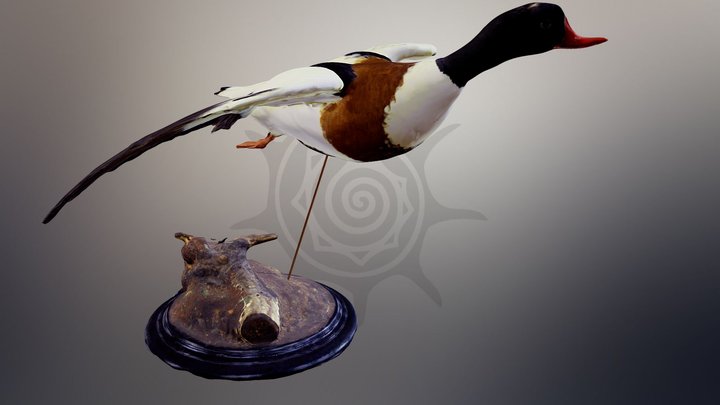
3D model
- Source
- Sketchfab
- Credit
- darwinmuseum.ru
- Licence
- CC0 Public Domain
- Commercial use
- the licence allows it
Smithsonian Open Access and MorphoSource were not reached for this taxon, so this list is what the others held rather than everything there is.
The description on this site
- Source
- Wikipedia, “Tadorna”
- Licence
- CC BY-SA 4.0
This is what the site found, which is not the same as what exists.
Keep going
What may have been alongside itTadorninae through timeFormations of the PleistoceneThe world it lived on
Occurrence data from the Paleobiology Database, CC BY 4.0. Boie 1822