Tachyoryctes
Tachyoryctes is a genus of rodent in the family Spalacidae. It contains the following species:Ankole African mole-rat Mianzini African mole-rat Aberdare Mountains African mole-rat Demon African mole-rat Kenyan African mole-rat Giant root-rat Navivasha African mole-rat King African mole-rat Rwanda African mole-rat Rudd's African mole-rat Embi African mole-rat Northeast African mole-rat Storey's African mole-rat

Charles J. Sharp · CC BY-SA 4.0 · via Wikipedia/Commons. May be a photograph of a specimen, or an artist’s reconstruction — an interpretation of a skeleton, since colour and soft tissue are almost never preserved.
On record
Recorded, not inferred- Sits inside
- TachyoryctiniPBDB
- Diet
- herbivorePBDB, for Rodentia
- Life habit
- fossorialPBDB
- Motility
- actively mobilePBDB, for Osteichthyes
- Environment
- terrestrialPBDB, for Eutheria
Time the record covers
At least 3.5 million years on record.
The record covers at least 3.6 Mya to 11.7 ka. No occurrence read is dated outside 11.63 Mya to 0 Mya.
15 occurrences of Tachyoryctes on record. The Paleobiology Database records this as a living group. Bar height is expected occurrences, not a count: each fossil is spread across the span it is dated to, so a tall narrow bar means tight dating and a low wide one means loose.
When
15 occurrences- Miocene5%
- Pliocene41%
- Pleistocene7%
- Holocene47%
These are dates about fossils, not the animal: the record can only begin after it arose and end before it died out, so either end may reach further. Shares are expected occurrences: a fossil dated to a span is counted partly in each period it straddles. More on what this infers.
Found in
3 formations
- Hadar Formation · Awash Group5
- Sagantole Formation · Awash Group1
- Adu-Asa Formation · Awash Group1
Loading coastlines…
The named rock units Tachyoryctes has been recovered from, largest first. Drawn where the rock is now, not where it formed. 8 occurrences have no formation on record, which is common for older literature.
Found in the same rock
164 taxa- Bos taurus6 sites
- Caprini6 sites
- Alcelaphus buselaphus5 sites
- Equus quagga burchelli5 sites
- Eudorcas thomsoni5 sites
- Australopithecus afarensis4 sites
- Connochaetes taurinus4 sites
- Sylvicapra grimmia4 sites
- Bovini3 sites
- Giraffa camelopardalis3 sites
- Hipparion3 sites
- Lepus capensis3 sites
- Madoqua3 sites
- Millardia coppensi3 sites
- Nanger granti3 sites
- Phacochoerus aethiopicus3 sites
- Raphicerus campestris3 sites
- Taurotragus oryx3 sites
- Tragelaphus scriptus3 sites
- Acomys2 sites
- Aepyceros melampus2 sites
- Agriotherium2 sites
- Anancus2 sites
- Arvicanthis2 sites
The Paleobiology Database records 15 sites for Tachyoryctes, and this reads all of them. The number is how many of those sites it was catalogued from too. The 24 sharing the most are listed.
This is not a list of everything alive at the time. It is only what has come out of the same ground as this animal and been written down.
Entered from
8 references- Faunal Evidence for Early Stockkeeping in the Central Rift Valley of Kenya: Preliminary Findings4
- Paleontological excavations in the Shungura Formation, Lower Omo Basin, 1969-19734
- Early Pottery and Pastoral Cultures of the Central Rift Valley, Kenya2
- Mio-Pliocene Mammals from the Middle Awash, Ethiopia1
- Holocene Paleoenvironmental Change in the Kenyan Central Rift Indicated by Micromammals from Enkapune Ya Muto Rockshelter1
- Ecological and temporal placement of early Pliocene hominids at Aramis, Ethiopia1
- Implications of Late Quaternary mammalian fauna from Lukenya Hill (South-Central Kenya) for paleoenvironmental change and faunal extinctions1
- Les proboscidiens des grands gisements a hominides Plio-Pleistocenes d'Afrique orientale1
Each of the 15 occurrences read was entered from one of these publications, ordered by how many each accounts for. This is not a search for papers mentioning the name. Entries link to doi.org where the Paleobiology Database holds an identifier, and to its own record where it does not. Relayed as the Paleobiology Database holds them, not checked against what they resolve to.
Media and terms
Media content2
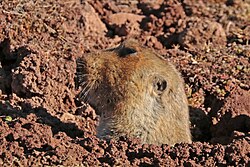
Picture of Tachyoryctes
- Source
- Wikipedia/Commons
- Credit
- Charles J. Sharp
- Licence
- CC BY-SA 4.0
- Commercial use
- the licence allows it
CT scan
- Source
- MorphoSource
- Credit
- AMNH Mammal Collections
- Licence
- not stated by the source
- Commercial use
- cannot be read from the licence given — check the record
- Specimen
- Tachyoryctes splendens · amnh:mammals:269633
Smithsonian Open Access was not reached for this taxon, so this list is what the others held rather than everything there is.
The description on this site
- Licence
- CC BY-SA 4.0
This is what the site found, which is not the same as what exists.
Keep going
What may have been alongside itTachyoryctini through timeThe world it lived on
Occurrence data from the Paleobiology Database, CC BY 4.0. Rüppell 1835