Stacheia
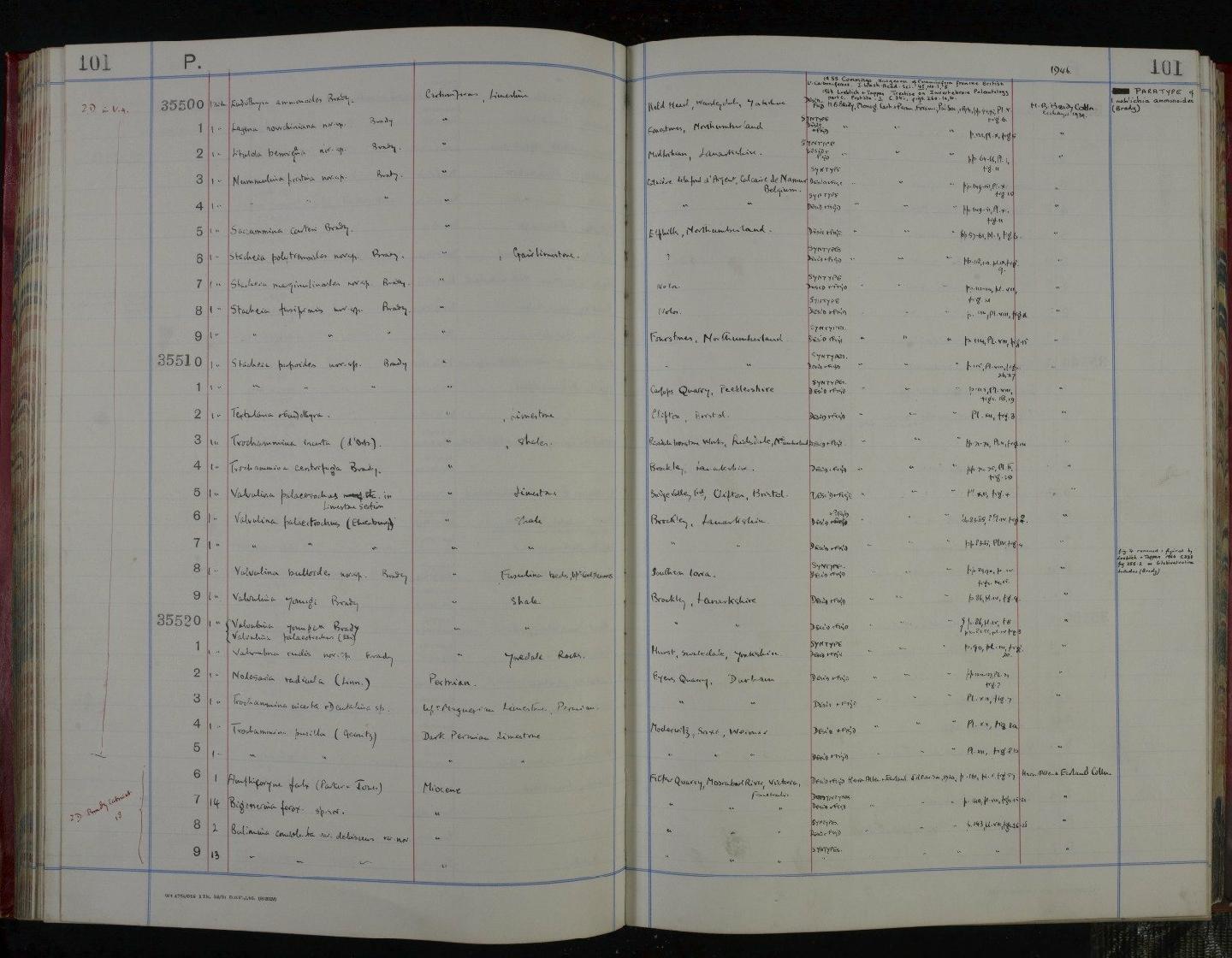
via GBIF · CC0 · via GBIF. May be a photograph of a specimen, or an artist’s reconstruction — an interpretation of a skeleton, since colour and soft tissue are almost never preserved.
On record
Recorded, not inferred- Sits inside
- AoujgaliaceaePBDB
- Diet
- "photoautotroph"PBDB, for Rhodophyceae
- Life habit
- epifaunalPBDB, for Rhodophyceae
- Motility
- stationaryPBDB, for Rhodophyceae
- Environment
- coastal,inner shelf,marinePBDB, for Rhodophyceae
Time the record covers
At least 134 million years on record.
The record covers at least 339.9 Mya to 205.7 Mya. No occurrence read is dated outside 351.9 Mya to 201.4 Mya.
68 occurrences of Stacheia on record, most of them in the Carboniferous. Bar height is expected occurrences, not a count: each fossil is spread across the span it is dated to, so a tall narrow bar means tight dating and a low wide one means loose.
When
68 occurrencesThese are dates about fossils, not the animal: the record can only begin after it arose and end before it died out, so either end may reach further. Shares are expected occurrences: a fossil dated to a span is counted partly in each period it straddles. More on what this infers.
Found in
14 formations
- Second Abden Shale Formation21
- Muldraugh Formation19
- Westbury Formation · Penarth Group12
- Murphy Road Formation · Windsor Group3
- Edwardsville Formation2
- Bricklieve Limestone Formation2
Loading coastlines…
The named rock units Stacheia has been recovered from, largest first. Drawn where the rock is now, not where it formed. 1 occurrence has no formation on record, which is common for older literature.
Stacheia and its relatives
CarboniferousWhere Stacheia and its relatives were recorded in the Carboniferous.
Found in the same rock
477 taxa- Glomospira22 sites
- Paraparchites22 sites
- Stacheiodes sp.21 sites
- Crinoidea20 sites
- Bairdia19 sites
- Eomarginifera longispinus19 sites
- Plectogyra18 sites
- Ortonia17 sites
- Rastidiscus sp.17 sites
- Thuramminoides16 sites
- Hyperammina15 sites
- Platycrinites15 sites
- Crurithyris urei13 sites
- Schizophoria13 sites
- Endothyra12 sites
- Fenestellidae11 sites
- Fourstonella11 sites
- Orbiculoidea nitida11 sites
- Schizophoria resupinata11 sites
- Cyathocrinites10 sites
- Aclisina pulchra intermedia9 sites
- Cladochonus9 sites
- Dichocrinus9 sites
- Eretmocrinus9 sites
The Paleobiology Database records 52 sites for Stacheia, and this reads all of them. The number is how many of those sites it was catalogued from too. The 24 sharing the most are listed.
This is not a list of everything alive at the time. It is only what has come out of the same ground as this animal and been written down.
Entered from
14 references- The paleoecology of a Lower Carboniferous marine transgression21
- Paleontology and paleoecology of the Crawfordsville fossil site (Upper Osagian: Indiana)19
- On Rhaetic Foraminifera from Wedmore, in Somerset12
- Biostratigraphical dating of Upper Visean limestones (NW Ireland) using foraminiferans, calcareous algae and rugose corals3
- Horton-Windsor district, Nova Scotia3
- Fossil communities of the Borden (Mississippi) delta in Indiana and northern Kentucky2
- Mississippian reef development in the Cracoe Limestone Formation of the southern Askrigg Block, North Yorkshire, UK1
- Upper Viséan Saccamminopsis–sponge microbial mud mounds, Sierra de la Estrella, southwestern Spain1
- Depth-related ecological zonation of a Carboniferous carbonate ramp: upper Viséan of Béchar Basin, western Algeria1
- Algues et pseudo-algues des calcaires Serpoukhoviens d'Ardengost (Hautes-Pyrenees) [Algues and pseudo-algues from Serpukhovian Limestones of Ardengost (Hautes-Pyrenees)]1
- Stratigraphy and geologic history of the Amsden Formation (Mississippian and Pennsylvanian) of Wyoming1
- Silurian, Devonian, and Mississippian Formations of the Funeral Mountains in the Ryan Quadrangle, Death Valley Region, California1
Each of the 68 occurrences read was entered from one of these publications, ordered by how many each accounts for. This is not a search for papers mentioning the name. 2 further references are not listed. Entries link to doi.org where the Paleobiology Database holds an identifier, and to its own record where it does not. Relayed as the Paleobiology Database holds them, not checked against what they resolve to.
Media and terms
Media content1
Picture of Stacheia
- Source
- GBIF
- Credit
- via GBIF
- Licence
- CC0
- Commercial use
- the licence allows it
No 3D scan of Stacheia was found in MorphoSource and Sketchfab.
Smithsonian Open Access was not reached for this taxon, so this list is what the others held rather than everything there is.
This is what the site found, which is not the same as what exists.
Keep going
What may have been alongside itAoujgaliaceae through timeFormations of the CarboniferousThe world it lived on
Occurrence data from the Paleobiology Database, CC BY 4.0. Brady 1876