Sphenodontidae
Sphenodontidae is a family within the reptile group Rhynchocephalia, comprising taxa most closely related to the living tuatara. Historically the taxa included within Sphenodontidae have varied greatly between analyses, and the group has lacked a formal definition. Cynosphenodon from the Jurassic of Mexico has consistently been recovered as a close relative of the tuatara in most analyses, with the clade containing the two and other very close relatives of the tuatara often called Sphenodontinae.

No machine-readable author provided. Knutschie assumed (based on copyright claims). · Public Domain · via Wikipedia/Commons. May be a photograph of a specimen, or an artist’s reconstruction — an interpretation of a skeleton, since colour and soft tissue are almost never preserved.
On record
Recorded, not inferred- Sits inside
- RhynchocephaliaPBDB
- Motility
- actively mobilePBDB, for Osteichthyes
- Environment
- terrestrialPBDB, for Amniota
Time the record covers
At least 246 million years on record.
The record covers at least 247 Mya to 11.7 ka. No occurrence read is dated outside 248.6 Mya to 0 Mya.
100 occurrences of Sphenodontidae on record, most of them in the Late Triassic. The Paleobiology Database records this as a living group. Bar height is expected occurrences, not a count: each fossil is spread across the span it is dated to, so a tall narrow bar means tight dating and a low wide one means loose.
When
100 occurrences- Early Triassic1%
- Late Triassic29%
- Early Jurassic8%
- Middle Jurassicunder 1%
- Late Jurassic21%
- Early Cretaceous18%
- Late Cretaceous6%
- Paleocene1%
- Miocene2%
- Pleistocene3%
- Holocene11%
These are dates about fossils, not the animal: the record can only begin after it arose and end before it died out, so either end may reach further. Shares are expected occurrences: a fossil dated to a span is counted partly in each period it straddles. More on what this infers.
Found in
33 formations
- Morrison Formation10
- Chinle Formation6
- Candeleros Formation · Neuquén Group5
- Los Alamitos Formation4
- Tecovas Formation · Chinle Group3
- Hillgrove Formation3
Loading coastlines…
The named rock units Sphenodontidae has been recovered from, largest first. Drawn where the rock is now, not where it formed. 9 further formations hold fewer occurrences each and are not listed. 29 occurrences have no formation on record, which is common for older literature.
Sphenodontidae and its relatives
Late TriassicWhere Sphenodontidae and its relatives were recorded in the Late Triassic.
Found in the same rock
906 taxa- Theropoda18 sites
- Sphenodon15 sites
- Pterosauria12 sites
- Coturnix novaezelandiae10 sites
- Cyanoramphus10 sites
- Redfieldiidae9 sites
- Actinopterygii8 sites
- Kuehneosaurus8 sites
- Ornithischia8 sites
- Rattus exulans8 sites
- Sphenodontia8 sites
- Turnagra capensis8 sites
- Archosauria7 sites
- Archosauriformes7 sites
- Hoplodactylus maculatus7 sites
- Mammalia7 sites
- Osteichthyes7 sites
- Puffinus gavia7 sites
- Suchia7 sites
- Aegotheles novaezealandiae6 sites
- Callaeas cinereus6 sites
- Chenonetta finschi6 sites
- Coenocorypha aucklandica6 sites
- Crocodylia6 sites
The Paleobiology Database records 92 sites for Sphenodontidae, and this reads all of them. The number is how many of those sites it was catalogued from too. The 24 sharing the most are listed.
This is not a list of everything alive at the time. It is only what has come out of the same ground as this animal and been written down.
Entered from
61 references- Quaternary fossil fauna of South Canterbury, South Island, New Zealand11
- Les rhynchocephales et les pterosauriens a crete parietale du Kimeridgien superieur-Berriasien d'Europe occidentale: le gisement de Canjuers (Var-France) et ses abords6
- New Triassic sphenodontids from south-west England and a review of their classification5
- Paleoecological analysis of the vertebrate fauna of the Morrison Formation (Upper Jurassic), Rocky Mountain region, U.S.A.4
- The ecology of a Late Triassic reptile assemblage from Gloucestershire, England4
- Earliest tuatara relative (Lepidosauria: Sphenodontinae) from southern continents3
- Late-Pleistocene avifaunas from Cape Wanbrow, Otago, South Island, New Zealand3
- An unusual aquatic sphenodontian (Reptilia: Diapsida) from the Tlayua Formation (Albian), central Mexico3
- New small reptile remains from the Late Cretaceous of Patagonia increase morphological diversity of sphenodontids (Lepidosauria)2
- Bridging the gap: sphenodont remains from the Turonian (Upper Cretaceous) of Patagonia. Palaeobiological inferences2
- A new Late Triassic vertebrate assemblage from northwestern Argentina2
- A new eilenodontine (Lepidosauria, Sphenodontidae) from the Lower Cretaceous of central Patagonia2
Each of the 100 occurrences read was entered from one of these publications, ordered by how many each accounts for. This is not a search for papers mentioning the name. 49 further references are not listed. Entries link to doi.org where the Paleobiology Database holds an identifier, and to its own record where it does not. Relayed as the Paleobiology Database holds them, not checked against what they resolve to.
Media and terms
Media content1
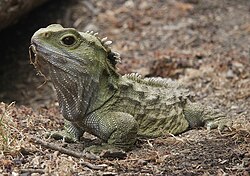
Picture of Sphenodontidae
- Source
- Wikipedia/Commons
- Credit
- No machine-readable author provided. Knutschie assumed (based on copyright claims).
- Licence
- Public Domain
- Commercial use
- the licence allows it
No 3D scan of Sphenodontidae was found in MorphoSource and Sketchfab.
Smithsonian Open Access was not reached for this taxon, so this list is what the others held rather than everything there is.
The description on this site
- Licence
- CC BY-SA 4.0
This is what the site found, which is not the same as what exists.
Keep going
What may have been alongside itRhynchocephalia through timeFormations of the Late TriassicThe world it lived on
Occurrence data from the Paleobiology Database, CC BY 4.0. Cope 1871