Siphonodendron
Siphonodendron is an extinct genus of colonial rugose corals common during the Carboniferous period. In fossil form it now appears as a white or brown mass of short spaghetti-like threads, usually flattened during distortion of the embedding limestone. It is in the sub-class Hexacorallia of corals with sixfold symmetry.

Notafly · CC BY-SA 3.0 · via Wikipedia/Commons. May be a photograph of a specimen, or an artist’s reconstruction — an interpretation of a skeleton, since colour and soft tissue are almost never preserved.
On record
Recorded, not inferred- Sits inside
- LithostrotionidaePBDB
- Diet
- suspension feederPBDB, for Rugosa
- Life habit
- epifaunalPBDB, for Rugosa
- Motility
- stationary, attachedPBDB, for Rugosa
- Vision
- blindPBDB, for Anthozoa
- Environment
- marinePBDB, for Rugosa
Time the record covers
At least 88 million years on record.
The record covers at least 382.31 Mya to 293.52 Mya. No occurrence read is dated outside 387.95 Mya to 290.1 Mya.
225 occurrences of Siphonodendron on record, most of them in the Carboniferous. Bar height is expected occurrences, not a count: each fossil is spread across the span it is dated to, so a tall narrow bar means tight dating and a low wide one means loose.
When
225 occurrences- Devonianunder 1%
- Carboniferous99%
- Permianunder 1%
These are dates about fossils, not the animal: the record can only begin after it arose and end before it died out, so either end may reach further. Shares are expected occurrences: a fossil dated to a span is counted partly in each period it straddles. More on what this infers.
Found in
55 formations
- Idmarrach Formation23
- Banner Formation10
- Bricklieve Limestone Formation10
- Clogrenan Formation9
- Bou-Rifi Formation8
- Knipe Scar Limestone Formation · Alston Group6
Loading coastlines…
The named rock units Siphonodendron has been recovered from, largest first. Drawn where the rock is now, not where it formed. 31 further formations hold fewer occurrences each and are not listed. 64 occurrences have no formation on record, which is common for older literature.
Siphonodendron and its relatives
CarboniferousWhere Siphonodendron and its relatives were recorded in the Carboniferous.
Found in the same rock
549 taxa- Syringopora20 sites
- Palaeosmilia murchisoni16 sites
- Canadiphyllum14 sites
- Lithostrotion13 sites
- Tetrataxis11 sites
- Endothyra10 sites
- Koninckophyllum10 sites
- Lithostrotion decipiens10 sites
- Axophyllum9 sites
- Clisiophyllum9 sites
- Dibunophyllum9 sites
- Dibunophyllum bipartitum9 sites
- Multithecopora9 sites
- Arachnolasma8 sites
- Diphyphyllum8 sites
- Earlandia8 sites
- Haplolasma8 sites
- Pleurosiphonella8 sites
- Aphralysia7 sites
- Caninia7 sites
- Fenestella7 sites
- Globoendothyra7 sites
- Koninckopora7 sites
- Michelinia7 sites
The Paleobiology Database records 90 sites for Siphonodendron, and this reads all of them. The number is how many of those sites it was catalogued from too. The 24 sharing the most are listed.
This is not a list of everything alive at the time. It is only what has come out of the same ground as this animal and been written down.
Entered from
53 references- Coralliferous carbonate shelves of Mississippian age, west side of Antler Orogen, central Nevada35
- Comparisons of Rugose corals from the Upper Visean of SW Spain and Ireland: implications for improved resolution in Late Mississippian coral biostratigraphy16
- Serpukhovian coral assemblages from Idmarrach and Tirhela Formations (Adarouch, Morocco)15
- Preliminary data on the coral distribution in the Upper Visean (Mississippian) succession from Adarouch area (NE Central Morocco)15
- Biostratigraphical dating of Upper Visean limestones (NW Ireland) using foraminiferans, calcareous algae and rugose corals12
- Mississippian coral assemblages from Tabainout mud-mound complex, Khenifra area, central Morocco9
- Corals from the Upper Visean of the southern Azrou-Khenifra Basin (Carboniferous, Central Moroccan Meseta)8
- The coral fauna of the Holkerian/Asbian boundary stratotype section (Carboniferous) at Little Asby Scar (Cumbria, England) and implications for boundary8
- Late Visean to Early Serpukhovian rugose corals from the Yashui Section, Guizhou, South China7
- Late Visean rugose coral faunas from South-Eastern Ireland: composition, depositional setting and palaeoecology of Siphonodendron biostromes6
- Coral assemblages of the Serpukhovian–Bashkirian transition from Adarouch (Morocco)5
- Rugose corals from the Upper Visean (Carboniferous) of the Jerada Massif (NE Morocco): taxonomy, biostratigraphy, facies and palaeobiogeography5
Each of the 225 occurrences read was entered from one of these publications, ordered by how many each accounts for. This is not a search for papers mentioning the name. 41 further references are not listed. Entries link to doi.org where the Paleobiology Database holds an identifier, and to its own record where it does not. Relayed as the Paleobiology Database holds them, not checked against what they resolve to.
Media and terms
Media content2

Picture of Siphonodendron
- Source
- Wikipedia/Commons
- Credit
- Notafly
- Licence
- CC BY-SA 3.0
- Commercial use
- the licence allows it
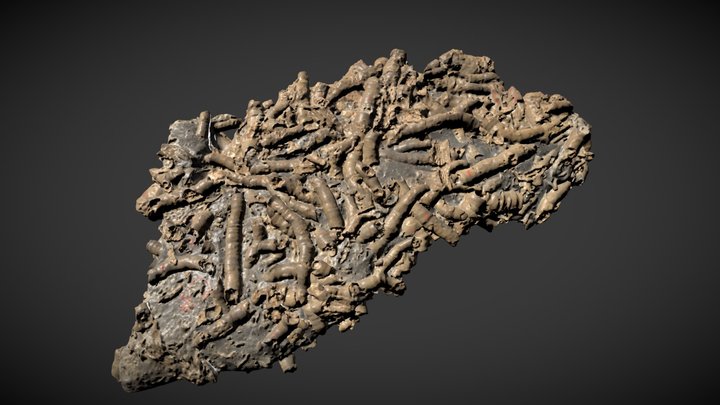
3D model
- Source
- Sketchfab
- Credit
- EDDyLab @ULiege
- Licence
- CC Attribution-NonCommercial
- Commercial use
- the licence does not allow it
The description on this site
- Licence
- CC BY-SA 4.0
This is what the site found, which is not the same as what exists.
Keep going
What may have been alongside itLithostrotionidae through timeFormations of the CarboniferousThe world it lived on
Occurrence data from the Paleobiology Database, CC BY 4.0. McCoy 1849