Simoedosauridae
Neochoristodera is a lineage of specialised crocodile-like fully aquatic choristodere reptiles. Noted for their long jaws and large size, these animals were predominant across the Northern Hemisphere, occurring in freshwater and coastal environments across the Cretaceous and early Cenozoic.

D. Gordon E. Robertson · CC BY-SA 3.0 · via Wikipedia/Commons. May be a photograph of a specimen, or an artist’s reconstruction — an interpretation of a skeleton, since colour and soft tissue are almost never preserved.
On record
Recorded, not inferred- Sits inside
- NeochoristoderaPBDB
- Motility
- actively mobilePBDB, for Osteichthyes
- Environment
- terrestrialPBDB, for Amniota
Time the record covers
At least 57 million years on record.
The record covers at least 113.2 Mya to 56 Mya. No occurrence read is dated outside 121.4 Mya to 48.07 Mya.
12 occurrences of Simoedosauridae on record, most of them in the Paleocene. Bar height is expected occurrences, not a count: each fossil is spread across the span it is dated to, so a tall narrow bar means tight dating and a low wide one means loose.
When
12 occurrences- Early Cretaceous8%
- Paleocene67%
- Eocene25%
These are dates about fossils, not the animal: the record can only begin after it arose and end before it died out, so either end may reach further. Shares are expected occurrences: a fossil dated to a span is counted partly in each period it straddles. More on what this infers.
Found in
5 formations
- Fort Union Formation3
- Slope Formation2
- Tienen Formation2
- Ravenscrag Formation1
- Jiufotang Formation · Jehol Group1
Loading coastlines…
The named rock units Simoedosauridae has been recovered from, largest first. Drawn where the rock is now, not where it formed. 3 occurrences have no formation on record, which is common for older literature.
Simoedosauridae and its relatives
PaleoceneWhere Simoedosauridae and its relatives were recorded in the Paleocene.
Found in the same rock
146 taxa- Simoedosaurus5 sites
- Amia2 sites
- Asiatosuchus depressifrons2 sites
- Axestemys vittata2 sites
- Champsosaurus2 sites
- Ectypodus2 sites
- Kosmodraco magnicornis2 sites
- Opisthotriton2 sites
- Parectypodus2 sites
- Tasbacka aldabergeni2 sites
- Trionychidae2 sites
- <Weil eucosmodontid>1 site
- Acipenser1 site
- Acritoparamys atavus1 site
- Adocus1 site
- Albulidae1 site
- Aletodon quadravus1 site
- Amia basiloides1 site
- Anisonchus oligistus1 site
- Anura1 site
- Aphronorus1 site
- Arfia gingerichi1 site
- Argillochelys antiqua1 site
- Asiabradypus incompositus1 site
The Paleobiology Database records 12 sites for Simoedosauridae, and this reads all of them. The number is how many of those sites it was catalogued from too. The 24 sharing the most are listed.
This is not a list of everything alive at the time. It is only what has come out of the same ground as this animal and been written down.
Entered from
6 references- High morphological disparity in a bizarre Paleocene fauna of predatory freshwater reptiles5
- The first choristoderes (Diapsida, Choristodera) from the Paleogene of Asia2
- The fossil vertebrates of Belgium2
- New choristodera from the Lower Cretaceous Jiufotang Formation in Chaoyang area, Liaoning China1
- Simoedosaurus dakotensis, new species, a diapsid reptile (Archosauromorpha; Choristodera) from the Paleocene of North America1
- Étude ostéologique du reptile Simoedosaurus (Choristodera)1
Each of the 12 occurrences read was entered from one of these publications, ordered by how many each accounts for. This is not a search for papers mentioning the name. Entries link to doi.org where the Paleobiology Database holds an identifier, and to its own record where it does not. Relayed as the Paleobiology Database holds them, not checked against what they resolve to.
Media and terms
Media content1
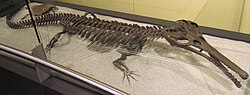
Picture of Simoedosauridae
- Source
- Wikipedia/Commons
- Credit
- D. Gordon E. Robertson
- Licence
- CC BY-SA 3.0
- Commercial use
- the licence allows it
No 3D scan of Simoedosauridae was found in Sketchfab.
Smithsonian Open Access and MorphoSource were not reached for this taxon, so this list is what the others held rather than everything there is.
The description on this site
- Licence
- CC BY-SA 4.0
This is what the site found, which is not the same as what exists.
Keep going
What may have been alongside itNeochoristodera through timeFormations of the PaleoceneThe world it lived on
Occurrence data from the Paleobiology Database, CC BY 4.0. Lemone 1884